
"Marielle Franco was a symbol"
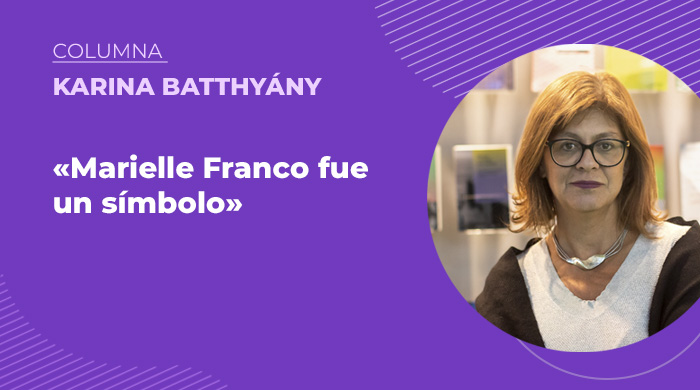
Transcript of Karina Batthyány's column
in InfoCLACSO – March 13, 2024
CLACSO is participating in the Regional Conference on Higher Education (CRES+5) in Brasilia, Brazil, to discuss the challenges facing higher education in Latin America and the Caribbean and to follow up on the agreements reached in 2018 in Córdoba, Argentina. And of course, we are also remembering the assassination of Marielle Franco.
Sociologist, feminist, journalist, and human rights and Black women's rights activist Marielle Franco was shot and killed on the night of March 14, 2018, in Rio de Janeiro. Six years after her brutal assassination, she was 38 years old and a member of the Socialism and Liberty Party. At the time, she had been denouncing the violence in the favelas and the actions of paramilitary groups. Her driver, Anderson Gomes, was also killed in the attack.
Marielle Franco was born on July 27, 1979, in Complexo da Maré, a favela of nearly 150.000 inhabitants in northern Rio de Janeiro. She defined herself as a "feminist woman, Black, and daughter of the favela." She became a young mother and sparked debates on gender issues, reproductive rights, LGBTQ+ rights, and the fight against racism. She was the youngest city councilor in Porto Alegre, the most voted-for federal deputy in Brazil, and the most voted-for state deputy in 2014. She ran for vice president of Brazil in 2018. She founded the "E Se Fosse Você" Institute, dedicated to combating fake news and hate networks.
Marielle Franco wrote her master's thesis in public administration on the abuses of the so-called Pacifying Police Units in the favelas, led the Rio de Janeiro Human Rights Commission, and, months before her assassination, was actively working for Lesbian Women's Visibility Day. She championed Brazil's African roots in a country where over 60% of the population is of African descent, but which at that time still had a very small minority of Black people represented in the political and media spheres. She insisted on the urgent need to continue developing the quota policies implemented in the early 2000s by Lula's government to facilitate university access for Black students and those from low-income backgrounds; a public policy goes beyond simply providing access to university places, as it requires transforming university programs, including other perspectives, and creating a more just society.
CLACSO is permanently preserving the figure and legacy of Marielle, whose name graces the main hall of our headquarters in Buenos Aires. Furthermore, CLACSO published the essay “It Was Always About Us: Accounts of Gender-Based Political Violence in Brazil,” in which Brazilian politician Manuela D'Ávila compiles the voices of fifteen women from her country with testimonies about discrimination and gender-based violence in the political sphere. One of the chapters is dedicated to Marielle Franco.
Indeed, Anielle Franco, Brazil's Minister of Racial Equality, tells us the following in the book's prologue: “My best memory of Mari is an affectionate one, of her smile, her joy, the memory of a young woman who worked hard for what she wanted. I know that everyone talks about her because of the political violence in which she was murdered, but I prefer and will always remember my sister in this way, for the affection, the friendship, the reciprocity, the camaraderie, and her happy smile.”
Anielle, also a promoter of the Marielle Franco Institute, maintains that “since then, March has become even more of a month of struggle. It is Women's Month, but in Brazil it must also be the month of combating political violence.”
In the special InfoCLACSO program we dedicated to Marielle Franco a year ago, Joana Coutinho, a professor of Political Science at the Federal University of Maranhão in Brazil, participated and remembered her with the following words: “Marielle Franco is a symbol. First, as a woman, young, an activist, and very courageous because she confronted organized crime in Rio de Janeiro. Why was Marielle Franco killed? I think that's the main question. Because she was a voice in Parliament, very competent, very active in the favelas of Rio, but it makes us think about how human rights activists are treated in Brazil.”
This special remembrance of Marielle Franco falls within a theme that CLACSO works on centrally: racial inequality, particularly in Brazil.
It's worth remembering that, according to official data from 2023, the poverty rate among Black and mixed-race people, who represent 56% of Brazil's more than 210 million inhabitants, is almost twice that of white people. They also suffer higher unemployment, earn less, and are the primary victims of police violence. According to the Brazilian Forum on Public Security, Black and mixed-race people account for approximately 85% of victims in police interventions.
The study “Social Inequality by Color or Race in Brazil”, published by the Brazilian Institute of Geography and Statistics at the end of 2022, establishes that, although the black and brown population represents the majority of the country, people from these groups are the ones who “have less access to education and depend more on informal work, two situations that limit access to basic rights, such as the minimum wage and retirement.”
Since taking power on January 1, 2023, Lula da Silva has been committed to repairing the historical “debt” that he believes Brazil owes to Afro-Brazilians for the centuries of slavery they suffered, and as a first step, he established the Ministry of Racial Equality, which is led by Anielle Franco.
Just a few months after taking office, the President of Brazil announced a series of measures to combat racial discrimination and reduce the historical inequalities faced by the black population, despite being the majority in the country.
The series of actions aims to improve the lives of Afro-Brazilians in the educational, labor, and religious spheres. “What this government will do in the next four years is to expand upon what we did when we created, on March 21, 2003, the Special Secretariat for Policies to Promote Racial Equality,” Lula stated.
Among the initiatives announced is a specific program to guarantee the rights of the quilombola communities, inhabited by descendants of black slaves, in relation to access to land, infrastructure and public services, after 4 years of management by the far-right Jair Bolsonaro who paralyzed all initiatives in this direction.
Lula also decreed the creation of several inter-ministerial working groups to promote projects that guarantee the “access and retention of Black students” in universities and to “propose mandatory quota policies” in government bodies. They will also be tasked with developing a program to reduce homicides and “social vulnerabilities” among Black youth. Another working group will aim to combat “religious racism,” which particularly affects traditional communities of African descent.
The Government will also revitalize Cais do Valongo (Valongo Pier), a former port in Rio de Janeiro through which more than a million slaves passed and which in 2017 was declared a World Heritage Site by UNESCO, by building a “reference center for African heritage”.
This Wednesday morning, we met with Minister Anielle Franco to sign an important cooperation agreement between the Brazilian Ministry of Racial Equality and our Latin American Council of Social Sciences (CLACSO), to work together towards overcoming social inequalities. Specifically, the racial dimension, which, along with gender, ethnicity, and the ways in which these intersect, are key elements of the inequalities that make our region the most unequal on the planet. This agreement will strengthen CLACSO's work with training, research, and outreach programs; it will also contribute a perspective that the Brazilian Ministry of Racial Equality (and CLACSO as well) is actively developing with the Global South, and especially with the links between Latin America and the Caribbean and Africa.
And finally, this March 14th will be another anniversary of the assassination of Marielle Franco, allowing us to remember her and for her family to continue going through this mourning for her loss six years ago.
If you would like to receive more information about CLACSO's training programs:
[widget id=”custom_html-57″]
to our email lists.

