
National regulatory frameworks for the protection of human rights defenders and their territorial implementation in Latin America
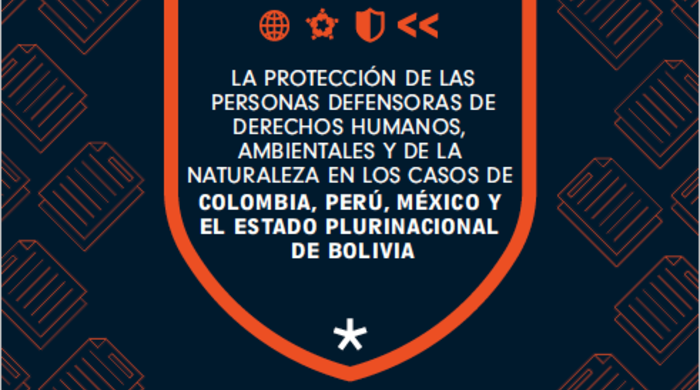
Researchers from the CLACSO Working Groups Political ecologies from the South/Abya-Yala y Critical legal thinking and sociopolitical conflicts They carried out a report on National regulatory frameworks for the protection of human rights defenders and their territorial implementation in Latin America within the framework of an alliance between Observatori DESCA and CLACSO.
In alphabetical order, the authors who participated in this work are:
Denisse Roca-Servat (Colombia)
María Elena Attard Bellido (Bolivia)
Mauricio Madrigal (Colombia)
Guillermo Luévano Bustamante with the collaboration of María Shuey Tristán Rodríguez (Mexico)
Raquel Neyra Soupplet (Peru)
Publication coordination: Marta Ribera Carbó and Irene Escorihuela Blasco.
The objective of this study was to investigate the existence of regulatory frameworks for the protection of human rights defenders in general, and environmental rights and Mother Nature defenders in particular.
Statistical data provided by national and international human rights organizations, such as Global Witness and the ombudsman's offices of various Latin American states, documenting the serious and systemic violations of the rights of environmental defenders. This underscores the importance of the Escazú Agreement in the region, which aims to create international obligations for member states to respect and guarantee rights, including access to information, participation, and justice in environmental matters. However, despite being signed by all and ratified by many, it is practically not implemented, demonstrating once again this gap and the capture of our states by economic and political powers.
For these reasons, this research seeks to understand how the ratification of the Escazú Agreement, or the lack thereof, has affected the development of legal frameworks for the protection of human rights defenders. It identifies advances and setbacks in the recognition of these rights and examines the impact of the neoliberal extractive model on the violation of the rights of human rights defenders.
Four countries were chosen: three severely affected by attacks on human rights defenders - Mexico, Colombia, Peru - and one with significant legislative progress in defense of Mother Earth, such as Bolivia.
Their regulatory frameworks, or the lack thereof, and their scope and application were studied. The report, which is part of CLACSO's efforts to promote social dialogues that impact the transformation of discrimination, persecution, and human rights violations in the region, provides general conclusions common to the four cases analyzed and shares specific recommendations for each one.
Interview on InfoCLACSO on Wednesday, May 22, 2024 with Raquel Neyra, Guillermo Luévano and Gustavo Lema.
The report was presented in person by Raquel Neyra Soupplet, co-coordinator of the CLACSO Working Group on Political Ecologies from the South/Abya-Yala, within the framework of International Congress: Towards Mandatory Due Diligence in Human Rights: Regulatory Proposals and Lessons Learned, which took place on July 13 and 14, 2023 at the Faculty of Legal Sciences, Universita Rovira i Virgili, Tarragona, Spain.

