
Advances and setbacks in local gender policies
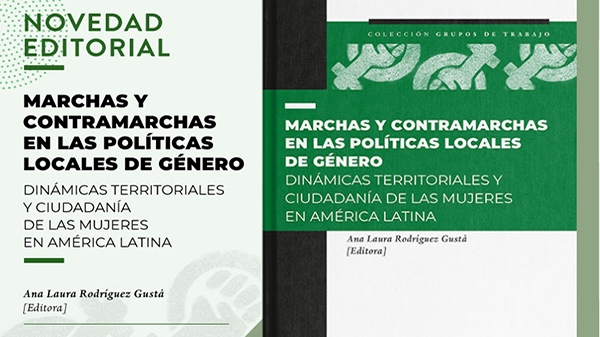
Territorial dynamics and women's citizenship in Latin America
The CLACSO Working Group on Gender, (In)equalities, and Rights in Tension presents the book “Advances and Setbacks in Local Gender Policies: Territorial Dynamics and Women’s Citizenship in Latin America.” Edited by Ana Laura Rodríguez Gustá, according to Karina Batthyány, Executive Secretary of CLACSO, “it is an invitation to debate the relationship between local governments and women’s citizenship, a key issue in our region today.”
In turn, Fernando Isuani, PhD in Social Sciences from FLACSO Argentina, adds that “in addition to informing and generating knowledge about local gender policies in various cities in Latin America, this book strongly reaffirms that, to produce better quality public policies, it is not enough for the State to be close to the problems, nor to have better laws, if there is not a clear political will to face social problems, an involved civil society, imagination and intelligence in public management and the necessary resources for it.”
In the Prologue, Virginia Guzmán, PhD in Sociology and member of the Center for Women's Studies in Chile, points out that “most studies cover sufficiently long periods of time, around two decades, to understand the sociocultural and political-institutional dynamics that underpin these processes. Likewise, the analyses reveal the complexity of transforming conceptions of gender and incorporating them into state institutions. This is related both to the systemic nature and deep cultural roots of this system, as well as to its degree of articulation with other important axes of social asymmetry. Finally, taking a long period of time as the field of analysis highlights the non-linear, contingent, and gradual nature of the processes studied, their continuities and discontinuities, their most significant milestones, and the expected and unexpected achievements. It makes it possible to understand the various actors involved, the crossroads and alternatives they face, and the discourses and proposals concerning gender equality in different political contexts.”
If you would like to receive more information about CLACSO's training programs:
[widget id=”custom_html-57″]
to our email lists.

