
Federal March in defense of the sovereignty of knowledge in Argentina
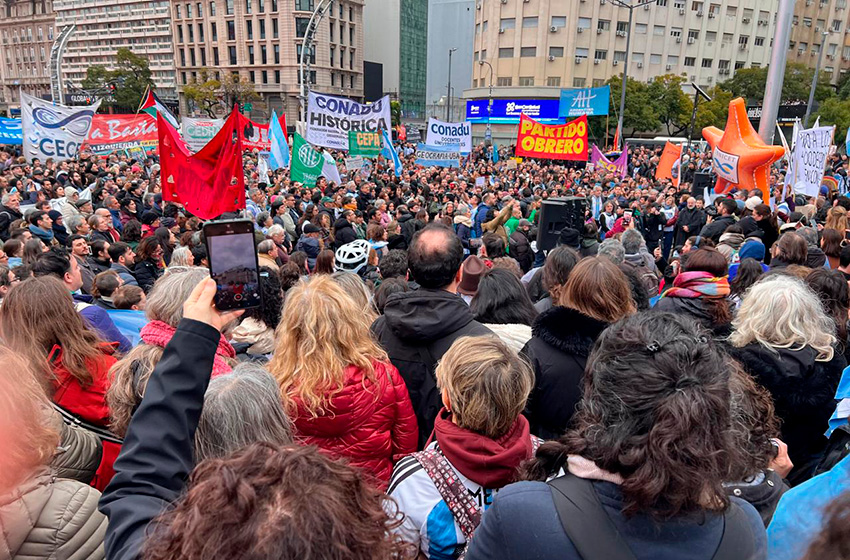
Scientists, researchers, fellows, technicians, and university students from across Argentina mobilized on Wednesday, August 12, in a Federal March that filled plazas, research centers, and universities throughout the country, centered on the Obelisk in Buenos Aires, to defend the sovereignty of knowledge and the national technological system, which is suffering one of the worst attacks in its history. The Latin American Council of Social Sciences was present at the demonstration in the heart of the Argentine capital, with its Executive Director, Pablo Vommaro , among others.
Convened by the Federal Roundtable for Science and Technology, the scientific and university community, accompanied by social organizations, raised their voices against the dismantling of the scientific system, the brutal cuts to the sector, the loss of jobs and the paralysis of fundamental projects, following the proposal of "I wear the shirt to defend Argentine science" in defense of "the Messis" of science.

Representatives from the sector read a joint document outlining the alarming figures that highlight the crisis facing the national scientific system: since December 2023, when Javier Milei's neoliberal government took office, Argentina has lost more than 6.400 science and technology workers. During that period, national investment in science and technology has been reduced by more than 50%, violating the law and falling from 0.302% of GDP to 0.14%, the lowest level on record since the budget series began in 1972. Another alarming statistic is the loss of purchasing power of salaries and so-called stipends, which, according to the document, ranges between 30% and 50%. The budgets of science and technology agencies have plummeted, with the emblematic case of the National Agency for Scientific and Technological Promotion (ANPCyT), which was once the heart of project funding and whose budget is now 88.6% lower. Likewise, the Government dissolved or restructured emblematic institutions such as the National Cancer Institute, the National Seed Institute (INASE) or the National Water Institute (INA).
“This is not just another adjustment. Never before has there been such violent and absurd cruelty as that of this government,” the statement emphasizes.
The mobilization on Thursday the 12th was accompanied by a national strike at public universities. Faculty and staff are demanding the implementation of the University Funding Law, a salary increase to address a gap they estimate to be over 28%, and greater funding for scholarships and university hospitals.
For CLACSO and the research centers that comprise it, scientific, social and technological knowledge is not a commodity or a dispensable budgetary expense, but a global public good and an indispensable condition for national and regional sovereignty.
Mobilizing in defense of the Argentine scientific system (led by CONICET, national universities and state R&D agencies) implies defending a country's capacity to generate its own responses to its productive, health, environmental and social problems.
The march on August 12th once again puts on the public agenda the immediate effects of budget cuts, the paralysis of research projects, the massive loss of jobs and the discontinuation of postdoctoral fellowships.
From the critical perspective of Latin American social thought, these processes lead to the expulsion of highly qualified professionals and researchers trained by the State, the deterioration of the purchasing power of technical staff, scholarship recipients, researchers, and the interruption of the trajectories of young scholarship recipients makes it impossible to train the personnel who will sustain the science of the future.
Popular and intersectoral mobilizations thus fulfill a vital pedagogical function: connecting the work of classrooms and laboratories with everyday society and seeking to counteract the narratives of delegitimization about the work of scientific personnel, demonstrating to the community that defending public science is defending the developments, quality education and opportunities of the whole of society.
Protecting university autonomy, research funding, and academic freedom from severe adjustment programs is crucial for the inclusive development model promoted by the social sciences in the region.
Watch the video coverage on CLACSO's social media channels
@clacso Mobilization in defense of science, technology and education Wednesday, August 12, 2026 Autonomous City of Buenos Aires, Argentina
♬ Original sound – CLACSO

