
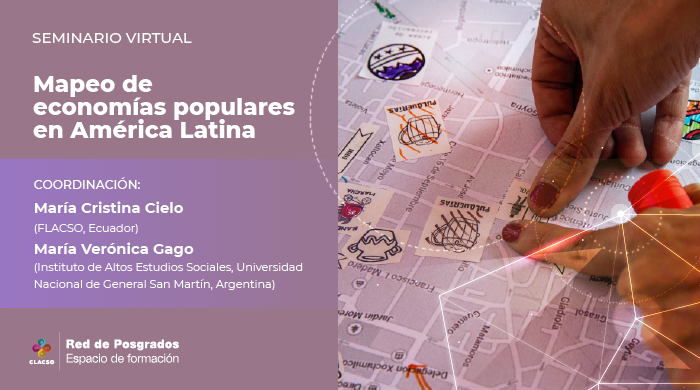
Mapping of popular economies in Latin America
Seminar 2126
ChairCLACSO
Coordination: María Cristina Cielo (FLACSO, Ecuador) and María Verónica Gago (Institute of Higher Social Studies, National University of General San Martín, Argentina)
Teaching team: Martha Lucia Bernal Suárez (IDAES-UNSAM, Argentina), Ana Julia Bustos (CONICET, Argentina) and Alioscia Castronovo (IDAES-UNSAM, Argentina)
Home: 27/05/2021 | Registration: 26/03/2021 to 24/05/2021
Workload: 12 weeks – 90 hours.
This seminar addresses the field of popular economies in Latin America from diverse political, epistemological, and conceptual perspectives. How do they function? What experiences do they reflect? What are their genealogies and territories? Which actors are involved? What productive and political logics do they set in motion? What temporalities do they evoke? How are they linked to the debates within feminist economics? Around these questions, we will explore popular economies in their multiplicity: that is, from the different economic, social, cultural, and political processes they entail, thus outlining a constellation of problems, conjunctures, and spatialities.
This seminar is part of the research experience of the CLACSO Working Group “Popular Economies: Theoretical and Practical Mapping,” whose transnational research and exchange took place between 2016 and 2019 and continues into the current three-year period (2019-2022) with new challenges, debates, and additions. Therefore, it involves a framework of collective research developed in various institutions across different countries, territories, and fields related to popular, community, and feminist economies. The course instructors come from diverse international backgrounds and conduct research in different regions, while also participating in a space for debate and collaboration that weaves together ethnographic research, fieldwork, theoretical reflections, and political analyses.
- To map the theoretical and practical perspectives (their intersections, conflicts and overlaps) that exist today on popular economies, as well as the genealogies in which they are inscribed.
- To introduce course participants to the reading and conceptual, political and experiential debate surrounding the actors of the popular economy, their specific territories and the conflicts that run through them.
- To produce critical approaches to thinking about economic practices in Latin America.
- To update the debates on the realities of work in the metropolises of our region from the perspective of popular economies as a mass reality and a laboratory for the crises and recompositions of neoliberalism.
- To intersect the debates surrounding popular economies using the conceptual tools of feminist economics. To understand, from this intersection, new forms of labor and sex-gender relations within the broader context of a colonial and patriarchal accumulation regime.
- Beyond the economy and informality
- Popular economy and feminist economy
- Community networks and the reproduction of life
- Work and exploitation in popular economies
- Affective economies and transformations in territories
- Popular infrastructure, logistics and migration strategies
- Self-management of work, popular infrastructures and social conflict
- Valorization processes, extractivism and popular economies
- Public policies, finance and popular economies
- A feminist perspective on debt and financial exploitation
- Arbona, J., Canedo, ME, Medeiros, C. and Tassi, N. 2014. “The popular economic system.” In The popular economy in Bolivia: three perspectives, Tassi N., Hinojosa A. and Canaviri R., eds. La Paz: Center for Social Research. Read pp.7-19, 27-38, 89-132.
- Castronovo, Alioscia (2018b). ¡Costureros carajo! Trajectories of struggle and self-management in Argentine popular economies. Iconos Revista de Ciencias Sociales. Flacso Ecuador, n. 62, pp. 119-139
- Cavallero, L. and Gago, V. (2019). A feminist reading of debt. Buenos Aires: Rosa Luxemburg.
- Cavallero, L. and Gago, V. (2020). “Indebting to govern: on financial extractivism towards subaltern sectors”, CRONÍA Research Journal 16 (20): 49-59. National University of Río Cuarto.
- Cielo, C. (2018) “Inequalities and forms of government in urban-rural articulations”, in: D. Martinez. Relations and tensions between the urban and the rural, Abya Yala: Quito. Pp. 75-99.
- Cristina Cielo, Héctor Fabio Bermúdez, Andrea Almeida Guerrero, and Mariela Moya (2016). “Contributions of feminist economics to the understanding of contemporary capitalism.” Journal of the Academy / ISSN 0719-6318 Volume 21
- Denning, Michael (2011). “Life Without a Salary”. New Left Review
- Escobar, Arturo. (2016) "Introduction" and "Chapter 3" in: Autonomy and design: The realization of the communal. Popayán: University of Cauca. Editorial Seal. Pp. 25-46 and Pp. 97-126.
- Federici, S. (2018). "Introduction" and "Chapter 1" in: The Patriarchy of Wages. Feminist Critiques of Marxism. Buenos Aires: Tinta Limón Ediciones.
- Federici, SIlvia (2018). “Women, Money and Debt: Notes for a Feminist Reappropriation Movement”, Australian Feminist Studies, 33:96, 178-186.
- Federici, Silvia (2018). The Patriarchy of Wages. Buenos Aires: Tinta Limón. Chapter 1.
- Fernández Álvarez María Inés, Beyond precarity: collective practices and political subjectivities from the Argentine popular economy, Iconos number 62, pp. 21-38
- Gago, V. and Mezzadra, S. (2015): “Towards a critique of the extractive operations of capital. Accumulation pattern and social struggles in times of financialization”, in Nueva Sociedad 255, January - February 2015. (pp. 38-52)
- Gago, Verónica (2019). Feminist Power. Or the Desire to Change Everything. Buenos Aires: Tinta Limón.
- Glave, LM; (1989). “Introduction” and “Chapter 1. Trajines. A chapter in the formation of the colonial internal market”. Lima: Institute of Agrarian Support.
- Gutiérrez Aguilar, R.; Navarro, ML (2018) “Keys to thinking about interdependence from the perspective of ecology and feminisms”, in: Under the Volcano, vol. 18, no. 28, Benemérita Universidad Autónoma de Puebla, Mexico.
- Hinojosa, A. (2019) “Introduction” in: Population trajectories in and from La Paz. From internal migration to the construction of the transnational political subject. La Paz: Institute of Research, Social Interaction and Postgraduate Studies, Social Work Program, Faculty of Social Sciences, Universidad Mayor de San Andrés.
- Report “Popular economies in the pandemic. Provisional mapping in times of isolation and global crisis”. (2020). CLACSO Working Group “Popular economies: theoretical and practical mapping”
- Mezzadra Sandro and Neilson Brett (2016). The Frontier as Method, or the Multiplication of Labor, Buenos Aires: Tinta Limón. Chapter 3 The Frontiers of Capital (pp. 103-149)
- Mezzadri, Alessandra (2019). “On the value of social reproduction Informal labor, the majority world and the need for inclusive theories and politics.” In Radical Philosophy 2.04 Spring.
- Mitchell, T. 2013. “Can the mosquito speak?” In Cosmopolitics: Anthropological Perspectives, edited by Montserrat Cañedo Rodríguez. Madrid: Trotta.
- Prieto, M. Miranda, MI 2018. “Rearticulating the economy from the territories. Towards an economy of links for the care of life”. In: Vega, C. Martínez, R. and Paredes M., eds. Care, community and common: cooperative experiences in the sustenance of life. Madrid: Traficantes de Sueños.
- Rivera Cusicanqui, S. (2010) “Potosí Reverse Principle. Another look at the whole” in: Rivera Cusicanqui, S. Et. Al. (2010), Potosí Reverse Principle. Madrid: MNCARS. (pp.2-14)
- Rivera Cusicanqui, S. (2018) “Towards an outline of a ch'ixi theory of value” and “Bonus fragments on the notion of ch'ixi”, in: A ch'ixi world is possible. Essays from a present in crisis. Buenos Aires: Tinta Limón.
- Roig, Alexandre (2020) Interview: “Income redistribution is not enough, power redistribution is needed” July 10, 2020.
- Simone, A. 2018. “The productivity of contingency in popular economies of the global south”. Íconos. Journal of Social Sciences 62: 153-164.
- Simone, Abdou Maliq. People as Infrastructure: Intersecting Fragments in Johannesburg. Public Culture, 16(3), pp. 407-429. ISSN 08992363
- Singh, N., González, M. and Garcia, G. 2018. “Becoming a commoner”. Political Ecology 55: 8-12.
- Tassi, Medeiros, Rodriguez-Carmona, Ferrufino (2013) “Introduction” and “Chapter 1” in: Making money without money: the overflow of popular merchants in Bolivia. PIEB.
- Tsing, A. 2013. “The jungle of collaborations”. Pp. 266-295 in Cosmopolitics: Anthropological Perspectives, edited by Montserrat Cañedo Rodríguez. Madrid: Trotta.
- Zambrana, Rocío (2020): “Accountability: Caribbean subversions of debt”, Eidos no. 34, pp. 57-82
|
|
Discount for payments made before 17/05 |
One payment |
|
CM Plenos |
$75 |
$150 |
|
CM Associates |
$95 |
$190 |
|
No link |
$95 |
$190 |
FAQ
The basic requirements for taking a seminar are:
- Availability of at least 4 hours per week to dedicate to the seminar course.
- Internet access.
- Reasonable handling of communication and computer tools.
- Language proficiency in the language in which the course will be taught. The official languages are Spanish and Portuguese.
If you have a link with a CLACSO Associated Center:
Paying in one payment: USD 150 (includes issuance and shipping costs of the digital certificate).
Paying BEFORE 17/05/2021: USD 75 (includes issuance and shipping costs of the digital certificate).
If you have a link with a Network or Institution Associated with CLACSO:
Paying in one payment: USD 190 (includes issuance and shipping costs of the digital certificate).
Paying BEFORE 17/05/2021: USD 95 (includes issuance and shipping costs of the digital certificate).
If you do NOT have a link with a CLACSO Associated Center:
Paying in one payment: USD 190 (includes issuance and shipping costs of the digital certificate).
Paying BEFORE 17/05/2021: USD 95 (includes issuance and shipping costs of the digital certificate).

