
Bogotá Manifesto
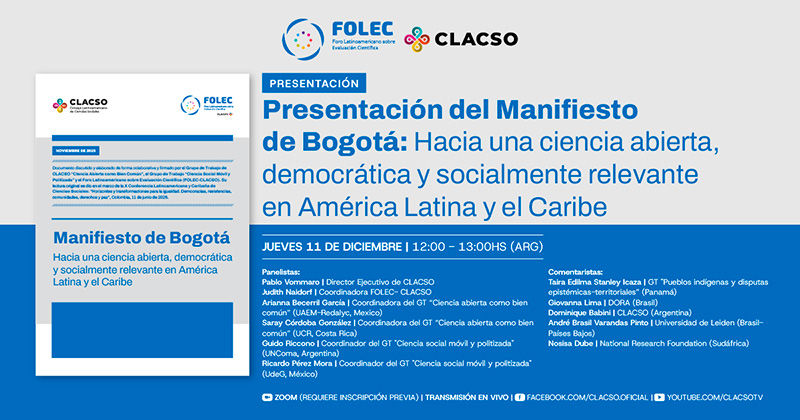
On Thursday, December 11, the public presentation of the “ Bogotá Manifesto: towards an open, democratic and socially relevant science in Latin America and the Caribbean ” took place.
This document was collectively developed by FOLEC-CLACSO in conjunction with the Working Groups “Open Science as a Common Good” and “Mobile and Politicized Social Science.” Its content stems from a participatory process initiated during the X Latin American and Caribbean Conference of Social Sciences (Bogotá, June 2025), where a regional community committed to transforming science and higher education systems began to take shape. After circulating to gather input and feedback from this community, the manifesto is now presented in its final version. This text also reaffirms and expands upon the FOLEC Declaration of Principles (2022), projecting new consensus to advance toward open, democratic, and socially relevant science in Latin America and the Caribbean.
They presented:
Pablo VommaroExecutive Director of CLACSO
Judith NaidorfCoordinator of FOLEC CLACSO
Arianna Becerril GarcíaCoordinator of the CLACSO Working Group on Open Science as a Common Good (UAEM-Redalyc, Mexico)
Saray Córdoba GonzálezCoordinator of the CLACSO Working Group on Open Science as a Common Good (UCR, Costa Rica)
Guido Riccono, Coordinator of the CLACSO Working Group on Mobile and Politicized Social Science (UNComa, Argentina)
Ricardo Pérez Mora, Coordinator of the CLACSO Working Group on Mobile and Politicized Social Science (UdeG, Mexico)
They commented:
Taira Edilma Stanley Icaza, CLACSO Working Group on Indigenous Peoples and Epistemic-Territorial Disputes (Panama)
Giovanna Lima, DORA (Brazil)
Dominique Babini, CLACSO (Argentina)
André Brasil Varandas PintoLeiden University (Brazil-Netherlands)
Nosisa Dube, National Research Foundation (South Africa)
Organized by: FOLEC – CLACSO Working Group on Open Science as a Common Good – CLACSO Working Group on Mobile and Politicized Social Science
Pre-registrationvia
The Manifesto was initially conceived within the framework of the 10th Latin American and Caribbean Conference on Social Sciences (Bogotá, June 2025), where a regional community committed to advancing towards open, inclusive, and collectively oriented models of knowledge and evaluation began to consolidate. Following this initial public circulation, the document received contributions and comments from numerous academic, institutional, and territorial actors, enriching and expanding its content over the subsequent months.
In its final version, the Bogotá Manifesto reaffirms and expands upon the guidelines established by the FOLEC Declaration of Principles (2022), particularly regarding socially relevant evaluation, epistemic and technological sovereignty, cognitive justice, and the democratization of knowledge. The document's presentation represents a further step in consolidating regional consensus to advance toward more open, responsible, and context-specific science policies.
The Manifesto proposes a transformative architecture supported by three interrelated pillars. The first is open science as a common good , which conceives of the entire scientific process—data, publications, infrastructure, evaluation, and social participation—as an accessible, inclusive, and non-commercial public good. The second is the construction of a new model of scientific evaluation with social relevance , one that transcends commercial metrics and prioritizes qualitative, contextualized, and participatory criteria. The third is epistemic and technological sovereignty , which aims to recover public and democratic control over the infrastructure, platforms, languages, and tools that enable the production and circulation of knowledge. Together, these pillars guide a horizon of structural transformation to reconfigure the region's scientific ecosystem on more just, collaborative, and democratic foundations.
These three pillars are further developed into 11 points organized into four guiding principles. The first principle, " Towards an ethical, democratic, and engaged science ," brings together guidelines on social justice in knowledge production, linguistic and cultural diversity, recognition of collective work, and guaranteeing the human right to participate in scientific progress. The second principle, " Democratization of knowledge and digital sovereignty ," includes commitments to non-commercial open access, the development of interoperable public infrastructures, and the construction of inclusive and representative academic information systems. The third principle, " Transformation of evaluation models ," focuses on promoting open and contextualized evaluation systems and overcoming dependence on commercial metrics through qualitative and regional indicators, while also incorporating criteria for gender equity and support for emerging career paths. The fourth principle, " Training and culture of open science as a common good ," underscores the importance of developing critical and pedagogical capacities to embed open science practices, responsible evaluation, and epistemic justice in institutions, academic communities, and public policies.

