
Teacher of the People, Teacher of Dignity
Teachings (partial and in progress)
of the cycle of popular protests in Chile
J. Fabian Cabaluz D.[1]
Santiago de Chile
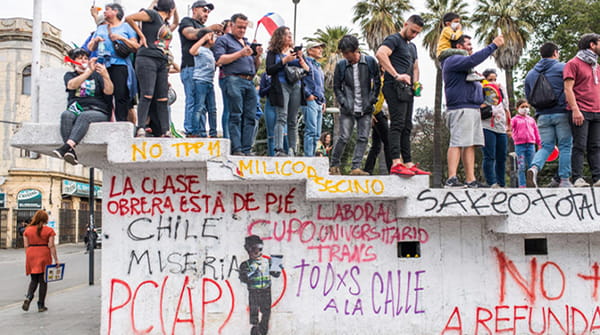
“The people, the people, the people, where are they? The people are in the streets demanding dignity,” “We are many, more than a lot, we are the people united in the struggle,” “Let’s go people, without fear, to achieve everything,” “The people united will never be defeated,” “The people are tired…,” “People resist!”, “We are calling ourselves the people again,” “Baquedano Square, Dignity Square,” “Until dignity becomes the norm,” “We take to the streets again, the dignity of the people is not for sale, it is defended!”
These are some of the slogans inscribed on walls, posters, chants, and shouts that have given life to the marches, pot-banging protests, and barricades throughout the country. As can be seen in these brief phrases and in accordance with the energetic and powerful expression of the streets, the concepts of town y dignity They are being tattooed on the skin of neoliberal Chile. For those who have defended the “successful Chilean model,” those who have championed “the miracle,” “the jaguar,” or “the oasis” of a project that has privatized practically all social rights, common goods, and spheres of social life, both concepts seem outdated, reminiscent of the twentieth century, of red and black flags, of social mobilizations, of militant leftists—a whole burden that has supposedly been overcome by the citizen with credit cards, the successful entrepreneur, the professional committed to their company, the efficient and productive worker, among other images that, as real and concrete history has shown, have shattered into thousands of pieces.
As many of you know, the concepts of town y dignity These concepts have generated a great deal of discussion in Latin America; both have been strengthened by dialogues and debates stemming from political philosophy, revolutionary projects, popular organizations and movements—in short, from theoretical and practical spaces. In this sense, they are concepts laden with political significance, concepts containing a dense web of meanings, concepts that are uncomfortable for the dominant bloc and its defenders, but that resonate with the people on the street, with those at the bottom, with the left, with those who produce the wealth of the land.
What have the concepts of town y dignity To the millions of people who have mobilized in these historic days of popular protest? We must clarify from the outset that our reflections are made as pedagogues and educators, that is, as individuals who are convinced that educational processes and the act of educating cannot be restricted to institutional spaces such as schools, high schools, or universities (spaces that are certainly relevant), but rather, we must try to broaden our educational and pedagogical reflections to other spheres of social life. In this sense, in this writing, we are interested in proposing a small hypothesis: the town and dignity They are educating us as a political community, they are teaching us vital lessons that, if we manage to understand them, can become central learnings for the construction of a new Chile.
Let us begin by pointing out at least five teachings from the people teacher.
A primary lesson revolves around attempts to understand what constitutes "the people." It has been argued that the people can be understood as a group of individuals who experience exploitation, exclusion, and domination. Therefore, we should associate the people with those who experience the daily theft of their labor and various aspects of their lives. This initial idea has even been shared by (neo)liberal perspectives, which maintain that the people refers particularly to socio-economic and cultural dimensions, thus directly linking them to those who suffer poverty, marginalization, and precarity. Obviously, for these conceptions, the notion of the people is reduced to the aforementioned dimensions, limited to those who suffer the injustices of the existing order, but without incorporating the political dimension. This leads us to a second lesson.
In accordance with the above, the people also It should be understood as a political category, referring to a subject that is politically constituted through action. Thus framed, the people can be constituted to the extent that they become politicized, that is, to the extent that: one, they act and mobilize collectively, organize, fight, protest, march, develop programmatic proposals, etc.; two, they intertwine discursive and ideological elements, knowledge, and wisdom that allow them to explain the social and political causes and conditions that explain their existence; three, they cultivate and develop a historical memory that is aware of their struggles against inequality and poverty, a memory of the country's political history, a memory that manages to recognize those responsible for the problems that afflict them; four, they create a plurality of organizational spaces where collectives, organizations, movements, unions, and assemblies develop their political life; and five, they articulate, in the here and now, that is, within their organizational forms, a historical project that humanizes and dignifies their daily lives.
A third lesson is that the people have defined themselves relationally, that is, in opposition to or antagonism with respect to oligarchies, elites, power groups, and/or dominant classes. In other words, the people take shape as they separate themselves, distance themselves, and become autonomous from the dominant group. In short, we could say that the configuration of the people progresses, on the one hand, by opposing and distancing themselves from those who hold wealth, power, and privileges, and on the other hand, by articulating and bringing together all the subjects that make up the social bloc of the oppressed and exploited.
Considering all of the above, and as a fourth lesson, we believe it is not at all wrong to maintain that the constitution of the people can lead to the generation and production of political crises. From our perspective, the configuration of the people enables the rupture of the hegemonic order, allows for the opening of fissures and the breaking of the normal state In this sense, the people enable the construction of scenarios for struggle against the conditions of exploitation and oppression experienced by the majority in Chile and Latin America. In this sense, the people represent the possibility of energizing and opening history towards horizons of hope and utopia; the people can open a future world, establish a new regime of truth, break with the established order, disrupt the status quo, and enable the birth of the new…
Finally, and as a fifth lesson, it seems important to point out that neoliberalism is incompatible with the political configuration of the people, since, however much it formally recognizes their existence as the source of sovereignty, it actually reduces them to the sum of individual voters. In fact, all the neoliberal logics that enshrine individualism, competition, entrepreneurship, and privatizations are completely contrary to popular sentiment. Now, it is important to highlight that neoliberal projects in Latin America have deployed at least three tactics to dismantle the subject of the people: first, they have systematically worked to disperse and dismantle the political life of social and political sectors opposed to their project, particularly striving to disrupt forms of popular unification, articulation, and convergence; second, they have promoted practices of transformation in which intellectuals and social and political leaders are incorporated to administer government programs (of a neoliberal nature, of course), thus neutralizing their capacity for influence and transformation; And thirdly, clientelistic networks have been articulated that are based on material support in exchange for political-electoral backing; these networks have also neutralized and demobilized social actors that make up the social bloc of the oppressed and exploited.
In short, the lessons learned from the people during these intense days of protest have shown us that they have taught us to recognize ourselves as subjects who experience exploitation, exclusion, and domination. Furthermore, we become a people when we unite through action, organization, and political struggle. It is important to add that we achieve this identity as a people to the extent that we distance ourselves from the historical project, worldview, and class interests of the dominant bloc. Additionally, our identity as a people opens the concrete possibility of transforming the social order, changing the course of events, and building a society that serves those of us who constitute the majority of the country. Finally, we believe that the people, with their profound wisdom, are showing us that neoliberalism is incompatible with our interests and needs and that, therefore, it is urgent to reject it as a societal project.
Now let us point out four great teachings formulated by the teacher Dignity:
First, as some leading figures in Latin American political philosophy have pointed out, when we speak of dignity, we are referring to one of the foundations of human life; that is, we must understand it as intrinsic and inherent to our lives. Dignity is not something that can be bought, sold, or exchanged. Put another way, we could say that we have been invited to understand that human life (but also living labor, nature, and freedom) cannot have any economic value (exchange value), since they are the source of all value, the wellspring that allows for the production and reproduction of human and planetary life. In other words, life, work, nature, and freedom, as the foundations of human existence, possess nothing but dignity. We insist, then, that a primary lesson is understanding that dignity is not the privilege of tiny social groups, but rather resides indiscriminately in each and every one of us.
On the other hand, we must point out that dignity is discovered by individuals, communities, and peoples when it is denied, since those who enjoy privileges or whose material conditions of life are met—think of the landowner, the owner of the means of production, the boss, the entrepreneur, the settler, the macho man—do not need to claim their dignity; rather, they take it for granted. However, when human beings are treated as things, objects, commodities, clients, numbers; when there is an incessant advance in the dehumanization of social relations—that is, when our dignity is denied—it emerges as a cry, as a demand, as a horizon. In these scenarios, the struggle for dignity begins, which takes shape as a struggle to negate the negation, to reaffirm our human condition. Clearly, in these struggles to dignify our existence, the working class, the people and/or the bloc of the oppressed and excluded, we are affirming and valuing ourselves, we are gaining strength and vitality, we are conquering and recovering portions of our lives, we are diminishing the power of the destructive logics of capital, patriarchy, and colonialism.
As a third lesson, we can maintain that those of us who advocate for the construction of a historical and social project of liberation must understand human dignity as a regulating principle of the material and symbolic reproduction of human beings (note, human dignity, not private property as the mercenaries of capital advocate). Therefore, the struggle for dignity implies placing limits on private property; it implies opposing the reduction of human beings to the category of commodities. In this sense, the teacher has shown us that fighting for dignity is appealing to the legitimate right of resistance, dissent, popular disobedience, and defiance. All these responses have been expressed in the streets of the country since October 18th, even when the government declared a state of emergency and a curfew, when repression intensified, resulting in the murder of some twenty comrades, the wounding of more than 2,500 people with the brutal use of rubber bullets, pellets, and tear gas; and the detention of more than 7,000 comrades. When practices of torture, abuse and sexual violence, illegal detentions and disappearances have been applied, replicating the state terrorism of the last civic-military dictatorship (to date there are nearly two hundred lawsuits against the state's repressive forces for these "isolated cases"). Despite the brutality of all the above, the resistance does not subside and continues to beat intensely in the streets of the country, fueled by the strength and vitality of those struggles that unfold for fundamental and vital issues.
Finally, we have been taught that it is important to remember that the struggles for dignity in Chile and Latin America have been marked by projects that demand the recovery of common goods and strategic resources (mining, water, fishing, oil, among others) that have been seized, plundered, and privatized, generally by foreign capital and imperialism, but with the acquiescence of the ruling elite. In this sense, the struggle for dignity has been linked to left-wing political programs that champion the notions of popular sovereignty, nationalization projects, and the struggles against imperialism and colonialism (both external and internal).
As has been denounced since the beginning of the popular protests, since the civic-military dictatorship inaugurated in 1973, human dignity has been systematically denied in our country. This has been expressed in the brutal privatization and annihilation of social rights (health, education, housing), basic services and common goods (transport, water, electricity, communications); in the starvation pensions received by retirees and in the extremely low wages that trigger the suffocating indebtedness of workers who, in order to afford food, clothing, studies, medicine, housing, etc., must use credit cards to be able to live throughout the month; in the destruction and plundering of the riches of our nature to favor the business of fishing, hydroelectric, mining, agricultural, forestry industries, among others; in the continuous and systematic dispossession of community and communal lands from indigenous nations and peoples; And in the repression and criminalization of all social groups that resist the policies of commodification, precarization, and annihilation of social life. More than four decades of savage neoliberalism in the country have denied and trampled upon our dignity; therefore, rebelling and fighting with all the forces of history is not only understandable, but necessary and vital.
To summarize the teachings of the Dignity teacher, we can point out that: one, living in dignity cannot be a privilege of minorities, since dignity is the foundation of every human being's life; two, as the processes of commodification of life advance in our country, the struggles for dignity become more urgent and necessary, which are nothing more than struggles against objectification, or, to put it affirmatively, struggles to re-humanize our existence; three, human dignity should be a regulating principle of our existence, which implies opposing the historical project whose regulating principle is private property; and four, appealing to our historical memory, the struggles for dignity must be inscribed in political projects that are articulated around the concepts of popular sovereignty, nationalization of common goods and strategic resources, and struggles against the different forms of colonialism.
As we have tried to point out, the people and dignity are teaching us many things in these busy and intense days of the awakening of Chilean society. Those of us who want to understand what is happening in the different layers of society must be very attentive to the signals emanating from the various social actors; we must know how to listen to our comrades, neighbors, and brothers and sisters; we must try to refine our questions and reflections; we must strive to connect what is happening in this corner of the world with the struggles and mobilizations unfolding at the continental and global levels; but the most difficult thing about all of this is that we must do all of the above without abandoning the streets, without ceasing to fan the flames of town and the dignity...
[1] Lecturer at the School of Pedagogy in History and Social Sciences, University of Christian Humanism; Coordinator of the CLACSO Working Group on Popular Education and Critical Pedagogies; Popular Educator, Community Public School, Franklin Neighborhood.
If you would like to receive more information about CLACSO's training programs:
[widget id=”custom_html-57″]
to our email lists.

