
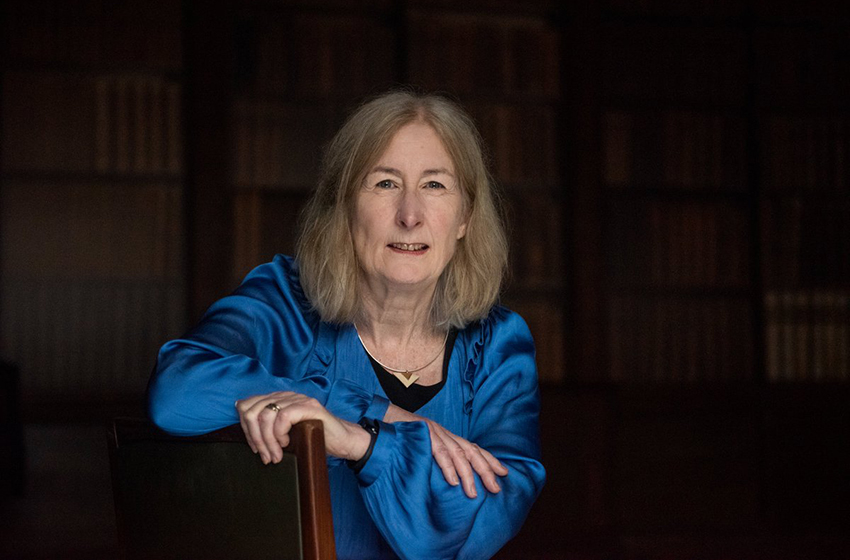
Lyndal Roper, winner of the 2026 Holberg Prize
El Premio HolbergThe Nobel Prize, one of the most prestigious international awards given annually to outstanding researchers in the humanities, social sciences, law or theology, named the Australian academic on Tuesday, March 17. Lyndal Roper as the 2026 award winner.
Roper is an emeritus professor of the Royal Chair of History at the University of Oxford. She will receive the prize, worth 6.000.000 Norwegian kroner (US$630.000), during a ceremony to be held on June 4 at the University of Bergen, Norway.
Professor Roper is internationally recognized as one of the leading researchers in early modern European history. Her pioneering studies have transformed our understanding of the witch hunts, the German Peasants' War (1524–1525), and the life and thought of Martin Luther, shedding light on how gender, the body, the psyche, and power operated in the social and religious conflicts of the sixteenth century. Roper's work is widely acclaimed for its methodological innovation and its ability to transcend disciplinary boundaries.
Lyndal Roper was the first woman, and the first Australian, to hold the Regius Chair of History at the University of Oxford, a position she has held since 2011. She has taught at Royal Holloway, University of London, and also at King's College London, where she earned her doctorate in 1985. Roper co-founded the Bedford Centre for Women's and Gender History in 1999. The Oxford Regius Prize was established in recognition of her mentoring of young scholars and her dynamic teaching. Roper is a Fellow of the British Academy, the Australian Academy of the Humanities, and the Berlin-Brandenburg Academy of Sciences and Humanities. In 2016, she received the Gerda Henkel Lifetime Achievement Award in History.
One of Roper's most important works is Oedipus and the diablo (Oedipus and the Devil(1994), which offers a new understanding of gender and culture by emphasizing that the body and psyche are inseparable from historical experience. The book explores the psychological forces at the intersection of the body, magic, religion, and sexuality, and examines masculinity, brutality, and notions of honor in early modern Europe. Roper shows how masculinity could function as a political instrument in the 16th century, and how violence, drinking, sexual behavior, and social discipline contributed to shaping Protestant identity.
En Witchcraft: Terror and fantasy in Baroque Germany (Witch Craze: Terror and Fantasy in Baroque GermanyIn her book, Roper analyzes hundreds of court records from southern Germany, demonstrating that the witch hunts and other aspects of the Reformation era cannot be understood without considering emotions, desire, and fear. She shows how ideas about motherhood, aging, and fertility underpinned accusations of witchcraft, and explains why confessions were extracted and why they were convincing to contemporary judges. The book—winner of the Roland H. Bainton Prize in 2005—also illustrates how these images continue to influence the cultural understanding of 'the witch'.
Roper's research also offers a new perspective on Martin Luther, the most emblematic figure of the Reformation. It shows how Luther's language, self-presentation, bodily experience, and emotional expression shaped both his theology and his public leadership. In works such as The fat doctor (The feiste Doctor, 2012), Martin Luther: Renegade and Prophet (Martin Luther: Renegade and Prophet,2016; Spanish edition, 2017) and Envy was your plague: The world and the legacy of Martin Luther
(Living I Was Your Plague: Martin Luther's World and Legacy(2021), Roper examines how everything from his use of coarse language to his projection of authority contributed to the political and religious upheavals of the 16th century. Luther thus emerges not only as a reformer, but as a historical individual shaped by the conflicts, cultural assumptions, and psychological tensions of his time.
Roper's last major study, Summer of Fire and Blood: The German Peasants' War (Summer of Fire and Blood: The German Peasants' WarRoper's book, published in 2025, received the Cundill History Prize in 2025. It is the first major English-language account of the Peasants' War—the largest popular uprising in Europe before the French Revolution—in more than a generation. This work offers a vivid reconstruction of the social tensions, religious turmoil, and political violence that fueled one of the most momentous popular uprisings of the early modern period, while also shedding light on the lived experiences of those involved in the conflict. Roper's other seminal works include La sacred House: Women y moral en el Augsburg de la Reform (The Holy Household: Women and Morals in Reformation Augsburg, 1989) and The Witch in the Western Imagination (The Witch in the Western Riding Imagination.
Describing the main purpose of her work, the laureate states: “Throughout my career, I have tried to make history from below; that is, I wanted a history that included the voices of ordinary people, of all types, colors, and classes, and of women in particular. I wanted new historical narratives that did not focus on great men and momentous events.”
“Here, I think my experience as a mother made me understand the importance of what can’t be expressed with words and how communication doesn’t always require language,” she continues. “And I wanted gender to be central to the story we wrote. I wanted to incorporate people’s bodily experiences into the story and also reflect on their unconscious motivations.”
In a statement, Holberg Committee Chair Professor Ann Phoenix said: “Lyndal Roper is one of the most outstanding researchers of early modern Europe and an exceptionally original historian. Her research challenges previously established assumptions about the early modern period,” she continued. “Professor Roper is a very deserving winner of the 2026 Holberg Prize.”

