
Latin American and Caribbean political systems facing the new wave of social mobilizations and protests

BACKGROUND
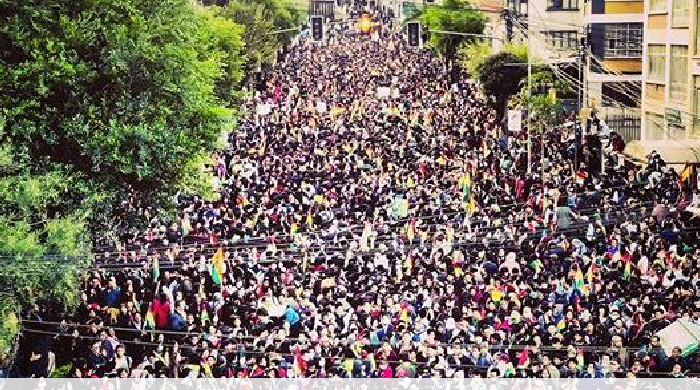
The year 2019 showed, relatively unexpectedly, a resurgence of mass demonstrations in Latin America and the Caribbean that began by confronting government decisions and then remained in the streets sustaining conflicts of great intensity and uncertain outcome.
A period of relative economic stagnation and persistently high levels of social inequality fuel discontent, while a growing disaffection with institutional political channels channels it into these forms of protest, without political parties being able to respond to the growing demands and collective actions. But massive, street-level social protests are not new to the region. They have been present throughout the Latin American and Caribbean democratic experience of recent decades, from the Caracazo in 1989, through the 2001 crisis in Argentina, to what some called the Latin American Spring between 2011 (Chile) and 2013 (Brazil).
The responses of governments and political systems to popular protests have been varied, but in very few cases have they managed to fully restore traditional democratic legitimacy, with the recovery of the political game in the hands of the classic institutions of the system.
At the end of the last century, Latin American democracy underwent a period of consolidation in which regular electoral competition became widespread across the region. Then, in the present century, a significant alternation of power occurred, marked by the so-called leftward shift, which enriched formal democracy with social substance. However, with the dissipation of this progressive cycle, democracy now finds itself at a new crossroads where the most widely accepted models of political science do not appear to provide sufficient answers to current questions.
The circumstances demand new comparative research efforts to understand the new political dynamics that have taken hold in various countries of the region, where emerging actors are gaining or regaining prominence within institutions that are no longer able to respond to their demands.
Is this simply a recurring phenomenon, yet also occasional and ephemeral? Do the most recent protests confirm the inability of the republican democratic model to adequately respond to the diverse demands of increasingly heterogeneous, diverse, and unequal societies? Why do protests in some countries appear explosive and disorganized, while in others they are convened and led by established social and political actors? What political consequences do protests generate? What strategies do governments employ to confront them? Why do they sometimes lead to the fall of a government, while in others they do not? What forms of continuity do current social movements achieve when protests dissipate? What are the legacies of protests for political systems?
To help answer these and other related questions and produce interpretations of these realities that aid in their understanding, the Latin American Association of Political Science (ALACIP) and the Latin American Council of Social Sciences (CLACSO) are calling for the submission of research projects within the framework of the call “Latin American and Caribbean political systems in the face of the new wave of social mobilizations and protests”.
Applicant profile.
Applications will be submitted by teams. Each team must consist of between 3 (three) and 5 (five) researchers who meet the following characteristics:
Principal Investigator: Must be a trained researcher, meaning they hold a PhD or equivalent qualification, as well as research experience, specifically in the thematic field of the Call.
At least 2 members of the team must be researchers in training (currently pursuing a master's or doctoral degree).
They must guarantee gender parity.
The person designated as responsible for the team in the application must be a member of a CLACSO member center and be affiliated also to an ALACIP Research Group, providing proof of both affiliation through a sworn statement. The team may have up to two principal investigators. In that case, at least one must belong to a CLACSO member center and the other to an ALACIP Research Group. Only one of the principal investigators will receive the corresponding monetary award on behalf of the team if the proposal is selected by the Evaluation Committee.
The teams must be made up of people from different institutions or different countries.
Each research team and its members may participate with a single proposal in this call.
If the scholarship is awarded and travel is necessary, the winners will be responsible for covering the costs of medical insurance or similar expenses.
If the scholarship is awarded, a specific letter of endorsement from the CLACSO member center and the ALACIP Research Group indicated at the time of application will be requested.
Support to be granted
It will be awarded A scholarship for the best-rated research project.
The scholarship will amount to US$8.500 (eight thousand five hundred US dollars) to develop the proposed research in a maximum period of twelve (12) months (July 2020 – July 2021).
The scholarships will be paid in installments through bank transfers made to the winners.
The scholarship funds are expected to be used up to 60% for fieldwork and up to 40% for third-party fees or services and research expenses. Registration fees for conferences and other publications cannot be paid for with the grant. The 60% must be reported to CLACSO with supporting documentation.
The winning group will work with the support of a tutor assigned by ALACIP who will monitor their research process and compliance with schedules and work plans.
The prize includes the publication of the final report in digital book format and the presentation of the results at a special session at the ALACIP 2021 Congress to be held in Chile.
The authors will grant CLACSO and ALACIP the original publication rights to their works, although these works may subsequently be published in any other medium, always citing the source and the award received. Award winners must inform CLACSO of the subsequent publication of their winning works.
Characteristics of the proposals
The member centers to which the applicants are linked must not have any outstanding debts in the payment of membership fees corresponding to the year 2019.
Completed research projects will not be accepted. Proposals may be linked to ongoing research processes, but the final works must be original and unpublished products and developed within the period established by the call for proposals.
Members of the Steering Committee or officials of the Executive Secretariat of CLACSO and members of the Executive Committee of ALACIP may not participate.
Proposals from researchers who are currently recipients of research grants, fellowships, or research projects organized by CLACSO will not be accepted. Applications from researchers who have previously received a CLACSO research grant will be accepted, provided that the recipient has fulfilled all obligations in a timely manner.
Texts written in two languages commonly used in Latin America and the Caribbean (Spanish and Portuguese) will be accepted, depending on the country of origin of the proposal.
Proposal selection criteria
In the first stage, the submitted proposals will be reviewed for their formal and administrative aspects to verify their compliance with the competition rules. Proposals that do not meet the established requirements will be technically rejected.
The proposals that pass to the next stage are evaluated by an International Committee made up of experts who will assess the quality and relevance of the proposals submitted under a pseudonym.
The Call for Proposals may be declared void if the proposals submitted do not meet the required quality standards.
Situations not covered in this document will be resolved by the convening institutions.
The ruling will be final.
Characteristics of research papers
The investigations will develop their work plan between July 2020 and July 2021. This plan will be implemented under the facilitation of a tutor assigned by ALACIP.
The report The final document submitted by the scholarship recipients will be reviewed by the tutor.
In their final version, the research papers submitted as a result should be between 45.000 and 60.000 words in length (excluding appendices and bibliography), written in Times New Roman 12-point font, single-spaced. This is an approximate guideline, and CLACSO reserves the right to make adjustments or exceptions if necessary. considers it necessary.
The structure of the text will be free, respecting the conventions of presentation of an academic text and the editorial standards of CLACSO.
In addition, each team must submit an Action Guidelines Document of a maximum of 4.000 words, containing inputs and recommendations for public policies and social intervention on the topics investigated.
Texts written in two languages commonly used in Latin America and the Caribbean (Spanish and Portuguese) will be accepted, depending on the country of origin of the proposal.
It is mandatory that the submission be made through the online registration system provided by CLACSO. Printed submissions and submissions sent by email will not be accepted. It is recommended to access the online system to review the registration form.
- Access the CLACSO website clacso.orgThe online registration system will be open until May 11, 2020.
- Register in the CLACSO Single Registration System (SUIC). The generated username and password will be required each time you wish to access the system to consult, modify, add, or submit information for this or any other CLACSO activity. You must designate one of your team members as responsible for registration.
- Identify the proposal by indicating its title and the pseudonym of the applicant(s). Applications with pseudonyms that correspond to the applicant's first and/or last name will not be accepted. Once the corresponding fields are completed, the system will enable the uploading of the following data.
- They must complete the registration form sworn declaration indicating the applicants' affiliation with a CLACSO Member Center and an ALACIP Research Group. Consult the database of member centers at www.clacso.org.ar/clacso/centros_miembros_clacso/inicio.php and the list of research groups in https://alacip.org/?page_id=2256#grupo.
- Complete the form personal and academic data and attach the curriculum vitae in free format; the digital copy of the identity document, passport or ID card; the digital copy of the highest academic degree obtained (or proof of degree in process) and the photograph.
- Once registration is closed, the system will produce an electronic certificate of receipt that will serve as proof.
NEW CLOSING DATE: MAY 25
Queries: [email protected]
If you would like to receive more information about CLACSO's training programs:
[widget id=”custom_html-57″]
to our email lists.
Results
OPINION
The Latin American Council of Social Sciences (CLACSO) and the Latin American Association of Political Science (ALACIP) announce the results of the call for research grants “Latin American and Caribbean political systems in the face of the new wave of social mobilizations and protests”.
They were received 25 applications Complete. After the technical review, 18 of them were found to be in a condition to be evaluated by the International Committee. This Committee considered the quality, relevance and coherence of the projects according to the terms of the call for proposals.
The evaluation carried out showed the high quality and consistency of the proposals submitted, as well as valuing his competence and intellectual contribution to the problem of the call, which made the selection process very difficult.
The evaluation was carried out by an International Committee composed of fourteen (14) evaluators experts nine (9) countries: Fernando Mayorga (Bolivia), Adriana Urrutia Pozzi-Escot (Peru), German Bidegain (Uruguay), Nicolás Somma (Chile), Daniela Perrotta (Argentina), Gonzalo de la Maza (Chile), Carolina Bautista (Colombia), Antoine Maillet (Chile), Anahí Durand (Peru), Rodolfo Disi Pavlic (Chile), Victoria Darling (Brazil), Franklin Ramírez Gallegos (Ecuador), Maira Machado (Brazil) and Marielle Palau (Paraguay).
According to the evaluation carried out, the winning project is the following:
| Team | CLACSO member center | Country of the institution | ALACIP Research Group | Title of the project |
| Juan Bautista Lucca (principal investigator), Renata Peixoto de Oliveira, José Francisco Puello Socarrás and María Angélica Gunturiz Rodríguez | Secretariat of Research and Postgraduate Studies – SIP / National University of Rosario | Argentina | Democratization in Latin America in Comparative Perspective | Protests in Times of Anger: Challenges to Neoliberalism and Liberal Democracy in the 2019 Latin American Demonstrations in Argentina, Brazil, Chile, and Colombia. |
This ruling is irrevocable and cannot be appealed.
Buenos Aires, July 20, 2020

