
"Central American countries are among the 25 most unequal in the world."
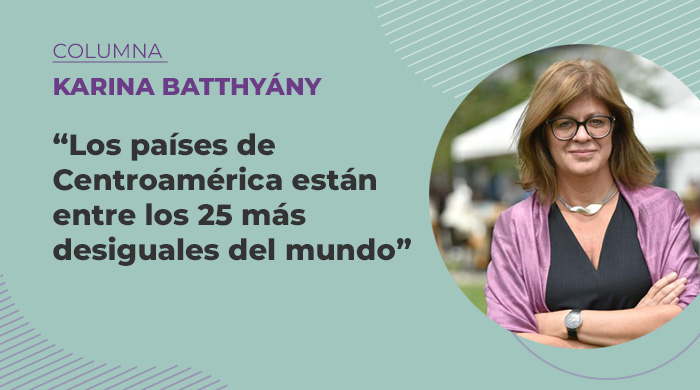
Transcript of Karina Batthyány's column
in infoCLACSO – December 11, 2024
Within the framework of the Platforms for Social Dialogue, and considering the current political, social, and economic situation, CLACSO works daily to highlight the complexities that characterize Latin America and the Caribbean, to which we have become accustomed. Guatemala, along with Brazil, Mexico, Colombia, Uruguay, and Honduras, has joined the progressive path, which entails advancing the principles of equality, justice, solidarity, and rights.
This December 10th marked the one-year anniversary of Javier Milei's government in Argentina, a government characterized by cuts of all kinds, particularly to the role of the State as a provider of welfare, to university budgets, to pensions and retirement benefits, to the education system, to the health system, and with the closure of the Ministry of Women, Gender and Diversity and the frontal attack on anyone who opposes the current government's direction.
I would like to highlight the significance of CLACSO's final forum of the year being held in Central America, specifically in Guatemala City. Indeed, last week, from December 4th to 6th, CLACSO's member centers in Central America and the Working Groups "Violence in Central America," "Feminisms, Resistance and Emancipation," and "Ruralities and Political Transitions in Central America and Colombia," together with the CLACSO Executive Secretariat, organized the International Colloquium "Social Sciences and Violence in Central America: Between Sieges and Resistance."
Central America significantly raises the average for all forms of violence in the region. Indeed, the armed conflicts of the 1980s registered levels of violence previously unimaginable. The social order that emerged from the peace processes of the 1990s, the transition to liberal democratic institutions, and the subsequent shift to neoliberalism, far from what was expected, failed to reduce this violence. Its dynamics and forms of manifestation changed, but its presence did not diminish.
The large and complex processes that shape the violence present today in each of the Latin American countries have a long history in Central America: territorial dispossession, re-militarization, drug trafficking and organized crime, migration, patriarchal violence, structural weakness of the State, impunity, criminal governance, gangs and maras.
Despite the regional and global importance of Central American processes, the region remains largely overlooked by Latin American social sciences. Therefore, this event aimed to deepen dialogues on violence in Central America among the academic and university sectors, social organizations, and political actors, and to reaffirm the crucial role of the social sciences in constructing knowledge about social reality and its transformative potential, which is part of the resistance that has always been present in the region.
The Central American region, made up of seven countries, is inhabited by more than 61 million people and is marked not only by violence, but also by pronounced inequalities, authoritarian states that coexist with democratic governments, and by the serious problem of migration that produces constant human mobility in generally dramatic and risky conditions.
According to World Bank data, in Central America half of the population lives below the poverty line, well above the average for all of Latin America and the Caribbean, where this year this figure fell by half a point, according to the Economic Commission for Latin America and the Caribbean (ECLAC), closing at 26,8%.
While the unemployment rate is relatively low, averaging 7%, informality climbs to 60% among young people, well above the rate for adults (40,8%), according to data from the International Labour Organization. This high level of informality is synonymous with social vulnerability.
The flow of remittances from migrants, especially those to the United States, plays a crucial role in Central American economies. It is estimated that these remittances have injected more than $100.000 billion into the economy in the last two years, creating an alarming level of dependence. For Honduras, El Salvador, Nicaragua, and Guatemala, these remittances represent more than 20% of their respective GDPs, with Honduras being the most extreme case, reaching 31%. If we examine the weight of different sectors in the GDP of each country in Latin America and the Caribbean, we will not find a single sector that represents more than 20%.
Due to high levels of inequality, Central American countries are among the 25 most unequal in the world, according to World Bank statistics. Oxfam reports that 10% of the region's population holds 83% of its wealth.
According to a report by the International Institute for Democracy and Electoral Assistance, almost 70% of Central American youth do not finish high school and investment in health is precarious: $200 per inhabitant per year compared to the Latin American average of $1.000.
At the political level, in Central America there are popular governments like that of Xiomara Castro in Honduras and that of Bernardo Arévalo in Guatemala, alongside authoritarian ones with little room for freedoms, such as El Salvador under Nayib Bukele, who did not hesitate to reform the Constitution in order to run for a second term.
In a context of the advance of the right and the far right in different parts of the world, the democratic governments of the region are besieged politically, judicially and economically by destabilizing and coup-plotting forces, causing, as Guatemalan President Bernardo Arévalo recently explained, that a “pact of corrupt people” persists in his country and that he is currently governing on an islet surrounded by sharks.
Another central problem we raised at the beginning of this column is migration, a reality that becomes even more complex if the future US administration of President-elect Donald Trump, who will take office on January 20, 2025, fulfills its campaign promises to further close the country's borders and use the Armed Forces to deport migrants in a situation considered "irregular," estimated at some 11 million people.
We have spoken extensively on this program and in various forums about the plight of the migrant caravans crossing Central America and Mexico to reach the United States. This issue is a priority for CLACSO and is a key component of one of its platforms for social dialogue, "Migration and Human Mobility." It is worth reiterating that the solution is not border walls or the persecution of migrants, but rather creating conditions in each country that allow its populations to develop economically, politically, and socially in dignified and sustainable conditions.
Since this will not be achieved overnight, in the meantime, those embarking on the long journey toward a different destination must be guaranteed the safety and protection that all people should receive. In this context, it is well known that migration in Central America particularly affects women and girls, who face challenges at every stage of their journey, including gender-based violence, discrimination, and vulnerability to trafficking, kidnapping, and murder.
Finally, another aspect that cannot be overlooked is that Central American countries are highly vulnerable to disasters caused by climate change. While this affects all five continents, it particularly impacts a region with limited resources for taking preventative measures and mitigating the effects of disasters.
Central America is at the forefront of current affairs due to all the issues addressed in this column and at last week's colloquium in Guatemala City, as demonstrated by the high level of the presentations and the depth of the analyses. It was undoubtedly another step towards breaking the wall of silence imposed by mainstream media and global policymakers, which renders this region, so rich in history and current events, invisible. And it will be one of the central themes of our 10th Latin American and Caribbean Conference in June 2025 in Bogotá, the capital of Colombia, where these issues related to Central America occupy a central place in the debates preceding the conference during the Assembly.
If you would like to receive more information about CLACSO's training programs:
[widget id=”custom_html-57″]
to our email lists.

