
Social movements and the battle for the meaning of the coronavirus crisis
Geoffrey Pleyers[1]
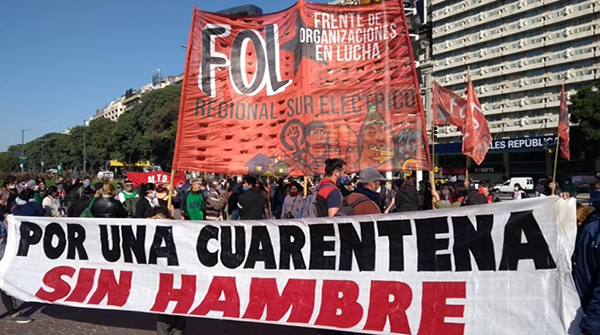
Numerous progressive intellectuals, grassroots movements, and social justice activists share a common conviction: the pandemic has exposed the limitations of the capitalist system dominated by transnational corporations and the damage it has caused over the past decade, particularly through austerity policies. They affirm the need for a societal model that prioritizes human beings, reduces inequality, and has improved public health systems.
In a recent articleI outlined a series of roles that social movements fulfilled during the pandemic and lockdown (Pleyers, 2020). They created networks of solidarity and mutual support, monitored government policies for addressing the crisis, and carried out popular education and information programs about the virus, disseminating ways to protect oneself and others against the pandemic in working-class neighborhoods. This article, divided into five sections, focuses on one of these functions of social movements during crisis situations: interpreting events to open up alternative social horizons.
The evaluation of the impacts of social movements is an ongoing debate within the field of study of these collective actors. Most of the literature focuses on strategic orientations and impacts on institutional policy. Other authors, who regularly point to “cognitive” or “cultural” approaches to social movements, consider the production of meaning (Eyerman and Jamison, 1991), knowledge (Sousa Santos, 2019), or narratives (Poletta, 2002) as one of their main contributions. Following this same line of thought, this article underscores the importance of the interpretive work on the multidimensional crisis that emerged in the wake of the COVID-19 pandemic, carried out by social movements, along with committed activists and intellectuals across all continents, as well as social science researchers who published thousands of opinion pieces during the lockdowns. They asserted that the crisis must be treated as a moment of rupture that will bring significant changes to our lives, our societies, and our world.
However, as I point out in the second section, a comparison with the changes in social and economic policies after the 2007-2008 financial crisis suggests a need for greater caution when assessing the impacts of crises on social change. In particular, it urges us not to confuse the (legitimate) desire for a more just society with historical necessities. The urgent need for a more just world, both socially and ecologically, is not a sufficient argument for its occurrence.
This should not diminish the importance of the actions of popular and progressive actors in opening new horizons for alternative futures. However, as the third part of the article argues, it calls for a relational analysis, taking into account not only the interpretive work of progressive and popular actors, but also the agency of actors who defend global capitalism, as well as reactionary movements (Pleyers, 2018, chap. 5). Different actors—progressive, capitalist, and reactionary—compete to impose different narratives of the crisis and the world that should emerge from it. Furthermore, as James Jasper (2012) argues, governments must also be included as relevant actors in the arena of defining the meanings of the crisis.
Faced with a global crisis unprecedented in modern history, the battle for its meaning and impact is being waged on a global scale. However, the fourth section of the article argues that this is not a single, homogeneous battleground. While the various scales, from the local to the global, are interconnected, significant differences remain between them, given that the struggle unfolds in fragmented public spaces. The article concludes with a brief reflection on the points raised, considering the future.
I. Interpreting the crisis
Opening new horizons of possibility has always been a key task of social movements. When dominant actors impose the idea that "there is no alternative" to the world order, social movements challenge them by asserting that "another world is possible," as the slogan of the World Social Forum stated. They introduce debates and reflections into an order that is taken for granted, thus contributing to a society's capacity to transform itself, "to produce itself" more consciously, as the sociologist Alain Touraine (1973) told us.
This role is even more important in times of crisis. Crises disrupt routines and "Business as usual." They offer opportunities to reflect individually and collectively on our shared values and collective goals. In this unprecedented and multidimensional coronavirus crisis, too, “everything that was solid melts into air” (Sousa Santos, 2020). The COVID-19 pandemic has profoundly shaken our daily lives and many of the “certainties” of our economic, political, and social system. Things that were unthinkable three months ago have become everyday reality, both in personal life and in society. The pandemic has shaken the economic dogmas that have governed the world for decades (Teivainen and Huotari, 2020). Forced to implement lockdowns to limit the spread of the virus, governments frame the “return to normalcy” as the goal of “national unity.”[2]"That brings together politicians, businesses, workers, and the entire population in a common fight against COVID-19. Activists, for their part, insist that what is presented as 'normal' is actually a constitutive part of the problem and is not a good way to confront it. 'Nothing could be worse than a return to normal,' says Indian activist Arundhati Roy."[3].
The main concerns and demands that have mobilized progressive activists and citizens in recent years have acquired even greater importance, visibility and urgency during the crisis: less corruption and less power of the elite, more democracy, social justice and dignity.
Alongside committed social scientists, experts and activists from grassroots movements demonstrated that the spread of the virus and high mortality rates are deeply linked to social inequalities. For example, the New York City Neighborhood and Housing Development Partnership has revealed how closely the incidence of COVID-19 follows the geography of neighborhoods with majority residents of color and where renters pay more than 30% of their income for housing (Afridi & Walters, 2020), highlighting the dramatic impact of inequalities on this crisis and on the pandemic's mortality rate.
Public health policies and social inequalities matter at least as much as how our bodies react to the virus when it comes to its deadly consequences. The pandemic and lockdowns constitute both a shared experience for billions of people worldwide and a very different challenge faced under profoundly unequal conditions regarding work, housing, and access to healthcare (Purkayastha, 2020).
Based on these analyses, researchers, progressive intellectuals, and grassroots actors attribute a strong social and political significance to the crisis, revealing that it is not merely a health crisis. Consequently, progressive intellectuals and actors in popular movements have outlined countless scenarios for "alternative futures." Most see the pandemic crisis as both a confirmation and a deepening of the crises they have denounced in previous work, framing it as a crisis of corporate globalization of capitalism (Amadeo, 2020), of the Anthropocene (Kothari et al., 2020), or a crisis of civilization (Escobar, 2020). Dozens of opinion pieces and petitions have circulated, asserting the need to build a more just society after the pandemic, with stronger public services and access to healthcare for all, universal basic income, and improved working conditions.
II. From crisis to social change
Promising initial results?
In the heat of the pandemic, progressive movements have had some success in disseminating certain arguments far beyond activist circles, at least in Western European democracies. After years of austerity in public services, governments increased budgets to mitigate the effects of the pandemic and limit the economic and social crisis. The state is intervening massively in the economy, and several governments are advocating for the relocation of production of “essential goods.” In Western Europe, champions of budget cuts to public hospitals are now participating in the daily applause sessions in support of the medical and healthcare staff working on the front lines of the pandemic. From Angela Merkel to Emmanuel Macron to Boris Johnson, they have declared that they consider the welfare state and public hospitals to be crucial features of their country's national identity.
Until February 2020, the French government implemented austerity measures in public hospitals and refused to address the demands of nurses and doctors who staged the longest strike in the sector in France. Its ambitious "reform plan" aimed to reduce state intervention in the economy and save money in public service sectors, including healthcare.
In his two addresses to the nation since the start of the lockdown in March 2020, Emmanuel Macron's perspective was very different. He hailed public hospital workers as heroes. The state increased the budget for public hospitals during the crisis, and the President vowed that there would be significant changes to public policy.[4]explaining that “the day after the pandemic will not be like the day before[5]“We will have to question the development model to which our world has been committed for the last few decades.[6]".
A staunch advocate of free trade before the pandemic, the French President now speaks of "economic sovereignty," grants massive loans to "national companies," and demonstrates a greater appreciation for the public sector. The pandemic has achieved what one of the longest general strikes in French history, between November 2019 and March 2020, could not: halting the pension reform promoted by President Macron's neoliberal agenda.
Lessons from the global financial crisis
This shift in stance and rhetoric echoes statements made by another French neoliberal president 12 years ago, during the global financial crisis. On October 23, 2008, Nicolas Sarkozy declared, “The ideology of the dictatorship of the market and public impotence died with the financial crisis.”[7]The anti-globalization movement couldn't have put it better. During the 2008 European Social Forum, they celebrated the fact that "the [financial] crisis has proven us right. Now governments must take our proposals into account and halt their neoliberal policies."
Unfortunately, that wasn't the case, and we know what happened next. In the years following the financial crisis, the dominant narrative placed the burden of the economic crisis on European welfare states, paving the way for austerity policies that deepened the social crisis and inequalities, and facilitating the success of the populist and xenophobic right.
What happened in the years following the 2008 global financial crisis in European politics points to three lessons for social change. The first is that, regardless of its magnitude, a crisis alone will not generate social change. This depends much more on the capacity of social actors to highlight the issues raised by the historical situation, promoting alternative political visions and economic rationales (Pleyers, 2010, Chapter 10). Social actors play a crucial role in raising public awareness, formulating novel proposals, and implementing concrete alternatives. There is no predetermined way out of any crisis, least of all a pandemic. Therefore, the actions of social actors during the crisis and its aftermath will have repercussions for society, the economy, and politics. And this should not be overlooked.
A second lesson is that sound arguments and facts are insufficient to shape the economic rationality and policies of the world emerging from the crisis. Sociologist Raymond Boudon (1989: Chapter 9) has demonstrated that the “truth” in economic theories has more to do with their capacity to forge a provisional consensus than with their scientific validity, which is always highly debatable. Likewise, the coronavirus pandemic is simultaneously a series of undeniable facts and a social reality that is reinterpreted very differently by various social actors. Each current of thought interprets the crisis in light of its previous narrative, thereby reinforcing its prior convictions and worldview. Facts and science are no longer shared points of reference but are subject to reinterpretation by populist ideologies and leaders who distrust science. J. Habermas’s (1998) faith in a deliberative public sphere and argumentative democracy is fading in the world of social media, fragmented public spaces, and the fake news and populist leaders.
Consequently, and this is the third lesson, the battle over the meaning of the crisis is a crucial one. The actors who contribute to shaping the dominant narrative of the crisis will pave the way for the world that will emerge from the pandemic. It is on the basis of this narrative that new policies will be driven, not only in public health but also in economic, social, cultural, and democratic matters. As the prominent Latin American scholar and activist Arturo Escobar said, “It is crucial at this stage to have narratives about other ways of life and to have them ready.”[8]«.
Each sector of popular or progressive movements promotes a perspective that inserts the pandemic into the meta-narrative surrounding its historical demands and the worldview it has been developing, which acts as the “master framework” (Snow & Benford, 2002) in its work of producing meaning from the crisis.
Some show the experience of the pandemic from the point of view of urban inequalities, others from an intersectional perspective, insisting on the weight of care work borne by women, and in particular women of color.[9]This is happening in families, communities, and public hospitals. Progressive intellectuals link the pandemic to the ravages of capitalism (“Capitalism is the real virus” has become a slogan on social media) and the ecological crisis. Latin American popular movements frame the crisis within the meta-narrative that emerged from the convergence of Indigenous, feminist, ecological, and social justice movements over the past decade: “The crisis reveals the profound social, political, and ecological crises we face. Behind the health crisis lies a crisis of civilization.”[10]«.
III. Counter-movements
However, progressive movements are not alone in this battle to impose the meaning of the COVID-19 crisis. They face two types of “counter-movements” (Polanyi, 1944): global capitalist elites (which Leslie Sklair (2001) proposes to analyze as a “social movement for global capitalism”) and reactionary movements.
Defending global capitalism
The years following the 2008 financial crisis demonstrated the ability of global capitalism's defenders to impose their narrative and interpretation of the crisis. Within a few years, they succeeded in shifting the meaning of the crisis and the focus of policy from the collapse of financial capitalism to the debts of welfare states, thus paving the way for a decade of austerity policies. A decade later, the actors best positioned to capitalize on the opportunities opened up by the crisis and the breakdown of economic dogma may well be on the same side. In many countries, not just in Europe, stimulus packages have channeled substantial amounts of public money to large corporations. In the United States, the first coronavirus relief package gave them $500.000 billion, five times more than was allocated to public hospitals.
While activists argued that the crisis should be an opportunity to promote a greener economic model, oil companies received their share of public money and governments established massive bailouts and loans for airlines.[11]In a global capitalist logic, countries and companies also see the crisis as an opportunity to gain new markets, and those willing to compete in them will have significant advantages.
Furthermore, Naomi Klein (2007) has demonstrated how capitalist elites have managed to exploit crises as an opportunity to impose and reinforce neoliberal policies. This scenario could be repeated with the COVID-19 crisis, as suggested, for example, by the initial measures taken by the Ecuadorian government to reinforce neoliberal policies during the lockdown. In other countries, while states increased their public health spending during the pandemic, it cannot be ruled out that the economic crisis and the increase in public debt resulting from the socio-health crisis could be used as justification for implementing cuts in social programs.
Reactionary movements
Reactionary movements have also been very active during the trade disruption caused by the lockdown. Various conspiracy theories spread through social media, giving rise to an unprecedented “infodemic.” Their discourses integrated the crisis into a broader narrative of a “culture war” that blames the pandemic on migrants, “multicultural society,” and “cultural Marxism.”[12].
Far-right activists protested against lockdowns and quarantines even when the pandemic was at its peak. In the United States[13]Thousands marched against the lockdown and business closures. The protests began in Michigan on April 15 and took place in nearly every state capital, with the support of Donald Trump. In Brazil, the president himself is participating in protests against the health measures imposed by the governors of various states.[14]In Germany, protests against the lockdown brought together anti-vaccine activists, anti-Semites, ultraliberals, and citizens who spread conspiracy theories framing the lockdown as the first step in a coup orchestrated by Angela Merkel.[15]Meanwhile, priests from conservative neo-Pentecostal churches claim, "Faith, not science, will save us."[16]"and they supported populist leaders who advocated reopening temples during the lockdown."
The pandemic triggered a rise in racism in all regions of the world: against migrant workers in India and China, against Asian Americans in the United States, against minorities and the poor accused of spreading the pandemic, and worldwide against refugees. The United Nations Secretary-General warned of a “tsunami of hatred and xenophobia, scapegoating and fearmongering” unleashed by the pandemic. In his words:
“As speculation swirls around the virus’s origin, migrants and refugees have been vilified as a source of the virus and denied access to medical treatment. Meanwhile, journalists, whistleblowers, healthcare professionals, aid workers, and human rights defenders are being attacked simply for doing their jobs.”[17]«.
Governments in the battle
Social movements are not the only actors seeking to shape the meaning of the current crisis. Nation-states have emerged as the main protagonists in the face of the pandemic. Governments are investing significantly in the battle over the meaning of the crisis to defend their handling of it, define the situation, and impose their narrative. The Communist Party of China carefully cultivates its image as an efficient government in controlling the pandemic and imprisons those who dare to challenge its narrative or criticize Xi Jinping's management of the crisis.[18]In Hungary, due to the "emergency measures" against the coronavirus, freedom of expression has been further restricted.[19]In Brasilia and Washington, populist leaders defend a worldview that seems capable of reinterpreting any fact of the pandemic, even after having failed to act to stop it.
This power play to shape the narrative is not exclusive to authoritarian states and populist leaders. The French government is particularly attentive to public discourse surrounding its handling of the crisis. On several occasions, the police have intervened to intimidate citizens who hung banners criticizing the president's management of the crisis.[20]On April 26, a woman spent four hours in police custody for hanging a banner that read, “Macronavirus, when will it stop?”, exposing the president’s responsibility for the spread of the crisis. Many governments sought to conceal their failures in managing the pandemic during its initial phase, blaming the spread of the virus on citizens who did not comply with lockdown rules. In terms of biopolitics and social control, democratic regimes sometimes adopted measures that challenge the rule of law. The policies adopted during the pandemic could pave the way for a new, more authoritarian era, with a biopolitics based on new technologies and artificial intelligence, and increased police control over citizens.
IV. A fragmented battlefield
The battle over the social and societal meaning of the pandemic is playing out across the globe. However, its difficulty lies in the fact that it is a highly segmented debate, at least on three levels.
First, it unfolds within a complex and highly fragmented media landscape. Social media platforms open spaces for expression and the dissemination of opinions, divergent information, and varied interpretations of the crisis. However, they also fragment the public sphere. Each political orientation floods its followers with news and analyses that reinforce its own worldview. Mass media, and in particular television channels and newspapers (now through their websites), remain the main players in the “consensus-making” process and the shaping of opinions. In most countries, the pandemic has tempered political conflicts, uniting a large part of the population against a common threat. In contrast, in both Brazil and the United States, the pandemic intensified societal polarization, as each side interpreted it within the framework of its own worldview.
Secondly, the debate about meaning is taking place in a connected but highly uneven way across different regions of the world. On the one hand, the experience of the pandemic is very different for the middle classes in European welfare states compared to working-class countries and neighborhoods, where most workers depend on the informal economy. On the other hand, popular movements and intellectuals in each region have interpreted the crisis according to the meta-narrative they constructed in the preceding years. For example, Latin American popular movements and their intellectuals framed it within the context of a “crisis of civilization,” a narrative far less prevalent in the Global North. International networks of popular movements and activists aim to overcome these divisions by promoting the exchange of experiences and analyses, opening spaces for a “global dialogue for systemic change.”[21]«.
Third, the pandemic is taking place in a tense geopolitical context (Bringel, 2020) that is redefining alliances and relationships between governments and their citizens. Liberal democracy is far from being the only regime and shared horizon. These changes also impact social movements. Activists participate in this battle for meaning under very different circumstances, and with very different risks, in authoritarian or democratic regimes.
V. Conclusion
The debates on interpretations of the crisis, presented in the first part, may seem irrelevant or mere intellectual exercises. However, they are a crucial step in laying the groundwork for economic and social policies that can reshape the economy and society, impacting the daily lives of millions. The COVID-19 pandemic has become a battleground for defining and proposing alternative futures. Progressive, capitalist, and reactionary movements compete to impose their narratives and shape policies and society. Meanwhile, governments urge a return to pre-pandemic "normalcy" and seek to disseminate their own narrative of the crisis. This debate on interpretations of the crisis may seem like a mere intellectual exercise, detached from the experiences and interests of citizens. However, what is at stake is the opportunity to reshape the economy and society, which will undoubtedly have a considerable impact on the daily lives of millions and on the ecological crisis.
Will popular movements and progressive activists succeed today where they failed a decade ago in the aftermath of the financial crisis? How humanity emerges from the COVID-19 pandemic will depend on scientific advances and research to find a vaccine. It will also be the result of a struggle over the social, political, and geopolitical meanings of the pandemic, as well as over the worldviews that should emerge from it. There is no easy path leading from the pandemic to a better, greener, and less unequal world.
A better understanding of the crisis and its potential consequences requires an in-depth analysis of the battle being waged by diverse social actors to impose a meaning on the crisis and, from there, contribute to shaping the world that will emerge from it. This battle does not end with the peak from the pandemic or with social confinement. These are just one of the stages in a prolonged struggle to redefine the social models, the global economy, and the political regimes of the 21st century.
VI. Bibliographic References
Afridi L., Walters C. (2020). Land Use Decisions Have Life and Death Consequences. Association for neighborhood and housing development, New York NY: ANHD. https://anhd.org/blog/land-use-decisions-have-life-and-death-consequences
Amadeo P. ed. (2020) Wuhan SopaLa Plata, Argentina: ASPO
Boudon R. (1989) Ideology, Paris: Seuil.
Bringel B. (2020) Geopolitics of the pandemic, scales of the crisis and disputed scenarios, Geopolitics, 11, 173-187.
Bringel B., Pleyers G. ed. (2020) "The world in suspense. Politics and movement in the face of the coronavirus"Buenos Aires: CLACSO. (Forthcoming)
Escobar A. (2018) Designs for the Pluriverse. Radical Interdependence, Autonomy, and the Making of Worlds, Durham, NC: Duke University Press.
Escobar A. (2020) “Post-pandemic transitions in a civilizational perspective”, Bringel B., Pleyers G. ed. (2020) Global echoes of the pandemic: Politics, movements, and alternative futuresBuenos Aires: CLACSO. (Forthcoming)
Habermas, J. (1998), Facticity and validity. On law and the democratic rule of law in terms of discourse theory, Madrid: Trotta.
Jasper J. (2012) Playing the Game. In James Jasper and Jan Willem Duyvendak eds (2012). “Players and arenas: The interactive dynamics of protest”, Amsterdam: Amsterdam University Press.
Klein, N. (2009). The Shock Doctrine, New York NY: Waterstone.
Kothari A., Escobar A., Salleh A., Demaria F., Acosta A. (2020/03/27) Can the coronavirus save the planet?, Open Democracy, www.opendemocracy.net/en/oureconomy/can-coronavirus-save-planet
Pleyers G. (2010), Alter-Globalization. Becoming Actors in the Global AgeCambridge: Polity.
Pleyers G. (2018), Social movements in the 21st centuryBuenos Aires: CLACSO.
Pleyers G. (2020), The pandemic is a battlefield. Movements during the COVID-19 lockdown», Journal for Civil Society, https://www.tandfonline.com/doi/full/10.1080/17448689.2020.1794398
Polanyi K. (1944), The great transformationBoston: Beacon Press.
Polletta, F. (1998) Contending Stories: Narrative in Social Movements. Qualitative Sociology 21, 419-446.
Purkayastha B. (2020), Divided We Stand. The pandemic in the United States, Bringel B., Pleyers G. ed. (2020) Global echoes of the pandemic: Politics, movements, and alternative futuresBuenos Aires: CLACSO. (Forthcoming)
Snow D., Benford, R (2002) Master frames and cycles of protest. In: Morris A., and Mueller, C. (eds), Frontiers in Social Movement Theory, pp. 133–155, New Haven, CT: Yale University Press.
Sousa Santos B. (2019) The end of the cognitive empire, Durham, NC: Duke University Press.
Sousa Santos B. (2020) The cruel pedagogy of the virusBuenos Aires: CLACSO.
Teivainen T., Huotari P. (2020) Democratic horizons in coronavirus governance, In: Bringel B., Pleyers G. ed. (2020) Global echoes of the pandemic: Politics, movements, and alternative futuresBuenos Aires: CLACSO. (Forthcoming)
Touraine, A. (1973), Production of the societyParis: Seuil.
Zarocostas J. (2020) How to fight an infodemic (world report), The Lancet, Vol. 395(10225), p. 676.
[1] Research Professor at the FNRS at the Catholic University of Louvain, Belgium. Vice President of the International Sociological Association (ISA) 2018-2022. His latest book published in Spanish is “Social Movements in the 21st Century” (CLACSO, 2018). Article originally published at: http://revistapai.ucm.cl/article/view/632/638
[2] Macron's first speech on the pandemic was titled "United France is our greatest asset in this challenging time we are going through with Covid-19. We will get through this together." https://www.elysee.fr/emmanuel-macron/2020/03/12/adresse-aux-francais
[3] Arundhati Roy (2020/04/17): “The Pandemic Is a Portal”, Yes Magazine. See Ilán Bizberg's contribution to this book. www.yesmagazine.org/video/coronavirus-pandemic-arundhati-roy/
[4] Mauduit L. (2020/04/12) Retraites, hôpital: la troublante conversion d'Emmanuel Macron, Mediapart, https://www.mediapart.fr/journal/france/120420/retraites-hopital-la-troublante-conversion-d-emmanuel-macron
[5] https://www.elysee.fr/emmanuel-macron/2020/03/16/adresse-aux-francais-covid19
[6] Présidence de la République, (2020, March 12) “Adresse aux Français”. Retrieved 28 May 2020, from https://www.elysee.fr/emmanuel-macron/2020/03/12/adresse-aux-francais
[7] President Sarkozy's speech on "the measures taken to support the economy", October 23, 2008.
[8] “Coronavirus and disputes over the public and the common in Latin America”, Online seminar organized by CLACSO, ALAS and ISA, April 9, 2020. https://youtu.be/pOFQlsesLf8
[9] Hirsch, A. (2020, May 7). After coronavirus, black and brown people must be at the heart of Britain's story | Afua www.theguardian.com/commentisfree/2020/may/07/coronavirus-black-brown-people-britain-ethnic-minorities
[10] Montserrat Sagot, Online seminar “Coronavirus and disputes over the public and the common in Latin America”, CLACSO, ALAS and ISA, April 2020. https://youtu.be/pOFQlsesLf8
[11] https://stay-grounded.org/savepeoplenotplanes
[12] This is, for example, the argument of this text and the video that circulated among xenophobic social media networks: “Belgium, the sinister country with a Marxist cultural model that leads in deaths per million inhabitants” www.antronio.cl/threads/el-siniestro-pa%C3%ADs-de-modelo-marxista-cultural-que-lidera-muertes-por-mill%C3%B3n-de-habitantes.1322094/
[13] Vogel, K.P., Rutenberg, J., & Lerer, L. (2020, April 21). The Quiet Hand of Conservative Groups in the Anti-Lockdown Protests. The New York Times. https://www.nytimes.com/2020/04/21/us/politics/coronavirus-protests-trump.html
[14] Travis Waldron (2020, May 20) “Brazil is the new epicenter of the Global Coronavirus pandemic”, Huffington Post.
[15] Baumgärtner M. et al. (2020, May 14). The Corona Conspiracy Theorists, Der Spiegel International. Retrieved 27 May 2020, from https://www.spiegel.de/international/germany/the-corona-conspiracy-theorists-protests-in-germany-see-fringe-mix-with-the-mainstream-a-8a9d5822-8944-407a-980a-d58e9d6b4aec
[16] Michelle B. (2020, April 3). Can faith healing work by phone? Charismatic Christians try prayer to combat the coronavirus. Washington Post. Retrieved 25 May 2020, from https://www.washingtonpost.com/religion/2020/04/03/supernatural-healing-christian-faith-coronavirus-pandemic
[17] UN Secretary-General Denounces 'Tsunami' of Xenophobia Unleashed amid COVID-19, NYC: UN. https://www.un.org/press/en/2020/sgsm20076.doc.htm
[18] Davidson H. (2020/04/08) Critic who called Xi a 'clown' over Covid-19 crisis investigated for 'serious violations', The Guardian. https://www.theguardian.com/world/2020/apr/08/critic-xi-jinping-clown-ren-zhiqiang-covid-19-outbreak-investigated-china
[19] Hungarian Helsinki Committee (2020) Emergency Law Gives Carte Blanche Powers to Government: Free Media and Human Rights Defenders Needed More Than Ever. (2020, March 31). www.helsinki.hu/en/emergency-law-gives-carte-blanche-powers-to-government
[20] Polloni C. (2020/04/16) Pour des flages au balcony, la police à domicile. www.mediapart.fr/journal/france/160420/pour-des-banderoles-au-balcon-la-police-domicile
[21] https://systemicalternatives.org/2020/04/29/global-dialogue-for-systemic-change
If you would like to receive more information about CLACSO's training programs:
[widget id=”custom_html-57″]
to our email lists.

