
“Social movements exercise citizen control, without which there is no real democracy.”
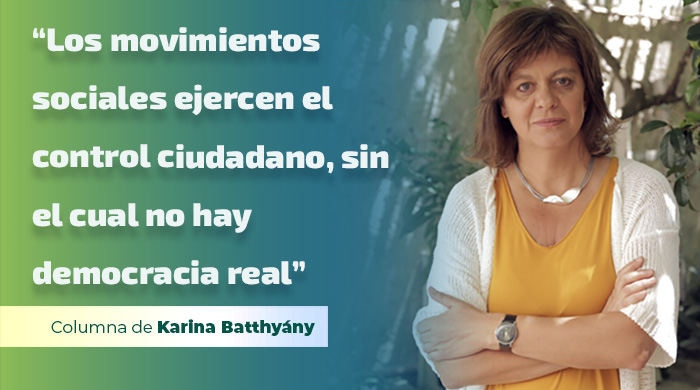
Transcript of Karina Batthyány's column
in InfoCLACSO – June 28, 2023
The meeting on social movements and activism in Fortaleza, Brazil, was held as part of the Social Dialogue Platforms strategy. There, we worked together with people from academia, public policy, and social movements and organizations to address the main problems facing our region.
The forum is specifically dedicated to analyzing social movements in contemporary Brazil, focusing on the renewed impetus for repositioning them under Lula's government, both regionally, globally, and in the post-Bolsonaro era. Furthermore, the forum is being held in Northeast Brazil, a particularly interesting region, not only because of the expression of social movements there, but also because of its historical positioning and, more recently, its electoral performance under Lula da Silva's new government.
The theme that brings us together, “Social Movements and Territory for Life”, we will understand it by the importance that social movements have in our region, the history of social and political struggles in Latin America and the Caribbean, where they involve a very large spectrum of strategies, different horizons and different subjects that mobilize throughout our territory.
The focus is on collective action, understood as a driving force for social transformation that takes on diverse forms of organization and is sustained by different actors and individuals. Furthermore, it proposes ways of relating to the State and political institutions.
Therefore, it is particularly important to have a specific Platform for Social Dialogue focused on the role of social movements as agents of change. In other words, we propose the challenge of creating a space for reflection and understanding of all the diverse forms that social movements represent and their potential connections. We want, therefore, to work within this diversity of movements and types of collective action to better understand the various factors interacting within them, including their divergences, affinities, opportunities, limitations, and potential. Our aim is always to promote collaboration among these proposals to strengthen the struggles currently taking place in Latin America and the Caribbean against oppression, for freedom, for justice, and for the consolidation of effective democracy in our region.
Therefore, the focus will be on understanding current social movements and activism—their strategies, potential, and threats—considering them historically and from a critical perspective. This will also involve gathering the memories of struggles that have been reinvented and reinterpreted in some cases, but which are rooted in long-standing practices and trajectories in our region.
We will be discussing these topics in various forums for dialogue, including those between academia and public policy; social movements and organizations; and through training programs with workshops and other initiatives. These topics will also be discussed at book and material presentations that CLACSO has produced in recent months. Furthermore, a communication and outreach strategy will be developed to reach all of Latin America and the Caribbean.
– In the recent past, you raised some very complex political contexts in Brazil and, in addition, the importance of social movements as limiters in many cases of certain brutalities of neoliberalism, right?
We are well aware of the role that social movements have played throughout Latin American history and in recent history. I would say that one of their main functions is the real capacity for citizen oversight in democracy. Without citizen oversight, there is no real exercise of democracy. And it is precisely social movements, as collective actors, that exercise this citizen oversight.
What does citizen oversight mean? It means being attentive to the various actions taken by governments and how these influence the reality of each of our countries. It means raising, for example, the commitments made at some point by the government or by those aspiring to govern. Furthermore, it means demanding accountability when these commitments are not fulfilled or when public policies are formulated that, far from moving the country or the region toward fairer, more equitable, and more developed situations, are regressive.
Therefore, we must denounce and act against attempts by capital and the market to appropriate public goods, such as education and healthcare, and natural resources, such as water, among many other demands. This real capacity for citizen oversight is one of the fundamental roles in Latin America.
If you would like to receive more information about CLACSO's training programs:
[widget id=”custom_html-57″]
to our email lists.

