
Popular social movements defend the causes of the vast majority.
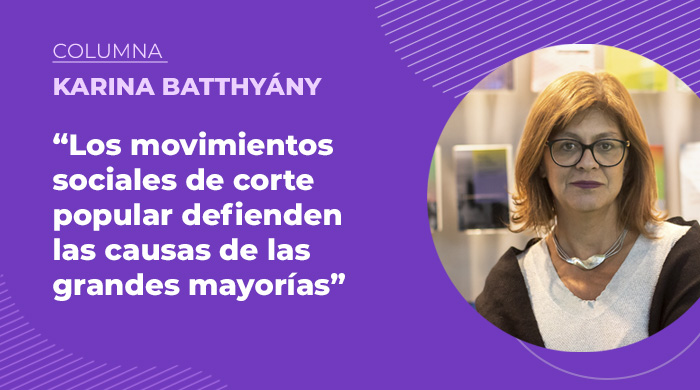
Transcript of Karina Batthyány's column
in InfoCLACSO – October 9, 2024
We held a meeting with the CLACSO Steering Committee at the University of Havana, Cuba, where we reviewed the activities of the past six months and discussed future priorities for the work of our CLACSO Network. Furthermore, we face the challenge that our next Conference, #CLACSO2025, will take place in eight months in Bogotá, Colombia, also with two assemblies. This is the most important moment for our CLACSO Network in terms of defining priorities for the next three years.
In a few days we will be publishing the call for the Assembly, which was approved by our Steering Committee, so that everyone knows who makes up our Member Centers.
– Within the framework of the Forum on Activism and Social Movements in Latin America and the Caribbean, what is the importance of considering this topic 65 years after the Cuban Revolution?
– The forum refers, of course, to grassroots social movements that operate within the framework of critical thinking and, therefore, defend the causes of the vast majority in our territories. Today, we are at a crucial moment to reflect on the demands and actions of these social movements and organizations. We see certain threats to democracy or anti-democratic expressions from the extreme right that call into question some of the gains achieved in the Latin American and Caribbean region, for example, everything related to the achievements concerning women's rights and the work that the feminist movement has done for many years.
The feminist movement is a social movement that has undoubtedly stood out in our region in recent times because it has driven the greatest transformations. Furthermore, we must highlight the issues related to environmental movements, the defense of migrants' rights, and, in general, the social movements that work in a coordinated manner around the issue of inequality.
Let us remember that Social Movements and Activism in Latin America is one of our Platforms for Social Dialogue (PDS). Therefore, what has taken place in this Forum is an ongoing social dialogue surrounding this issue and its various dimensions of inequality, such as gender, generational, environmental, and territorial.
In short, we are convinced that only by articulating knowledge, social movements, and public policy can we advance the necessary transformations in our America. I want to highlight the participation of colleagues from the CLACSO Member Centers in Cuba, as well as from across Latin America and the Caribbean. Participants came from various sectors, such as the CLACSO Working Groups, the postgraduate network, and the different activities we carry out. In total, more than 150 people registered to participate in the Forum on Activism and Social Movements, which took place in various venues at the University of Havana.
– The opening of the Forum included the participation of the Minister of Science, Technology and Environment (CITMA), the Rector of the University of Havana, and the representative of the CLACSO Steering Committee for Cuba. What were those shared meetings and bilateral discussions like?
The fact that the inauguration took place in the Aula Magna of the University of Havana demonstrates the importance that the CLACSO Cuba Member Centers network has placed on this event. At the inauguration, we had the privilege and honor of the participation of the Minister of Science, Technology and Environment, Eduardo Martínez Díaz, the Rector of the University of Havana, Miriam Nicado García, and myself, representing CLACSO. Highlighting the voices, initiatives, and proposals emerging from social movements and organizations is more important than ever for the Caribbean and all of Latin America.
If you would like to receive more information about CLACSO's training programs:
[widget id=”custom_html-57″]
to our email lists.

