
“Feminisms are a great example of work for transformation in Our America”
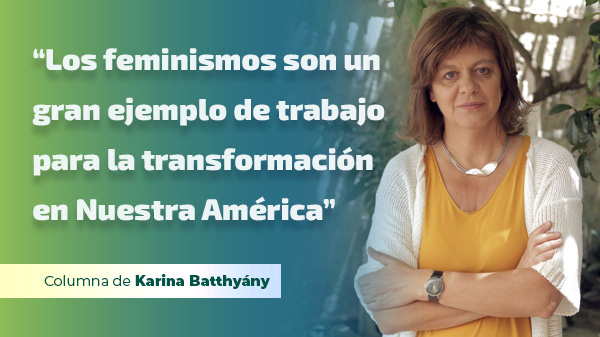
Transcript of Karina Batthyány's column
in InfoCLACSO – August 30, 2023
In today's InfoCLACSO column, we'll be focusing on the Latin American and Caribbean Feminist Meeting (EFLAC) and the collaborative work we at CLACSO will be undertaking with our colleagues organizing the next EFLAC. From there, we'll explore the main concerns and challenges facing feminism in the region today.
The EFLAC is a gathering of feminist women from across Latin America and the Caribbean, held every four years. The first one took place in Brazil in 1985, around the time of the Beijing Conference. These gatherings provide spaces for collaboration, debate, and dialogue among women from different countries with diverse experiences and perspectives. They have been crucial in shaping the feminist agenda at the regional level, addressing issues such as gender-based violence, sexual and reproductive rights, women's political participation, feminist economics, care work, the environment, and migration, among others. Ultimately, these are critical issues for feminism in our region today.
The EFLAC (Latin American and Caribbean Feminist Forums) are a forum for coordinating feminist struggles across the different countries of our region, primarily for building a shared regional agenda. These meetings have resulted in the adoption of declarations and resolutions for the implementation of public policies promoting gender equality in our Latin American and Caribbean countries. They also serve as a meeting place and training ground for young women and emerging feminists, facilitating the exchange of knowledge and experience among women and feminists of different generations.
This important space for building consensus is key to achieving a strong and well-organized regional feminist movement. It is a site for discussion, debate, and action, enabling progress toward achieving equality for women in Latin America and the Caribbean. Furthermore, it must be understood within the context of the role the feminist movement plays today across the various feminist perspectives in our region: a fundamental, consistently leading, and indispensable role in securing women's rights.
The feminist movement has made significant progress in recent years in various areas, including education, health, politics, the economy, and culture. For example, in the political arena, women have indeed gained access to public office and decision-making positions. Perhaps less than we would like, but there has been progress in our region, and it is thanks to these feminist struggles that public policies such as quota laws for political participation have been implemented.
It has also been fundamental in the area of gender-based violence, through the discussion, approval, and implementation of laws and specific policies to eradicate it. And in the workplace, it has played a crucial role with all the laws that aim to guarantee equal opportunities in paid employment.
In the field of economics, progress has been made in eliminating gender discrimination in the workplace, in order to address, demonstrate, and try to overcome the wage gap that still exists between men and women in our region. Another very important issue is how violence develops in the workplace, specifically workplace harassment and sexual harassment against women.
Meanwhile, in the field of culture we can find great achievements such as the participation or greater representation of women today in the media, in literature, art, music and culture in general, working to break down gender stereotypes and to make visible the experiences, visions and voices of women.
The feminist movement has made significant progress in securing rights and creating spaces for women's participation and presence. However, the Latin American and Caribbean Feminist Meeting will also face gender-related challenges, as Latin America remains one of the regions with the highest rates of gender-based violence in the world, where women are victims of physical, sexual, psychological, and economic violence.
At EFLAC, political representation will be discussed because women still have low political representation in the region, with women underrepresented in the governments of Latin America and the Caribbean. On average, only 25% of seats in national parliaments are currently held by women at the regional level.
The issue of inequality and poverty will also be on the agenda, as women in Latin America are more likely to fall into poverty than men. Before the pandemic, in 2019, 22% of women lived in poverty compared to 15% of men. Furthermore, health will be a key area of discussion, debate, and action at EFLAC, particularly regarding sexual and reproductive health and specific healthcare for women.
There is an additional challenge in our region that has to do with the resistance and reaction that conservative groups are having towards the advance of the feminist movement and the progress in the conquest of women's rights such as, for example, the right to abortion, equal pay and the recognition of the rights of lesbian, bisexual and transgender women.
– It's impressive how powerfully intertwined issues related to feminism, as conceived from academia and social movements in our America and the Caribbean, are…
This is perhaps one of the areas where we can best see the connection between knowledge, academia, and social movements and organizations, which then has an impact on public policy. In this sense, feminisms, particularly the actions of the feminist movement in Latin America and the Caribbean, are a great example from which we must continue to work and deepen our understanding in order to find opportunities for the transformation of Our America.
If you would like to receive more information about CLACSO's training programs:
[widget id=”custom_html-57″]
to our email lists.

