
"The discourses of the new right contain a profound critique of the welfare state."
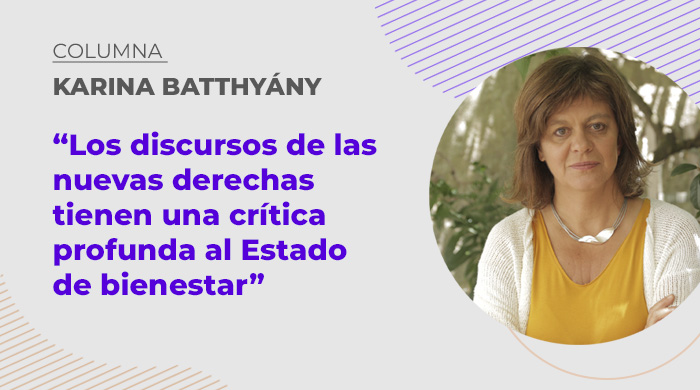
Transcript of Karina Batthyány's column
in InfoCLACSO – June 12, 2024
Within the framework of the Forum “Democracies, inequalities, authoritarianism and constituent processes in Latin America and the Caribbean”, CLACSO is concerned and committed to placing the issue of democracies on the table for discussion, because we consider it important and urgent for our region and for the whole world, due to the resurgence of the new right, the far right and their reconfigurations.
Today, the discourses of the new right are mainly about an anti-welfare model, that is, a profound critique of welfare models, of the role of the State as the main agent in the provision of welfare, both at the individual and collective level.
When I speak of well-being, I always refer to fundamental pillars such as education, health, social security, employment, care, as well as environmental and territorial issues. Furthermore, we demonstrate how anti-rights movements and the new right have a profound critique of the role of the State in these dimensions of everyone's daily life, dimensions that enable this idea or construction of well-being. And they do so by defending an economic model—that is, a neoliberal model.
The neoliberalism of these times is not the neoliberalism of the 90s, but it has a common premise: the reduction of public spending through the reduction in state participation, the increase in the privatization of those common or public goods and the opening of markets in the basic areas of welfare.
Right-wing and new right-wing expressions are strongly marked by their extreme conservatism on basic social issues such as women's rights and dissidents, the issue of voluntary termination of pregnancy, same-sex marriage, or gender identity.
Another point we are observing with great concern in our Latin American region and around the world is antifeminism, or the fight against “gender ideology”—that is, against progress on the gender agenda and the rights of women and gender minorities. As a headline example, consider the recent events in Argentina, where not only has inclusive language and a gender perspective been prohibited by decree, but the Ministry of Women, Gender and Diversity has also been shut down at the national level, along with programs aimed at preventing and eradicating gender-based violence.
– There's a level of contradiction here, in the most unequal region on the planet, Latin America, where the proposal is to reduce the size of the state and adopt a "every man for himself" approach. The right wing has used powerful marketing tools to convince people that the very tools that led to so much inequality are the same ones that will solve the problems of inequality, right?
– These are recipes we already know. That's why I said it's the neoliberalism of our times, but it fundamentally shares a common root with those neoliberal policies that were implemented in our region starting in the 90s. And we know their results very well: the amplification of inequalities, the exacerbation of certain dimensions of inequality, and everything related to the processes of reducing the State's role in ensuring those basic dimensions of well-being for everyone.
In the discussion panels for upcoming CLACSO and LASA activities, one issue that also concerns us is the setback in human rights associated with the restriction of rights, particularly for the most vulnerable minorities in our region. This includes issues related to the rights of women and gender minorities, as well as the rights of Indigenous peoples, Afro-descendants, migrant communities, and other minority groups.
At #LASA2024, CLACSO organized one of the central panels focused on the care society, specifically addressing the challenges it presents for the Latin American and Caribbean region. Why highlight this? Because we believe that this proposal for a care society, and for prioritizing issues related to the care of life in all its dimensions through new social pacts or agreements, can be a key element in the search for future alternatives.
– With all the work that has been carried out to bring the issues of caregiving and its implications during pandemic periods to the forefront of the debate, unfortunately, in some countries, as is happening in Argentina, there is a significant regression, making it more crucial than ever to discuss these issues…
– Absolutely. That's why I'm placing the issue of the care society at the center of the discussion. Because we believe that this could be one of the future alternatives for the region, but also internationally, in European countries and in the Global South, the proposal to move forward on issues of care and the dimensions of our daily lives in the face of the central knots of inequality.
Ultimately, we all need, provide, and coordinate care in order to preserve everyone's lives. CLACSO recently held an important international meeting in Cuba, where discussions focused on gender issues and care policies in Latin America and the Caribbean from the perspective of different countries, considering both progress and setbacks, as well as the development of national care systems. The issue of care is one of the distinctive proposals from the Global South in these times of global crisis.
If you would like to receive more information about CLACSO's training programs:
[widget id=”custom_html-57″]
to our email lists.

