
"The challenges we face stem from historical inequality that causes social unrest and political instability."
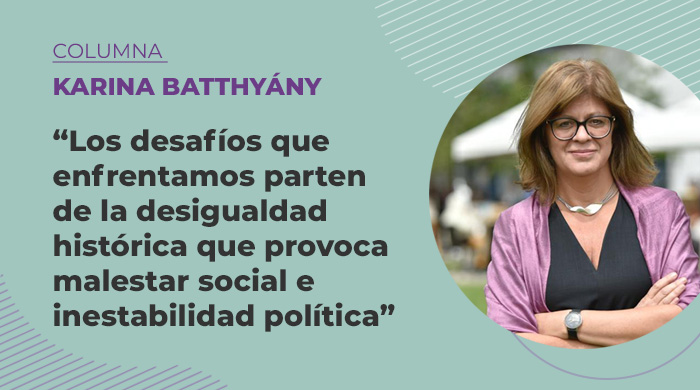
Transcript of Karina Batthyány's column
in InfoCLACSO – December 13, 2023
Current events compel us to place the issue of democracy and human rights at the heart of our CLACSO agenda. I want to recap the 40-50-50 cycle. It began in March 2023 in Argentina, commemorating 40 years of democracy. It then continued with the 50th anniversary of the civil-military coup in Uruguay, followed by the 50th anniversary of the coup in Chile in September.
The 40-50-50 cycle summarizes several strategic pillars, including democracy, memory, and all aspects related to human rights. These are also pillars of our Platforms for Social Dialogue (PDS). Furthermore, these themes are connected to the broader notion and concept of citizenship and the exercise of citizens' rights.
In other words, these are key issues we've been discussing in the context of Latin America, but also globally. Democracy is once again taking center stage in the social sciences and humanities, particularly in the concerns of various countries regarding the consolidation of, or threats to, democratic systems. This is often marked by the rise of right-wing, far-right, and new right-wing movements, which challenge democratic principles and incorporate authoritarian elements.
The challenges facing Latin America and the Caribbean stem from historical and structural inequality, which causes social unrest and political instability. This inequality is central to the analysis of democratic systems. We cannot speak of consolidating democracies when, in many cases, what is being consolidated are the processes of inequality and exclusion.
A second point: in recent years, political instability has emerged in various Latin American countries, linked to the resurgence of authoritarianism. In some countries, very specific measures have been taken that run counter to democratic practices, such as restrictions on freedom of expression and political participation by citizens.
Third, it is essential to recognize the extent of violence in its various forms as a persistent problem in the Latin American and Caribbean region. Violence has diverse underlying causes, including poverty, inequality, and elements associated with drug trafficking, among others. This violence undermines democratic foundations and creates an atmosphere of insecurity and fear.
We also observe in some countries a process of political polarization (a deep divide, as it would be called in Argentina), which poses a challenge to democracies in Latin America and the Caribbean. This polarization makes it difficult to reach certain basic consensuses necessary for democratic functioning and on public policies that transcend government administrations. In many cases, these processes of political polarization have also facilitated the rise of authoritarian leaders who exploit this social, cultural, and political division among the people who inhabit a given territory.
A key theme in this 40-50-50 cycle is how to encourage governments to take measures to address and reverse inequality in our Latin American and Caribbean region, such as investment in education, health, social security, care, among others, to help build foundations of individual and social well-being and reduce processes of political instability.
We have also addressed the promotion of civic and social education to encourage participation in the political process by providing informed and engaged citizens who are more actively involved in their countries' political processes. Furthermore, we advocate for the absolute and unrestricted protection of human rights, including freedom of expression, to help ensure that everyone has a voice in the political processes of their countries.
Another element addressed at CLACSO was how to strengthen a solid institutional framework in terms of the different powers in the States of our countries that protect democracies from authoritarian threats or the curtailment of rights in different areas.
Within the framework of the axes we are working on in this 40-50-50 cycle, we will continue to advance with our PDS linked to the issues of democracy, memory and human rights, adding also the activities that we will carry out in cooperation with the French Development Agency (AFD).
From CLACSO, with our headquarters in Argentina, we will be vigilant and alert to any measures implemented to prevent democratic backsliding or attempts to undermine the processes of democratic strengthening and the consolidation of rights. We will also be monitoring developments in other Latin American countries, especially in Central America, which we follow closely and with concern.
How fundamental is the work of academics in a context where Latin American universities have been besieged by the erosion of rights in education, research, and other areas…
Not only were universities in general under siege, but public universities in particular, especially those in the social sciences and humanities. We saw this in Bolsonaro's Brazil, and unfortunately, we are seeing it today in various countries and regions, such as Central America. There is a general attack on universities, but a particularly strong attack on those of us who work in social science research, with direct consequences for academic freedom and freedom of expression. We are also facing cuts to funding available for teaching and research, which undermine the development of these disciplines in our countries.
If you would like to receive more information about CLACSO's training programs:
[widget id=”custom_html-57″]
to our email lists.

