
Contemporary challenges in care
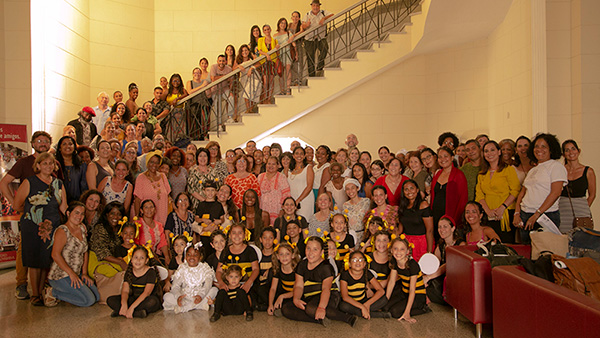

With a well-attended closing ceremony on the afternoon of Thursday, April 27, the Forum “Contemporary Challenges in Care: Demographic and Political Dynamics” concluded at the University of Havana, Cuba. The forum was organized by CLACSO, UNICEF, the Cuban Ministry of Labor and Social Welfare, the United Nations Population Fund, OXFAM, UN Women, the Friedrich Erbert Foundation, and the CLACSO Caribbean Region Member Centers.
Those participating in the closing included Miriam Nicado, Rector of the University of Havana; Karina Batthyány, Executive Director of CLACSO; Marta Elena Feitó, Minister of Labor and Social Security of Cuba; Teresa Amarelle Boue, General Secretary of the Federation of Cuban Women; and María Isabel Domínguez, representative of the CLACSO Steering Committee for the Caribbean region.
The three days of the Forum were filled with intense exchange and presentations on the challenges of care in current times, with very creative proposals to continue advancing on this issue, which is addressed in very diverse ways by civil societies and states in the countries of Latin America and the Caribbean.
The events began on Tuesday the 25th with the International Postgraduate School in Care with a gender perspective, in addition to the training workshops that had a large turnout.


Then, on Wednesday the 26th, the Forum was inaugurated by Miriam Nicado, Karina Batthyány, María Isabel Domínguez and Magela Romero, Coordinator of the Cuban Network of Studies on Care in Cuba.


The first Dialogue "Conceptual and Theoretical Issues" included Karina Batthyány, Juan Carlos Alfonso (ONEI, Cuba), Arlin Pérez (Full Professor, Faculty of Law, University of Havana), María del Carmen Zabala (FLACSO, Cuba) and Pablo Vommaro (Director of Research at CLACSO) moderated by Jusmary Gómez (CIPS, Cuba).

Following the presentation of the audiovisual: “Caring for those who care” – Manzana de los Cuidados, Ciudad Bolívar, Bogotá, Colombia, Valentina Perrotta (CLACSO Working Group on Care and Gender, Uruguay), Verónica Serafini (Member of the CLACSO Steering Committee, Paraguay), Marlene Choque (Working Group on Anti-patriarchal Struggles, Families, Genders and Diversities, Bolivia), Gloria Amézquita (Member of the CLACSO Steering Committee, Dominican Republic) and Laura Poverene (Working Group on Childhoods and Youth, Argentina) engaged in dialogue.

Magela Romero, Antonio Aja (CEDEM, Cuba), María Isabel Domínguez, Yelene Palmero (CEM/FMC, Cuba), Ariel Fonseca (General Director of Employment of the MTSS, Cuba) and Teresa Viera (MINCULT, Cuba) participated in the third Dialogue.

The presentation of reports was led by Karina Batthyány and Valentina Perrotta spoke on “Comprehensive Care Work” CLACSO-MIDES Argentina, and Paola Mascheroni spoke on “State of the art on Care in rural contexts in Latin America and the Caribbean” CLACSO-UN Women.

The second day concluded with a dialogue led by Mariela Castro (CENESEX, Cuba), Paola Mascheroni (Working Group on Agrarian Labor, Inequalities and Ruralities, Uruguay), Rosa Campoalegre (CIPS, Cuba), Ana Vergara (Working Group on Critical Studies in Motherhood and Fatherhood, Chile), and Luciana María Santillán (Working Group on Gender, (In)equalities and Rights in Tension, Argentina). Martha Rosa Muñoz (FLACSO, Cuba) moderated.
The Forum «Contemporary challenges in care: Demographic and political dynamics It is part of the Platform for Social Dialogue "Rights, violence and gender equality", which CLACSO is promoting for the coming years.
The objective of this proposal is to produce evidence-based, critical, and contextualized knowledge with a significant impact on policymaking, public opinion formation, and the positive transformation of living conditions for the most vulnerable populations. Specifically, this Forum aims to exchange, discuss, disseminate knowledge, and influence care policies in Latin America and the Caribbean. It will be a multi-stakeholder space for the open and dynamic exchange of ideas and experiences related to care, approached from diverse perspectives.

If you would like to receive more information about CLACSO's training programs:
[widget id=”custom_html-57″]
to our email lists.

