
Human Rights and Peacebuilding as Dimensions for Strengthening Democracy in Latin America and the Caribbean

RESEARCH PROPOSAL CALL FOR TEAMS
Registration deadline: August 23, 2021
Fundamentals
Recent years in Latin America and the Caribbean have shown a scenario of mass mobilizations often motivated by situational conflicts that also reflect a long-term historical process related to disputes surrounding the validity, guarantee and expansion of Human Rights.
Linked to the construction of citizenship in a comprehensive sense and updating the struggles of the seventies, eighties and nineties of the twentieth century in the region, the conflicts surrounding Human Rights include diverse dimensions such as economic, social, cultural, environmental, identity, ethnic-racial, gender and different types of recognitions.
In this context, various countries have experienced a marked deterioration in the human rights situation, both in terms of the exercise of democracy and the situation of diverse social groups and populations. Furthermore, the rise of right-wing and regressive governments has reinforced this trend and fueled the growth of anti-rights and denialist movements. This has also manifested itself in attacks on social leaders in regions such as Central America, Colombia, and Brazil. In some countries, the increase in human rights violations coincides with a rise in government corruption and the erosion of public services, as well as attacks on social movements seeking to confront it.
On the other hand, the armed conflicts experienced by various countries in the region during the second half of the 20th century found alternative means of resolving the underlying conflicts through various peace agreements beginning in the 1990s. These agreements have taken different paths in recent years, revealing their limitations and unresolved issues, or facing direct threats and risks. Some peace processes have failed to materialize (largely due to the actions of the states themselves), creating conditions for a reconfiguration of the dynamics of violence in these territories. This has led to a resurgence of social, political, and intellectual concerns regarding peace and its associated conflicts.
For their part, in 2014 the States that make up the Community of Latin American and Caribbean States (CELAC), meeting in Havana, signed a resolution that declared Latin America and the Caribbean as a "zone of peace", committing to resolve their disputes without the use of weapons.
Likewise, in recent years, social movements have grown in various Latin American and Caribbean countries, fueling struggles and disputes over human rights, their defense, guarantee, and expansion. Youth movements, student organizations, environmental groups, and the women's and LGBTQ+ movements are clear examples of this trend.
Based on these analyses, CLACSO is launching the Research Call for teams on "Human Rights and Peacebuilding as Dimensions for Strengthening Democracy in Latin America and the Caribbean." This call encourages applications from research teams comprised of researchers from diverse disciplines, backgrounds, and experiences who address the issues outlined here from a critical perspective and with the commitment to contribute innovative solutions to the challenges presented.
CONTEST RULES
-
Applicants must be researchers with accredited ties to CLACSO Member Centers, which they will demonstrate with a sworn statement. If awarded the scholarship, they must submit a letter of support signed by the highest authority of the center.
-
Submissions by collective authors of up to four (4) members will be accepted.
-
The formation of the teams must respect gender parity (at least 50% women) and must select one of the members as responsible for the registration of the project.
-
Each team must be made up of trained researchers, that is, those who hold a master's degree, doctorate or equivalent and have a proven academic track record and/or researchers in training, that is, those who are pursuing master's or doctoral studies or are up to 35 years of age, in this case with a degree.
-
Each researcher or research team may only participate with one proposal in this call.
-
If the scholarship is awarded and travel is necessary, the winners will be responsible for covering the costs of medical insurance or similar expenses.
Up to eight (8) group scholarships will be awarded.
The amount of the scholarships awarded will consist of:
-
$12.000 for each research team.
The proposed research will be carried out over a maximum period of 10 (ten) months. The grants will be paid in installments via bank transfers made to the principal investigator. It is expected that at least 60% of the grant funds will be used for activities related to gathering and processing the information necessary for the research, which must be reported to CLACSO with supporting documentation.
The winners will work with the support of tutors assigned by CLACSO who will follow the process of their research and results.
CLACSO will publish the final products in print and/or digital media, giving them wide publicity and dissemination through the means it deems appropriate.
The authors will transfer the original publication rights of their works, given that CLACSO adheres to and defends the principles of open science and open access to knowledge, so that the resulting work is easy to find, accessible, interoperable, and reusable. Subsequently, these works may be published in any other medium, always citing the grant received. Grant recipients must inform CLACSO of the subsequent publication of works resulting from the grant work.
-
The member centers to which the applicants are linked must not have any outstanding debts in the payment of membership fees corresponding to the year 2020, due on June 30 of the same year.
-
Completed research projects will not be accepted. Proposals may be linked to ongoing research processes, but the final works must be original and unpublished products and developed within the period established by the call for proposals.
-
Members of the Steering Committee or officials of the CLACSO Executive Secretariat may not participate.
-
Proposals from researchers who are currently recipients of research grants, fellowships, or research projects organized by CLACSO will not be accepted. Applications from researchers who have previously received a CLACSO research grant will be accepted, provided that the recipient has fulfilled all obligations in a timely manner.
-
Texts written in the four languages commonly used in Latin America and the Caribbean (Spanish, English, Portuguese and French) will be accepted, depending on the country of origin of the proposal.
-
In the first stage, the submitted proposals will be reviewed for their formal and administrative aspects to ensure their compliance with the competition rules. Proposals that do not meet the established requirements will be rejected.
-
Applications that pass to the next stage will be evaluated by an International Committee composed of experts who will assess the quality and relevance of the proposals, which will be submitted under a pseudonym.
-
The Call may be declared void or a smaller number of scholarship recipients may be selected, if the proposals submitted do not meet the required quality and consistency.
-
Situations not covered in this document will be resolved by the convening institution.
-
The ruling will be final.
-
The research projects will develop their work plan between October 2021 and July 2022. This plan will be implemented under the facilitation of tutors assigned by CLACSO.
-
The progress and final reports submitted by the scholarship recipients will be reviewed by the tutors.
-
In their final version, the research papers submitted as a result should be between 12.000 and 15.000 words in length (excluding appendices and bibliography), written in Times New Roman 12-point font, single-spaced. This is an approximate guideline, and CLACSO reserves the right to make adjustments or exceptions if deemed necessary.
-
The structure of the text will be free, respecting the conventions of presentation of an academic text and the editorial standards of CLACSO, in addition to APA + GENRE.
-
In addition, each team must submit a Guidelines for Action Document, containing inputs and recommendations for public policies and social intervention on the topics investigated.
-
Texts written in the four languages commonly used in Latin America and the Caribbean (Spanish, English, Portuguese and French) will be accepted, depending on the country of origin of the proposal.
It is mandatory that the submission be made through the online registration system provided by CLACSO. Printed submissions and submissions sent by email will not be accepted. It is recommended to access the online system to review the registration form.
-
Visit the CLACSO website www.clacso.org . The online registration system will be available starting Monday, June 28, 2021.
-
Register in the CLACSO Single Registration System (SUIC). The generated username and password will be required each time you wish to access the system to consult, modify, add, or submit information for this or any other CLACSO activity. Applicants submitting collective proposals must designate one of the authors as responsible for registration. This same person will receive the corresponding monetary award if the proposal is selected by the Jury.
-
Identify the proposal by indicating its title and the pseudonym of the applicant(s). Applications with pseudonyms that correspond to the applicant's first and/or last name will not be accepted. Once the corresponding fields are completed, the system will enable the uploading of the following data.
-
Applicants must complete the sworn statement on the registration form indicating their affiliation with a Member Center belonging to the CLACSO network. The list of member centers can be found at: https://www.clacso.org/institucional/centros-asociados/.
-
Complete the personal and academic data form and attach the curriculum vitae in free format; the digital copy of the identity document, passport or ID card; the digital copy of the highest academic degree obtained (or proof of degree in process) and the photograph.
-
The proposal must be uploaded to the form that appears once the personal and academic data has been completed.
-
Once registration is closed, the system will produce an electronic certificate of receipt that will serve as proof.
Registration closes: August 23, 2021 (23:59 PM, Argentina)
Winners will be announced in September 2021.
Project implementation: October 2021 to July 2022
Final report submission: July 31, 2022
The results will be published on the CLACSO website. The winners will be contacted by email.
Inquiries: [mail protected]
RESULTS
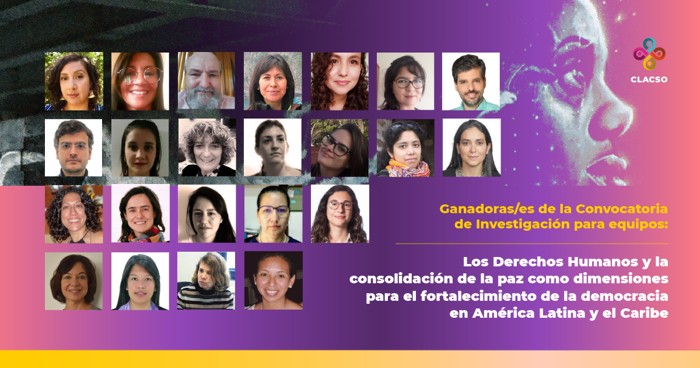
The Latin American Council of Social Sciences (CLACSO) announces the results of its research call for teams, “Human Rights and Peacebuilding as Dimensions for Strengthening Democracy in Latin America and the Caribbean . ” This call focuses on the debates surrounding the validity, guarantee, and expansion of human rights, encompassing diverse dimensions such as economic, social, cultural, environmental, identity-based, ethnic-racial, and gender-related rights, as well as various forms of recognition. The marked deterioration of human rights has generated diverse responses, both from the state and from social movements, that question and challenge democratic processes.
Seventy applications were received , of which, after the technical and formal review, 55 were in a condition to be qualitatively evaluated by the International Committee to consider the quality, relevance and coherence of the proposals according to the Call.
The evaluation process was carried out by an International Committee composed of 11 experts from 6 countries: Carolina Jiménez (Colombia), Jaime Zuluaga (Colombia), Roberto López (El Salvador), Jairo Estrada (Colombia), Consuelo Ahumada Beltrán (Colombia), Irene Palma (Guatemala), Víctor Manuel Moncayo Cruz (Colombia), Emilio Taddei (Argentina), Eliud Torres Velázquez (Mexico), Andrea Daverio (Argentina), Nilia Viscardi (Uruguay).
Following the evaluation, which recognized the excellent quality, relevance and rigor of most of the applications, 8 proposals were selected.
The list of winning proposals from the Call for Proposals is as follows:
|
Winning Proposals |
|||
|
Authors |
Member Center |
Country |
Title of the proposal |
|
Daniel Yepes, María Dolores Moreno Álvarez |
CO-024 Institute of Political Studies – IEP/UdeA – University of Antioquia |
Colombia |
A Meeting in Motion: Popular Student and Youth Organizations in the Struggles for Human Rights, Democracy, and Peace with Social Justice. The Case of Medellín (2019-2021) |
|
Isa Lima Mendes, Monica Herz |
BR-021 – Institute of International Relations – IRI/PUC-Rio – Pontificia Universidade Católica do Rio de Janeiro |
Brazil |
The Political Representation of Colombian Women in the Implementation of the Peace Agreements with the FARC |
|
Rafael Paternain, Matilde Inés López Schwedt, Luciana Scaraffuni |
UY-004 – Department of Sociology – DS/UDELAR – Faculty of Social Sciences – University of the Republic |
Uruguay |
Police violence on the margins of the state: conflicts and human rights violations in the Marconi neighborhood of Montevideo |
|
Stephania Recalde García, María Eugenia Ibarra Melo |
CO-006 – Center for Socioeconomic Research and Documentation – CIDSE/UNIVALLE – Faculty of Social and Economic Sciences – University of Valle |
Colombia |
Women on the front lines: political participation of women and feminists in the Colombian national strike in 2021 |
|
Mariana Mora Bayo, Inés Giménez Delgado, María Paula Saffon Sanin, María Elena Herrera Amaya |
MX-012 – Center for Research and Higher Studies in Social Anthropology – CIESAS – Member of the CONACyT System of Public Research Centers |
Mexico |
Justice and peacebuilding: Indigenous and Afro-Mexican peoples against multiple forms of violence and racism in Guerrero, Mexico |
|
Laura Judith Sanchez, Rita Herrera – Angélica Rossana Gauna |
AR-063 – Research Center – CIFFyH/UNC – Faculty of Philosophy and Humanities – National University of Córdoba |
Argentina |
Practices and meanings in the criminalization of women arrested for drugs: borders between law and violence. |
|
Myrian Alejandra Delgado Chávez, Mónica Mabel Dazzini Langdon, Enrique Fuertes |
EC-015 – Faculty of Human Sciences, Pontifical Catholic University of Ecuador – FCH-PUCE – Faculty of Human Sciences – Pontifical Catholic University of Ecuador |
Ecuador |
Strategies for peacebuilding in the Amazon: a community palimpsest |
|
María Antonieta de los Ángeles Campos Melo, Natalia Isabel Caniguan Velarde, Gabriela Garcés, Alba Zambrano |
CL-022 – Center for Social Sciences and Humanities – CISOH – University of La Frontera |
Chile |
Guaranteeing rights, appropriating power: Political trajectories of Mapuche Lafkenche women in two regions of southern Chile. |
This ruling is irrevocable and cannot be appealed.
Buenos Aires, October 12, 2021

