
Caregiving: organization and time management
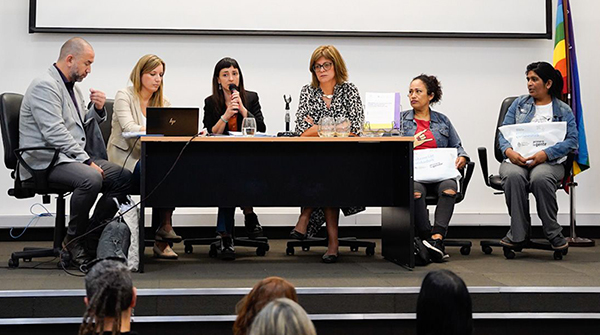

On Thursday, October 27, in the city of Buenos Aires, the Directorate of Comprehensive Care and Community Policies of the Ministry of Social Development of Argentina and the Latin American and Caribbean Council of Social Sciences presented the report «Caregiving: organization and time management«.
Two of its promoters, the Executive Director of CLACSO, Karina Batthyány, and Valentina PerrottaThe members of the "Care and Gender" Working Group highlighted the importance and objectives of this work.

Eric Domergue interviewed
The purpose, he estimated Karina BatthyányThis report aims to "once again place the issue of care at the center, something we at CLACSO have been emphasizing for several years now, because we understand that it represents one of the main sources of gender inequalities. And in this case, we also take a particular approach, which is to examine this logic of comprehensive care by considering its various components, especially community care and the policies that can be developed to address this gender and care perspective in a holistic way. This report effectively sheds light once again on how the issue of care impacts gender inequalities for women, particularly women with young children, and how this impact varies depending on the region, socioeconomic status, and, of course, other variables and dimensions that we are constantly working on and highlighting from this gender and care perspective."

To Valentina Perrotta“The pandemic that erupted in our homes brought the issue of caregiving to the forefront, 24 hours a day, but it’s a reality that the region has been grappling with for some time, and which academia has been addressing for 30 or 40 years. In other words, as a social and academic topic, it had already been accumulating; what the pandemic did was bring the burden of 24-hour home care to the forefront, without external support, and this, of course, generated many costs, especially for women who had to juggle caregiving with their paid work, all taking place in the same place: their homes.”

They also discussed with CLACSO Radio the importance of continuing to emphasize care policies and combating gender inequalities. Carolina Brandariz from the Directorate of Comprehensive Care and Community Policies of the Ministry of Social Development, and the Deputy Secretaries of UTEP, the Union of Workers of the Popular Economy, Dina Sanchez y Norma Morales.
Carolina Brandariz She explains that “this is a project we developed within the framework of the diploma programs we conducted last year at the federal level, with 157 commissions nationwide. Two thousand women workers in the informal economy, who generally dedicate their economic activity to community care work, responded to a survey. This was the input on which the Care Directorate, of which I am a part, along with CLACSO, worked together to develop this report on the use of time, care management, and the strategies these women workers use to manage the care of their families, their neighborhood, and their community.”

To Dina SanchezThe point is that “every step we take is a step towards the full recognition that our colleagues deserve, because they do an enormous amount of care work, caring for life, caring from childhood to adulthood. And that is very important, so let's continue working together to further strengthen this work and so that at some point there will be full recognition for something so important to society as a whole.”
Norma MoralesShe added that “during the pandemic, the immense work done by these workers in the informal economy was phenomenal. I believe the pandemic also helped to highlight the historical demand we've been making for many years (…) and it also allowed us to bring to the forefront of societal debate that care work should receive economic recognition. We were clearly able to establish this debate in society, and we didn't stop there; we also developed strategies to build public policies, laws, and a framework so that they receive not only political, economic, and symbolic recognition, but also so that society recognizes that these workers in the informal economy are the ones who guarantee thousands and thousands of essential tasks in working-class neighborhoods.”
Pablo VommaroClacso's Director of Research and coordinator of the report's presentation, also highlighted the importance of advancing care policies that involve the entire society with state policies.
She emphasized “the efforts we make at CLACSO to build bridges between academia, social movements, and public policy; that is, to recognize that knowledge production lies in this dialogue, in this network of mutual recognition and empowerment of experiences and unique knowledge situated precisely within a community or neighborhood context. Therefore, thinking about comprehensive care at the community level involves considering this experience, this knowledge that can be systematized from academia, from an experience or contribution that CLACSO might offer, but also from recognizing that there is shared knowledge. In other words, it's not that the academy, the university, or the team of experts or researchers who produced the research presented in this report are going to tell the neighborhood what to do or teach them, but rather that they are going to systematize an experience to enhance or strengthen the everyday practices that are already taking place, in this case, in community care.”

If you would like to receive more information about CLACSO's training programs:
[widget id=”custom_html-57″]
to our email lists.

