
The lessons that the pandemic taught Cuban society
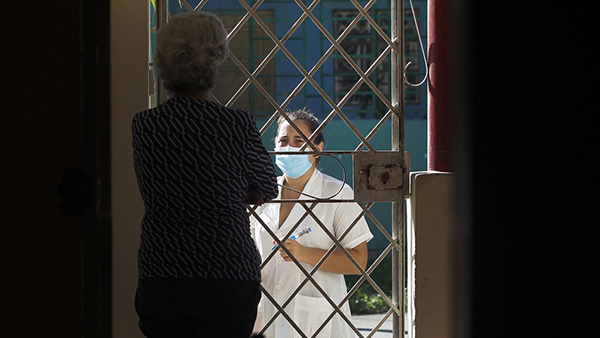
A medical student conducts a search as part of the measures implemented to prevent the spread of COVID-19 in the 10 de Octubre municipality of Havana, Cuba. February 21, 2021. Photo: Jorge Luis Baños/IPS
Luis Brizuela
Official data indicates that around 70 percent of the main scientific projects and clinical trials linked to curbing SARS-CoV-2 on the island have a woman as the principal investigator.
Healthcare and scientific personnel, as well as caregiving and support networks, have been essential for Cuban society in the last year, when it had to build resilience in the face of the multiple impacts of COVID-19.
“The pandemic has taught us many lessons in terms of organization, politics, and capacity building for change. The first is unity, the need to build support networks based on shared goals,” sociologist Rosa Campoalegre told IPS.
The second lesson, added the researcher from the state-run Center for Psychological and Sociological Research (CIPS), based in Havana, “is to unite from below, from the neighborhoods, which is where the battle of solidarity against the pandemic is won, the main Cuban weapon.”
Since the first three cases of infection with the SARS-CoV-2 virus, which causes COVID-19, were reported on March 11, individuals and self-employed businesses made masks and donated them to neighbors and citizens in vulnerable situations, actions that were sometimes made visible through social media.
Solidarity initiatives stood out, such as the delivery of modules with food, medicines and hygiene items to people with disabilities, adults and senior citizens, as well as trans people, among the segments most vulnerable to the impacts of the disease.
In several of the 15 provinces of this Caribbean island country, training projects on good practices for care and support were extended, given the necessary physical distancing.
“The virtual world has been a clear path to greater solidarity. We learned that online spaces can be a weapon of love and struggle, guided by ethics and a particular way of seeing the world,” Campoalegre explained.
This researcher, together with professionals from the CIPS Family Studies Group, in collaboration with other entities, led the Acompáñame telecare project, which involved a hundred people between 61 and 79 years old who lived or spent most of their time alone in their homes.
The project to share dialogues and affections through the telephone and social networks in the face of a lack of interactions, was carried out in the municipality of Plaza de la Revolución, one of the 15 that make up the Cuban capital, and which with 28,3 percent of its population over 60 years old is classified as the most aged on the island.
According to Campoalegre, with the coronavirus “we learned to be stronger and take care of ourselves, as a first element to take care of others; in addition to refocusing within families and prioritizing family strategies to face the crisis.”
This is agreed by Dr. Sahily Ramírez, a resident of the city of Holguín, 685 kilometers east of Havana, who was caught by surprise in Venezuela as a member of the Cuban medical mission in that nation.
“I was on the 'red line' three times, directly attending to patients who were positive for or suspected of having Covid. Although I was afraid of getting infected, I always kept a positive mindset and gave my best in caring for them,” Ramírez told IPS in an electronic interview.
After returning in October, “I was reunited with my six-year-old daughter, under the care of my parents and my maternal grandmother, who are hypertensive and over 60 years old. Now I work in one of the isolation centers for people with COVID-19” in that city, said the specialist in Comprehensive General Medicine.
“I feel that the pandemic has challenged me both professionally and personally. When I get home, I make sure to disinfect everything before hugging my daughter, whom I support with her online classes, with whom I play since she has no siblings, and to whom I provide psychological support, as well as to my family,” Ramírez added.
For Campoalegre, it is urgent to "move towards an integrated national care system, which brings together both the public and private sectors," because if there is one important thing we have confirmed, "it is that we are interdependent and we all need care, as a universal right."
Although there are no official figures, experts acknowledge that the crisis caused by the pandemic has had a greater cost for women, since they bear the brunt of domestic and caregiving tasks given the persistence of the patriarchal order that shapes the sexual division of labor.
However, as a nation that has achieved scientific parity recognized by international organizations, Cuban women stand out in the research and healthcare efforts against the pandemic.
Official data indicates that around 70 percent of the main scientific projects and clinical trials linked to curbing SARS-CoV-2 on the island have a woman as the principal investigator.
Health system, aid
Specialists consulted by IPS considered that in the case of Cuba, another strength against the coronavirus has been the public and free health system and a health personnel trained in disaster situations.
With some 100,000 medical professionals and another 85,000 nurses, many of whom have collaborated in countries against natural disasters and epidemics such as the Ebola outbreak in Africa in 2014-2015, the island stands out among the nations of the hemisphere with the fewest deaths from the coronavirus, with 357 deaths and 58,379 infections as of Wednesday the 10th.
Furthermore, the national biopharmaceutical industry developed five vaccine candidates against COVID-19, an unprecedented achievement in Latin America and the Caribbean.
One of the antigens, Soberana 02, began the third and final phase of clinical trials on March 8 in 44,000 volunteers from eight Havana municipalities.
If it proves safe and effective, this candidate, along with the other four that are going through different phases of studies, would allow the entire Cuban population to be immunized before the end of the year, health authorities have said.
However, building resilience to the impact of COVID-19 involved additional burdens for citizens, such as facing shortages of food and medicine and other economic problems responsible for the 11 percent drop in gross domestic product last year.
The strengthened US embargo through sanctions imposed by the administration of former President Donald Trump (2017-2021), including limitations on remittances, sought to cut off the government's main sources of funding, but directly affected families and private businesses, experts acknowledge.
Despite certain salary guarantees, the suspension of work or reduction of working hours had a negative impact on Cuban households, many of which depend on the informal market for income.
Of the 600,000 people in the private sector, around 250,000 temporarily froze their licenses due to supply chain disruptions and sales declines, statistics show.
For its part, the 2019 Statistical Yearbook showed that for every 100 people of working age, only 65 were employed or seeking employment, in a country with 7,1 million citizens of working age.
The impact of the economic restructuring that began on January 1st, accompanied by the elimination of the dual currency system and several subsidies, the devaluation of the peso, as well as an increase in prices, wages, and pensions, remains to be measured for the post-pandemic scenario.
See note in Inter Press Service in Cuba
If you would like to receive more information about CLACSO's training programs:
[widget id=”custom_html-57″]
to our email lists.

