
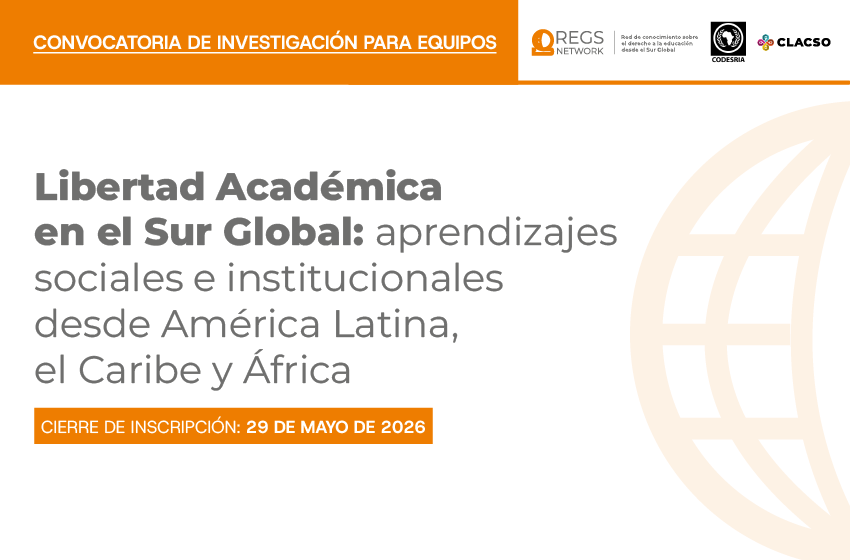
Academic Freedom in the Global South: Social and Institutional Lessons Learned from Latin America, the Caribbean and Africa
Presentation
Since 2021, the Knowledge Network on the Right to Higher Education from the Global South (REGS) has been working to consolidate an international network of research, dialogue and knowledge production that problematizes educational inequalities and promotes alternative approaches to guarantee the right to education from the Global South.
On this occasion, the Latin American Council of Social Sciences (CLACSO) and the Council for the Development of Social Science Research in Africa (CODESRIA), as part of the institutions that make up and support this network, invite research teams to submit projects that critically and contextually address the challenges of Academic Freedom in the regions of Latin America, the Caribbean and Africa.
In a global context marked by political, social, and technological transformations, academic freedom—understood not only as an individual right of faculty and students, but also as a fundamental pillar of university autonomy, democracy, and the strengthening of civic spaces—faces increasing threats. This call for proposals seeks to promote critical thinking and the production of original knowledge that allows us to understand, make visible, and defend spaces of knowledge production against censorship, harassment, precarity, and commodification, with a particular focus on fostering South-South dialogue.
Objectives of the Call
- To promote empirical and theoretical research on the state of academic freedom in Latin America, the Caribbean and Africa.
- Strengthen academic cooperation and the exchange of experiences and learning between research teams from both regions.
- To produce inputs that contribute to public debate and influence higher education policies that guarantee autonomy and the right to science.
Thematic Areas of Interest
Research projects must be registered under one or more of the following axes:
- Democracy, autonomy, and academic freedom: Impact on academic freedom, freedom of learning, and research agendas. Resistance to external pressures, harassment, and denialism.
- Academic freedom and university governance: the role of students, academic staff and faculty in university governance.
- The human right to science and knowledge: Access gaps and their impact on freedom of thought and intellectual work. Production and social circulation of knowledge as a public and common good.
- Intersectionality and Academic Freedom: Analysis of inequalities of gender, race, ethnicity, territory and class in educational, academic and scientific production trajectories.
- Socio-educational equality: Epistemic diversity and cognitive sovereignty: Dialogues between academic, ancestral, and popular knowledge. Strategies against epistemic hegemony and the defense of local knowledge systems.
- Knowledge in Resistance: Good Living and Ubuntu as horizons for a Pluriversal Academic Freedom.
- Academic freedom in the post-truth era: Disinformation, algorithms and the human right to science.
- Methodologies for the qualitative and quantitative evaluation of academic freedom in the Global South.
- Comparative studies: Transregional analyses between countries in Latin America, the Caribbean and Africa.
- Academic freedom in the digital age: Artificial intelligence, biases, data sovereignty, algorithmic justice and their implications for academic freedom.
- The university in a neoliberal context: the question of intellectual freedom, institutional and academic integrity, staff work and unionization, the commodification of education, and neo-managerialism.
Call for applications rules
- The information provided in the registration form is considered a sworn statement.
- Collective applications are expected (teams of between 3 and 5 members), linked to CLACSO Member Centers, CODESRIA or academic and research institutions of the regions called, or civil society organizations of the recipient regions.
- Composition: Teams are expected to meet, at a minimum, gender parity requirements. They must include:
- Established researchers: Those who hold a master's degree, doctorate or equivalent and a proven academic track record.
- Early-career researchers: people who are currently pursuing master's or doctoral studies or who hold a bachelor's degree.
- Applications will be accepted from researchers who have previously been selected for a CLACSO or CODESRIA research grant, provided the recipient has fulfilled all relevant obligations in a timely and appropriate manner. Each researcher may only participate in one proposal. A team leader must be designated to manage the application process. Proposals from researchers who are currently recipients of grants, fellowships, or research projects organized by CLACSO or CODESRIA will not be accepted.
- Members of the Steering Committee or officials of the Executive Secretariat of CLACSO or CODESRIA may not participate.
- If the project is awarded and any travel is necessary, the winners will have to cover the costs of medical insurance or similar expenses themselves.
- Up to 6 (six) proposals will be supported.
- The amount of support will consist of $6.000 (six thousand dollars) for each selected proposal, payable in installments linked to the delivery of progress reports and final results.
- DurationThe investigations will have a total duration of 8 months from the signing of the acceptance certificate.
- TutorsThe selected teams will work with the support of tutors assigned by CLACSO who will follow the process of their investigations and results.
- PublicationCLACSO, in collaboration with CODESRIA, will publish the final products in digital media, giving them wide publicity and dissemination through the means it deems appropriate. If necessary, researchers will be asked to make the adaptations and adjustments required so that the resulting research can be published in various formats. Authors will transfer the original publication rights of their works, as CLACSO adheres to and defends the principles of open science and open access to knowledge, ensuring that the resulting work is easy to find, accessible, interoperable, and reusable. Subsequently, the works may be published in any other medium, always citing this Call for Proposals. Researchers must inform CLACSO and CODESRIA of the subsequent publication of the works resulting from their research.
- OriginalityCompleted research projects will not be accepted. Proposals may be linked to ongoing research processes, but the final works must be original and unpublished products and developed within the period established by the call for proposals.
- LanguagesTexts written in the languages commonly used in Latin America, the Caribbean and Africa (Spanish, Portuguese, English and French) will be accepted, depending on the country of origin of the proposal.
- Registration: proposals must be uploaded to the registration system, completing the form that appears once the personal and academic data of those who make up the research team have been completed.
- Investigation project: Document (maximum 10 pages) that includes: rationale, objectives, methodology, expected results (at least one high-quality research article and one public communication activity about science), schedule of activities and bibliography.
- Trajectory: Brief profile or curriculum vitae of the team members (maximum 5 pages).
- Originality and relevance of the proposed topic in relation to the themes of the call for proposals
- Theoretical consistency and methodological soundness
- Feasibility of the work schedule within the 8-month period
- Comparative perspective or potential impact on South-South dialogue
- Regional diversity and gender parity and diversity in the composition of the team presenting the proposal.
- Incorporation of researchers in training (postgraduate students, recent graduates) to integrate younger generations and promote intergenerational dialogues
- Administrative reviewIn the first stage, the submitted proposals will be reviewed for their formal and administrative aspects to verify their compliance with the competition rules. Proposals that do not meet the established requirements will be rejected.
- Peer reviewApplications that pass to the next stage will be evaluated by an International Committee composed of experts who will assess the quality and relevance of the proposals, which will be submitted under a pseudonym.
- ResultsThe call may be declared void or a smaller number of projects may be selected if the proposals submitted do not meet the required quality and consistency.
- Situations not covered in this document will be resolved by the convening institutions.
- The ruling will be irrevocable and unappealable.
- Opening of the call for applications: April 10th 2026
- Registration closing: May 29th 2026
- Publication of results: Friday 7 of August of 2026
- Start of the investigation period: 1 September 2026
- Enter the website of CLACSOThe online registration system will be available starting on the day 10 April.
- Register in the CLACSO Single Registration System (SUIC). The generated username and password will be required each time you wish to access the system to consult, modify, add, or submit information for this or any other CLACSO activity. Applicants who are part of collective proposals must open a single form This will include all researchers on the team. One of the authors must also be designated as responsible for the registration. This same person will receive the corresponding monetary award if the proposal is selected by the Jury.
- Identify the proposal by indicating its title and the pseudonym of the applicant(s). Applications with pseudonyms that correspond to the applicant's first and/or last name will not be accepted. Once the corresponding fields are completed, the system will enable the uploading of the following data.
- Applicants must indicate in the form their institutional link with a Member Center of the CLACSO Network, CODESRIA or an institution from the convening regions.
- Complete the personal and academic data form and attach the curriculum vitae in free format; the digital copy of the identity document, passport or ID card; the digital copy of the highest academic degree obtained (or proof of degree in process) and the photograph.
- The proposal must be filled out on the form that appears once the personal and academic data has been completed.
- Once registration is closed, the system will produce an electronic certificate of receipt that will serve as proof of application.
Registration closes: May 29, 2026
Publication of results: August 7, 2026
Start of the investigation period: September 1, 2026
The results will be published on the CLACSO website. The winners will be contacted by email.
For questions or more information: [email protected]

