
Academic freedom, inequalities and decolonial struggles in Latin America
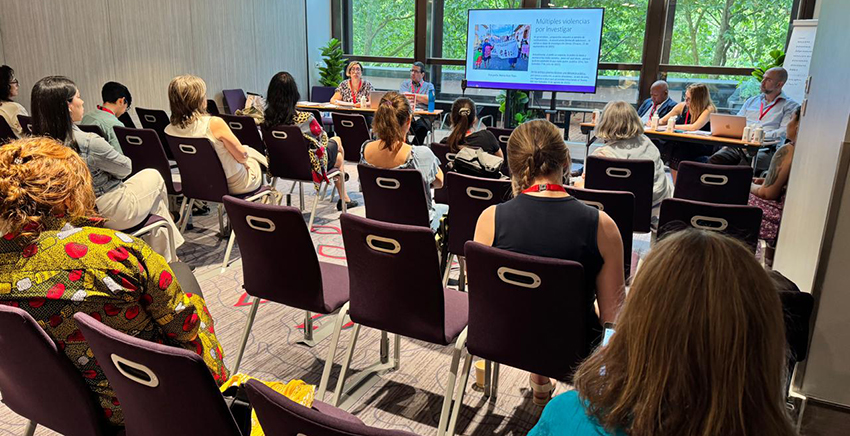
Within the framework of the International Congress of Latin American Studies Association (LASA 2026), held in Paris, France, CLACSO and Coalition for Academic Freedom in the Americas (CAFA) organized the panel “Academic freedom, inequalities and decolonial struggles in Latin America”, a space for reflection and exchange on the challenges facing the production, circulation and recognition of critical knowledge in the region.
The activity was carried out within the framework of the project “Strengthening comparative research and critical thinking within the framework of academic freedom in the Americas”The panel, promoted by CAFA and CLACSO, was coordinated by [name missing]. Camilla Croso, The Executive Director of the Coalition for Academic Freedom in the Americas (CAFA) included comments from Pablo Vommaro, Executive Director of CLACSO, and brought together the presentations of Jorge D. García Rincón (Descarimba Afro-Diasporic Research Association), Vernor Muñoz (Latin American Campaign for the Right to Education) and Marisa G. Ruiz Trejo (Autonomous University of Chiapas), who presented research developed in different countries of Latin America.
Upon opening the activity, Cross She emphasized the importance of understanding academic freedom beyond traditional conceptions focused solely on individual or institutional freedom of expression. She noted that the research driven by the project seeks to understand how structural inequalities, power relations, and various forms of exclusion condition the possibility of researching, teaching, and producing knowledge in the region.
She also emphasized the need to strengthen the international circulation of knowledge produced in Latin America and the Caribbean, challenging the mechanisms that determine which knowledge is legitimized and which remains invisible. In this regard, she maintained that it is necessary “to fight for power” also in the academic and publishing fields, expanding the spaces for recognition of the region's intellectual productions.
Academic freedom and epistemic racism
The first exhibition was organized by Jorge D. García Rincón, who presented research focused on the experiences of Afro-descendant women and Afro-diasporic organizations in Latin America.
Her work showed how racial and gender inequalities continue to condition the recognition of the scientific production of black and Afro-descendant women, whose research often faces institutional barriers, silencing, and mechanisms of exclusion within university systems.
García Rincón She explained that many of these organizations function as spaces of refuge, solidarity, and collective knowledge building in the face of academic contexts that frequently ignore or delegitimize their contributions. She also emphasized that academic freedom cannot be conceived in the abstract, but rather is permeated by power relations, social inequalities, and persistent forms of epistemic racism.
Among the conclusions of the investigation, he emphasized that “Advancing academic freedom as a human right requires highlighting and transforming the institutional structures in which Afro-descendant peoples have been subjugated and marginalized.”as well as recognizing the diversity of existing knowledge systems in Latin America and the Caribbean.
The challenge of democratizing the circulation of knowledge
Then Vernor Muñoz It presented the results of an investigation developed by teams from Cuba and Costa Rica on academic freedom, inequality in scientific publication and decolonial models for open access digital academic publishing.
One of the main findings of the study was that open access, while a fundamental advance, does not in itself guarantee equal conditions in the production and circulation of knowledge.
“Openness is not a sufficient condition”Muñoz stated, explaining that multiple structural obstacles persist that affect the recognition of Latin American academic productions.
The research identified several ways of editorial colonialism, expressed in indexing systems, evaluation metrics, metadata, technological platforms and language policies that favor knowledge produced from the Global North and limit the visibility of perspectives, languages and research agendas specific to Latin America and the Caribbean.
In this context, the study proposes moving towards inclusive publishing models, with a gender perspective and a decolonial approach, capable of expanding the recognition and legitimacy of knowledge produced from the region.
Feminisms, violence and academic freedom
The third presentation was given by Marisa G. Ruiz Trejo, who shared the results of an investigation developed in Chiapas, Guatemala and El Salvador on critical thinkers, feminisms and the crisis of academic freedom.
Based on testimonies from researchers, teachers, students, activists, writers, and cultural workers, the study documented various forms of violence, censorship, discrimination, and persecution that affect women and dissidents in academic and community settings.
Among the main findings were the difficulties faced by women who are mothers within university institutions, the criminalization of feminist agendas, racial violence, threats linked to investigations on forced disappearances, human rights or territorial conflicts, and the obstacles faced by indigenous and Afro-descendant women to access and remain in academic spaces.
“Calling oneself a feminist already implies a violation of academic freedom.”Ruiz Trejo pointed out, referring to the testimonies collected during the fieldwork.
Along with identifying these problems, the research highlighted the resistance strategies developed by the researchers themselves, through networks of care, solidarity, and collective support. As part of this process, the team developed a “pedagogical toolkit” designed to promote reflection and provide resources for working on academic freedom from feminist, community, and human rights perspectives.
An intersectional look at academic freedom
In his closing remarks, Pablo Vommaro He highlighted that the research presented allows for an understanding of academic freedom from an intersectional perspective that articulates racial, gender, epistemic, economic, and territorial dimensions.
The Executive Director of CLACSO pointed out that restrictions on academic freedom do not come solely from governments or authoritarian regimes, but also from institutional structures, market logics, linguistic hegemonies, mechanisms of exclusion and forms of concentration of knowledge that operate on a global scale.
She also emphasized that the research developed within this project not only produces new knowledge, but also generates tools for public action, strengthens solidarity networks among researchers, and contributes to building environments of trust for those facing situations of censorship, discrimination, or persecution.
Vommaro also highlighted that these experiences allow for linking critical knowledge, democracy, and social transformation, strengthening academic communities capable of confronting the multiple forms of violation of academic freedom that persist in the region.
At the close of the panel, Croso reiterated one of the conclusions shared by the research teams: defending academic freedom requires building networks of solidarity, support, and collective work. She pointed out that, in many contexts, researching inequalities, human rights, feminisms, or racism involves facing concrete risks, making it essential to strengthen the bonds between researchers for sustaining the production of critical knowledge.
The subsequent debate deepened these discussions and incorporated reflections on the commodification of knowledge, citation policy, the inclusion of Afro-descendant, indigenous and feminist authors in university programs, the methodological challenges of decolonial perspectives and the threats that researchers face today in different regions of the world.
The activity helped consolidate a space for regional dialogue on one of the central challenges of our time: guaranteeing democratic conditions for the production of critical knowledge, recognizing the diversity of experiences, knowledge and subjects that contribute to building a more plural, inclusive and socially committed science.

