
"Public universities in Latin America and the Caribbean are under siege"
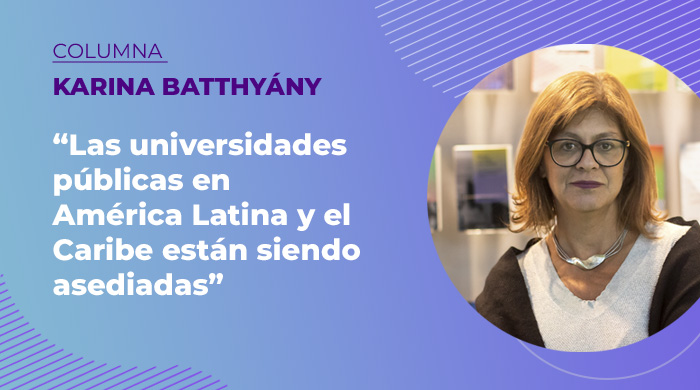
Transcript of Karina Batthyány's column
in InfoCLACSO – February 21, 2024
We are in Havana, Cuba, participating on behalf of CLACSO in Universidad 2024, a biennial event. Here, the focus is on higher education, particularly universities, as key players in its development. CLACSO is also participating in the CRES+5 sessions, the follow-up to the Regional Conference on Higher Education taking place in Brasilia, Brazil.
Within the framework of these events, CLACSO, together with its Member Centers in Cuba, has developed a forum on the challenges of higher education. The forum discusses higher education in terms of quality and relevance, but also the link between higher education and the major challenges of inequality in the Latin American and Caribbean region.
We are at a very complex moment for Latin America and the Caribbean, not only in Argentina, but also in other countries of the region. Public universities are being besieged in two worrying ways. One is the budgetary strangulation to which public higher education is subjected, which directly threatens the right to higher education in general for everyone throughout their lives.
The other issue is linked to academic freedom, a fundamental principle of universities. There is significant tension, with the closure of programs, particularly in the social sciences, and the direct persecution in many countries of colleagues and professors working in the social sciences: restrictions on freedom of expression and thought, which also influence research agendas and the production and creation of knowledge. Furthermore, this is compounded by a regional and global trend of commodification and privatization of higher education, which in many cases has become a business. Powerful economic actors are attempting to gain control of tertiary education.
From CLACSO, we developed the Forum “Higher Education and Social Transformation” together with the Member Centers of Cuba, but also with the participation of colleagues from all over the Latin American and Caribbean region, to raise the concern of higher education and what we can do through our Platform for Social Dialogue (PDS).
– Within the framework of this Forum, there was a panel focused on open science, understood as a logic of democratizing knowledge and social transformation as a central point in the discussion on the production and generation of knowledge…
Let us remember that CLACSO is a pioneer in advocating for absolutely unrestricted open access and the concept of open science. This means conceiving of science without any barriers, especially regarding the results of scientific development and knowledge. To this end, in 2019, CLACSO created the Latin American Forum on Scientific Evaluation (FOLEC), because this idea of open knowledge and open science is also related to knowledge evaluation processes. This is evident, for example, in the circulation of research results within academia, where there is (once again) a trend toward the commodification and privatization of knowledge by publishing industries that make a very profitable business out of its distribution. Furthermore, in Latin America and the Caribbean, 80 percent of research is funded with public funds, but its circulation and dissemination are then carried out through these publishing industries, which not only commodify the results but also create concrete barriers to open access to knowledge. In other words, anyone who wants to read or publicize their results encounters the commodification of these processes.
– Throughout this journey regarding higher education, being in Cuba and having a very powerful network of Cuban CLACSO Member Centers, there is an importance in the Cuban academic system for the logic of Our America and the different universities of the region…
– Of course. Cuba has always been an example for the entire region in education, in terms of development at all levels. At CLACSO, we are working to continue addressing the challenges that Cuba and other Latin American countries are currently facing, and to see what we can learn from the Cuban experience in terms of knowledge production and dissemination. Therefore, it is no coincidence that the CLACSO event at Universidad 2024 and the CLACSO panel are taking place in Havana.
If you would like to receive more information about CLACSO's training programs:
[widget id=”custom_html-57″]
to our email lists.

