
“Poverty rates in rural areas are up to two or three times higher than those in urban areas.”
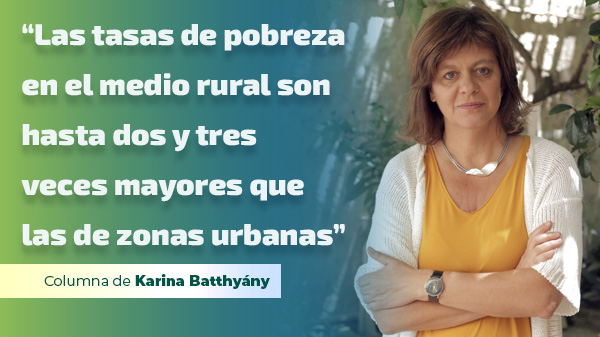
Transcript of Karina Batthyány's column
in InfoCLACSO – October 11, 2023
The international seminar “Rural Labor Markets, Inequalities, and Social Vulnerability in Latin America” is part of the broader project of the Platforms for Social Dialogue (PDS), as it addresses the crucial integration of knowledge, public policy, and social movements focused on resistance and struggle throughout Latin America and the Caribbean. This seminar connects several of our platforms that focus on inequality and poverty, the reshaping of the labor market, and issues related to gender and violence, which manifest themselves particularly in rural areas.
We are in a post-pandemic Latin American and Caribbean context, where we are experiencing the economic and social crisis left by the COVID-19 pandemic, which has had a significant impact on the region's labor markets. When we speak of labor markets, we are referring to those of a region where informality was already a pre-pandemic characteristic, a situation that has intensified in these post-pandemic societies. This crisis reveals structural elements of our region, but it also highlights certain inequalities, revealing the structural problems of poverty and inequality so characteristic of our region.
It also highlights the issue of informality in labor markets, particularly in rural areas, and the lack of social protection. Informality goes hand in hand with the complete absence of social protection. This means a lack of rights, the inability to access the healthcare system and the broader social welfare system, including retirement benefits and pensions.
Furthermore, the pandemic exacerbated labor market deficits, primarily related to decent work, which is characterized by formal employment. While this is a general problem in labor markets, it is far more pronounced in rural areas compared to urban markets.
In rural areas of Latin America and the Caribbean, more than 123 million people live today. Approximately 50 million of them work, either in paid employment or through some form of exchange. Therefore, in our region, rural employment supports one in five people.
According to figures from both the ILO and ECLAC, poverty rates in rural areas are 46%, with 22% living in extreme poverty. These rates are two to three times higher than in urban areas (depending on the specific country). Informality is a characteristic of our region, but it is even more pronounced in rural areas: approximately 76% of employed people in rural areas work informally and therefore lack social protection.
These are enormous challenges that compel us to action in the area of public policy related to social security: how to extend social security coverage to rural populations whose work is characterized by factors such as seasonality, temporary employment, a higher prevalence of self-employment, and family workers. We must discuss specific public policies geared toward rural environments that consider the needs, narratives, and challenges of workers in these rural production units, as well as strengthen existing local mechanisms in different territories to promote these policies and create decent working conditions in rural areas. It is crucial to involve the various rural, peasant, and Indigenous movements and organizations present in these territories; to work with them to make progress on these challenges.
In the case of women in rural areas, we must first consider the difficulties they face regarding caregiving and time management; often, productive and reproductive activities coexist in the same physical space. In rural areas, it is difficult to distinguish between productive and reproductive tasks. Surveys we have conducted in rural Latin America and the Caribbean show a ratio of one to three, meaning that women dedicate three times as much time to domestic and care work compared to men. This gap also exists in urban areas, but it is not as pronounced.
We need to bring the issue of women in rural areas to the forefront, because we also need to ask ourselves how these caregiving and domestic tasks contribute to rural societies. Let's not forget that this notion or paradigm of care societies, originating in Latin America and the Caribbean, is being discussed as a possible alternative to current societies. Indeed, there is a very important issue associated with what happens in rural and community settings, which are often two closely related dimensions due to their similarities in the transition between rural and urban areas.
Furthermore, in these rural areas, there is a family-based or family-run production system, where women's work is rendered invisible. For example, consider the agricultural sector: is it truly productive work or more related to reproduction? Often, women's participation is seen more as assistance than actual work, with all that this implies, and their contribution to the rural sector is underestimated.
Looking at all female employment in Latin America, 14% of women working in the export sector are employed in agriculture and livestock. This means we are not talking about a sector of little importance in the region's labor market.
Finally, from a feminist gender perspective, there is a dimension that concerns the role of women in the face of climate change. This includes not only their role as defenders of their territories and natural resources, but also how climate change is affecting them differently, along with the land and natural resources, and how in many cases they are responsible for providing these resources to their households.
In particular, peasant and indigenous women play a very important role when we talk about climate change and environmental issues, ensuring, among other things, food security in their homes and the protection of natural resources and adaptation to climate change.
I want to mention that in Latin America we have approximately 60 million women living in rural areas, but only 30% (one in three) own or have legal title to their land (this is not the case for men). Furthermore, only 5% of women receive technical assistance for rural production. In other words, we have a problem with land ownership and rural production sites, and with adapting to the consequences of climate change. We need to include the issue of women in rural areas in the broader discussion of public policies aimed at these areas, and particularly when we discuss climate change and the environment.
– I was thinking about the peasant women's movements in Argentina, which are waging a struggle based on resistance, like Berta Cáceres, a woman who was murdered for her fight against climate change in the countryside; and Francia Márquez, who spent her entire pregnancy working in a mine. You were talking about a sector very far removed from state support, without social security and without any real impact. I remembered certain figures from some elections in both the United States and Argentina, where some of the support for these new right-wing movements came from rural areas. How much does the lack of state presence sometimes end up leading to right-wing ideologies?
The discussion surrounding the role of the State, particularly in these seemingly more distant or less accessible places, influences certain behaviors. Above all, there's this feeling that the State is ultimately absent and that there are no public policies; the State's presence is not visible, and this gives rise to other types of discourse.
We must not forget the potential intersection between all the work done in the peasant and rural sectors and the nationalist question, since it is an expression of these new right-wing and far-right movements in Latin America and the Caribbean. Clearly, all these dimensions of inequality are interconnected, and we cannot analyze them in isolation.
In addition to mentioning Berta Cáceres and Francia Márquez, I also want to highlight the Mapuche struggle in Chile, where there is a strong leadership presence in the fight for the return of territories occupied by multinational corporations for renewable energy and other energy production, displacing the Mapuche people. Women's voices have been particularly prominent in this struggle. For example, at the recent conference we held in Norway, at the University of Bergen, where these issues were discussed between Europe and Latin America, a Mapuche leader clearly outlined the situation her community was facing. I mention this to add another voice to the growing list of women's voices and resistance movements in Latin America and the Caribbean.
– It's so difficult to get these issues into the media, and the influence of large agricultural and livestock companies is very strong in the media landscape, with extraordinary advertising campaigns…
– We know the reality of mass media in our region. That's why InfoCLACSO, from CLACSO, along with other communication and outreach tools, is so important to reach beyond the barriers imposed by the mainstream media.
The situation I described regarding the Mapuche people in Bergen, Norway, became very clear. It's not just the media blackout, but also actors linked to those Norwegian companies operating in Chile. First, they tried to prevent the aforementioned Mapuche leader from entering Europe by stopping her in Paris, and then, once she managed to enter, she was heard speaking about the control and the attempt to prevent her entry.
If you would like to receive more information about CLACSO's training programs:
[widget id=”custom_html-57″]
to our email lists.

