
“Platforms for Social Dialogue are a way of working collaboratively to build alternatives”
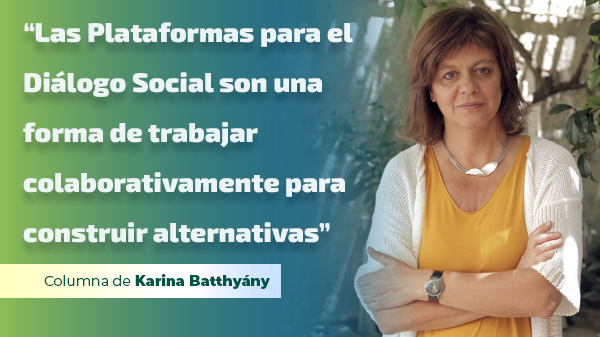
Transcript of Karina Batthyány's column
in InfoCLACSO – July 26, 2023
In this column, I want to take stock of this first year of development of the Platforms for Social Dialogue (PDS). We envisioned these platforms as mechanisms that articulate and promote exchanges among multiple actors from the academic community, civil society organizations, social movements, and public policy to produce knowledge, build capacity, recognize the power inherent in social activism, and, above all, to influence public policy. And more generally, to address the realities and the need for social transformation in our Latin American and Caribbean territories, particularly in those places and with those most vulnerable populations experiencing the most critical or dramatic situations.
These platforms are also essentially a way to work cooperatively and collaboratively. We designed them to work, collaborate, and foster exchanges, and to address the social issues we consider priorities. Furthermore, they aim to build alternatives and common regional agendas that have a concrete impact on improving the quality of life for the most marginalized sectors of our societies and those sectors that suffer various forms of violence, oppression, and discrimination. Ultimately, they suffer as a result of the inequalities that, unfortunately, have historically and structurally characterized us in Latin America and the Caribbean.
Each of these platforms has different components related to research, training, communication, and publications. As we move forward, the thematic emphases may be reinforced and varied. The specific locations where these platforms are developed also change, both geographically and in terms of their different structures and formats. These have been transforming and acquiring unique characteristics specific to the themes and territories with which we at CLACSO are working.
The eight themes are: Inequalities and Poverty; Migration and Human Mobility; Environment and Climate Change; Democracy, Human Rights, Memory and Peace; Rights, Gender and Violence; Social Movements; Education and Work. These themes are interconnected, because we cannot talk about inequalities and poverty without talking about democracy, gender issues, migration, or climate change.
On the specific page of the Platforms for Social Dialogue (www.clacso.org/platforms-for-social-dialogue/), you can find the activities of each one of them, the forums, the talks, the publications, the calls for research, among other proposals.
In the area of research, there was the call for proposals for the working groups that CLACSO regularly organizes. Many of these groups are organized around these platforms. Today, we have approximately 90 groups working very actively within CLACSO. Specifically, we are raising the need to generate specific knowledge about these Platforms for Social Dialogue, which are precisely the teams that bring together academia, social organizations, and public policy.
In the research calls we issued in 2023, this is a requirement for application; that is, the teams formed must include individuals from academia, social organizations, and public policy. Furthermore, in terms of research, this year has been fruitful in terms of forging alliances with various institutions that strengthen each research topic, achieving effective impact at the local, national, and regional levels. Building on our Platforms for Social Dialogue project (developed with support from Swedish Cooperation), we have invited other institutions with which CLACSO collaborates, as well as some new ones that have joined, all interested in working on these issues. This is to combine efforts and achieve greater impact through these platforms.
During this period, we have partnered with 23 institutions that have joined CLACSO to strengthen research on the various themes of the Platforms for Social Dialogue. Furthermore, eight research calls for proposals have been launched recently, six are currently underway, and seventeen have already been completed this year. These are significant numbers in terms of the opportunity to submit research proposals within the framework of these platforms.
In addition, there are training components, where I want to highlight very especially – besides the proposals for Diplomas, Seminars, Master's degrees and Specializations that CLACSO has – the postgraduate school workshops that are held every time we have a forum of the PDS in the different territories and regions of Latin America and the Caribbean.
This training program is truly having a significant impact. Those participating in these schools and workshops are people involved in social movements, social organizations, or public policy. We believe it's a genuine breeding ground for developing the potential to shape policies that move towards more just and equitable societies.
We also have the field of dissemination, where the work of CLACSO TV has been truly invaluable, as well as that of the other channels CLACSO has on its networks: there have been over a thousand broadcasts this year with more than ten thousand posts on social media that have generated thousands upon thousands of interactions; in other words, they are not just simple publications. These are posts where there is genuine interaction with those who are reading the content.
Today, in terms of reach, we have close to 42 million users with these posts linked to the Platforms for Social Dialogue. This number in itself demonstrates the importance of these PDS campaigns, in addition to the articles on the CLACSO website (https://www.clacso.org/).
I want to mention that in 2023 we have carried out 400 activities within the framework of the Platforms for Social Dialogue. Some of these were in person and others virtual, related to different countries or regions of Latin America and the Caribbean.
In 2023, we selected over 150 projects implemented within the framework of the PDS (Programs for Sustainable Development), involving more than 420 researchers; a third of whom are young researchers. Furthermore, over 50 organizations and social movements participated in the PDS activities, collaborating at various stages of the research teams and also taking part in forums held in different countries across Latin America and the Caribbean.
There is also the chapter linked to publications, in open access and without any restrictions, like everything published by CLACSO, available in our library at the Latin American and Caribbean Social Sciences Bookstore (https://libreria.clacso.org/Today, we have over 800 publications this year alone. These have had over 2.300.000 downloads in a year, involving more than a thousand authors.
Another important fact: of these authors, two-thirds are women and one-third are men who have contributed to our Platforms for Social Dialogue this year. Also worth mentioning is their work at book fairs, both internationally and regionally.
Through our various training programs, both online and in person, including workshops and graduate schools, we have reached 6,000 students in 36 countries this year. These results demonstrate the impact of our more than one hundred training programs at different levels, such as master's degrees, specializations, diplomas, seminars, workshops, and schools, all of which are linked to the themes of the Platforms for Social Dialogue.
I want to remind everyone that our Social Dialogue Platforms (PDS) were launched at our Conference in Mexico in June 2022. Once the ninth Conference concluded, work began on developing the Platforms for Social Dialogue. In 2023 alone, we issued calls for research on key topics such as Poverty and Inequalities, emphasizing multidimensionality; Environment, Climate Change, and Good Living; Political Economy and Inequalities, considering neoliberal cycles and the leftward shift in Latin America and the Caribbean; and Democracy, Human Rights, and Peace.
But, in addition, new calls for proposals are coming in the areas of Migration; Environment and Climate Change; and Gender Inequalities and Violence.
Therefore, I invite everyone to closely follow the activities of our PDS, that is, to actively participate in these platforms. Also, please pay close attention to CLACSO's communication channels on social media and CLACSO TV, among other platforms.
If you would like to receive more information about CLACSO's training programs:
[widget id=”custom_html-57″]
to our email lists.

