
Women and the destiny of Brazil

Magdalena León T.[1]
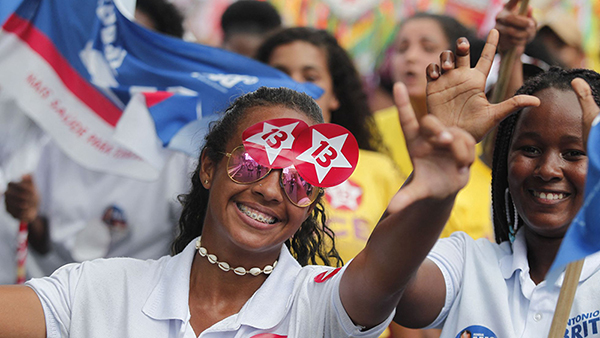
In the context of the Brazilian presidential elections, one of the data points circulating as relevant and even decisive for the results of the first round is the majority proportion of female voters, which reaches 52,65% of the electorate.
It has also been noted that this majority of voters shows, according to various polls, a distinct profile in their voting intentions, as they lean more towards Lula and show a higher rejection of Bolsonaro.
This majority contrasts sharply with their underrepresentation in political power: in 2018, only 7% of senators and 15% of federal deputies were elected. A law has been in effect since 2009 establishing a minimum of 30% and a maximum of 70% of candidacies for both men and women, but progress has been very slow, as this election barely exceeds that minimum (33,3%).
Alongside these stark figures lies the political trajectory of Brazilian women, a trajectory that encompasses diverse dimensions and demonstrates a prominence that extends far beyond the electoral sphere, but which will undoubtedly be decisive this Sunday. This prominence is grounded in their struggles to defend and expand democracy, to win rights; it is rooted in their work to create better living conditions for the entire population, in their pursuit of structural transformations for a country that ranks among the ten most unequal in the world.
New ways of doing politics and new forms of leadership have been developed by women in their process of building change and resisting neoliberalism and neoconservatism. Within the context of advances and setbacks experienced by governments throughout this century, the transformation of the political system has faced significant setbacks in recent years. Several key moments stand out in this difficult journey.
One of these events involved the right wing's reaction to Brazil's first elected female president, Dilma Rousseff. The patriarchal dimensions of a male-dominated political power were unleashed during the impeachment process she faced in 2016, which was entirely unfounded. The mobilized women defended democracy and supported the legitimate power of a woman identified with their causes, while a majority of men in the Senate decided on her removal, mocking the institutions and displaying grotesque sexism.
Already in the phase of direct attack on democracy in the following years, the levels of violence that the exercise of this form of power acquires were expressed in the assassination of councilwoman Marielle Franco in 2018. This was not an isolated event, but the expression of the systematic attack on these new forms of leadership: "andMarielle's leadership expresses the distinct nature of women's political activism, which, in diverse spheres, champions a commitment to life and to the conditions for its continuation, inseparable from radical transformations. From this profoundly political commitment to life, Brazilian women have spearheaded mobilizations and acts of resistance (…) shaping a kind of counter-power that challenges the violent, armed, and patriarchal power of right-wing forces that attack life in various ways to sustain and deepen a predatory capitalism. This is why these leaders are now considered 'dangerous,' why the threat of political femicide now looms.[2].
The 'No' campaign, spearheaded by the women's movement in the 2018 elections, raised awareness of the dangers looming over Brazil at that time, the consequences of which are still felt by the majority of the population today. But it was also in that year that worrying signs of a rightward shift among certain sectors of women came to light. A "A new group of 'right-wing women' has emerged, primarily from the middle, upper-middle, and elite classes. They are young, between 20 and 30 years old, with no children or young children. They generally hold university degrees in various fields and work in the formal labor market in a wide range of liberal professions. They are financially independent women who have built their image and discourse around the concept of empowerment and individual gain, in line with the American 'Lean In' movement. Their main claim is that they don't need to 'whin'. They are staunchly critical of the 'discourse of women's victimhood' (…) Their motto is 'I am a woman, but I am not a feminist'”[3]
Navigating the pandemic crisis, exacerbated by the Bolsonaro government, whose administration has demonstrated hatred towards women, has had such implications that it is perceived that life itself is at stake should this nefarious government continue.[4]The deployment of necropolitics ranged from Covid denial to the promotion of armed violence.[5], including budget cuts or under-execution for education, health, prevention of gender violence, among others, and the deliberate environmental destruction in the Amazon.
As has happened all over the world, during the pandemic women's work intensified but under more precarious conditions[6]This exacerbates an already critical situation caused by the dismantling of redistributive and social protection policies. Therefore, the women's mobilizations in this 2022 campaign emphasize the urgency of reconstruction of a devastated country and democracy, in the need to place life at the center of politics[7].
For its part, Lula's candidacy, facing this reality, has indicated that economic recovery will begin with women. It envisions job creation, equal pay policies, prioritizing female heads of household in various social protection programs, expanding the care network at all levels, and renegotiating debts.[8].
For women, this is a phase of reconstruction with a horizon of equality. As Nalu Faria says, “We cannot conceive of equality if it is not for everyone. This means envisioning a comprehensive transformation of this model, breaking with the material foundations upon which oppressive and unequal relations are organized in society.”[9].
[1] Researcher at the Latin American Faculty of Social Sciences, Ecuador. Member of the CLACSO Working Group on Feminisms, Resistances and Emancipation. Article written on 29/9/2022.
[2] Manifesto 'Justice for Marielle Franco, a popular leader of our time', CLACSO Working Group on Feminisms, Resistance and Emancipation, March 2018
[3] https://www.academia.edu/40062926/Informe_sobre_las_elecciones_presidenciales_de_Brasil_2018
[4] https://www.sof.org.br/disputa-eleitoral-a-vida-das-mulheres-esta-em-jogo-e-nos-vamos-defende-la/
[5] (Civilian gun ownership has increased by more than 400%)
[6] https://www.sof.org.br/acesse-pesquisa-trabalho-e-vida-mulheres-brasileiras-pandemia/
[7] https://www.marchamundialdasmulheres.org.br/wp-content/uploads/2022/07/2907-Panfleto-Convocato%cc%81ria1308.pdf
[8] https://pt.org.br/para-lula-a-recuperacao-economica-comeca-pelas-mulheres/
[9] https://www.brasildefato.com.br/2022/08/12/mulheres-vao-as-ruas-neste-sabado-por-democracia-e-para-colocar-igualdade-em-pauta-nas-eleicoes

