
“Women are on the front lines of those affected by the climate crisis”
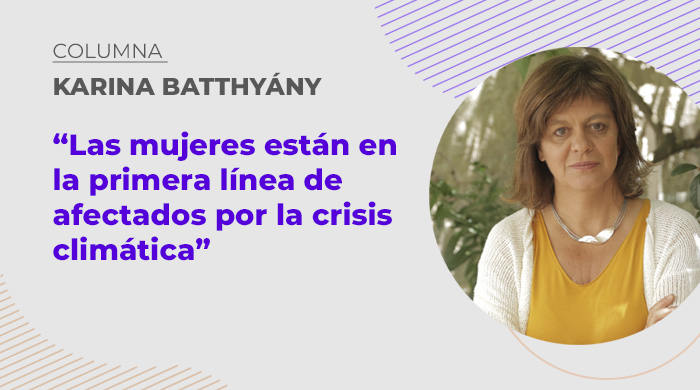
Transcript of Karina Batthyány's column
in InfoCLACSO – March 19, 2025
In this third InfoCLACSO program within the framework of March, Women's Month 2025, we continue to cover the different themes that make up the struggles, with advances and setbacks, of women in the world and in particular in our region, in Our America.
Today we will also delve deeper into three central themes surrounding the Platforms for Social Dialogue that we will promote at our #CLACSO2025 Conference: “Rights, violence and gender equality”, “Environment, climate change and social development”, and “Migration and human mobility”.
In the first section, we address two important issues within feminist studies: the rights of women and gender minorities, and the lack of opportunities in all areas of life and society. When we talk about gender equality, we must consider gender-based violence, one of the most central and serious problems in Latin America and the Caribbean.
According to approximate data, in Central America, one in four women between the ages of 15 and 49 has experienced violence in their lifetime. This alarming figure is not uniform across the region. The situation in Central America is worrying and brutal. When we introduce other variables, we find that violence against women affects different groups of women in distinct ways.
The situation in Central America is worrying and, to a greater or lesser extent, is replicated in other countries of Latin America, both in the form of violence against women and in the abandonment of specific policies. The most alarming case in recent months is that of Javier Milei's Argentina, which defunded, dismantled, and gutted policies aimed at preventing, assisting, and protecting women and LGBTQ+ people experiencing violence. Furthermore, the aforementioned figures are even more alarming for Indigenous women, Afro-descendant women, rural women, women with disabilities, and women belonging to LGBTQ+ communities.
At the closing of the International Colloquium “Social Sciences and Violence in Central America: Between Sieges and Resistance,” held last December in Guatemala City, the CLACSO Working Groups “Violence in Central America,” “Feminisms, Resistance, and Emancipation,” and “Ruralities and Political Transitions in Central America and Colombia” issued a statement warning of alarming signs of authoritarianism in the region. They also pointed out that this violence disproportionately affects girls, adolescents, and women subjected to sexual violence, as evidenced by the thousands of cases of abuse, rape, and forced pregnancies that limit their life plans. Social, economic, and political inequalities continue to affect them, and despite some legal advances, their lives remain marked by exclusion, racism, and violence in various spaces, including academia, along migration routes, in homes, workplaces, on the streets, in the media, and in the digital world.
Environment, climate change and social development
At the intersection of feminism and environmental issues, we find emerging points of convergence in terms of knowledge production and public policy proposals. The implications of global climate change are now undeniable and include, among other things, the progressive degradation of environmental conditions, the acceleration of extinction rates, and a very severe impact on the conditions for the reproduction of human (and non-human) life.
According to United Nations reports, the climate crisis does not affect everyone equally. Women and girls face disproportionate impacts from environmental degradation (primarily because they make up the majority of the world's population living in poverty) and their livelihoods are heavily dependent on the natural resources available in their local environment.
It is estimated that four out of every five people displaced by the impacts of climate change are women and girls. Severe disasters can also disrupt essential services, such as sexual and reproductive health care, further exacerbating the harm to women and girls.
The UN also maintains that women are driving the most significant climate solutions at all levels: as farmers, workers, consumers, household managers, activists, leaders, and entrepreneurs. Especially in rural areas, women and girls are often responsible for obtaining food, water, and firewood for their families. During droughts and periods of irregular rainfall, they perform more arduous work, walk longer distances, and dedicate more time to ensuring their families have income and resources. This situation can also expose them to increased risks of gender-based violence, as climate change intensifies existing conflicts, inequalities, and vulnerabilities. Because they are on the front lines of the climate crisis, women are well-positioned to be agents of change and help find different ways to mitigate the causes of global warming and adapt to its impacts on the ground, in their communities, and in their daily lives.
Indigenous women have always been at the forefront of environmental conservation. They contribute their ancestral knowledge and practices, for example, by preserving crop biodiversity and seed varieties, protecting pollinators and local bee populations, using natural methods of fertilization and soil formation, and leaving forests undisturbed.
However, women have less access to a range of resources, from land rights and credit to education and technology. The United Nations believes that if women had the same access to productive resources as men, agricultural yields could increase by 20 to 30 percent, feeding an additional 100 to 150 million people. This would reduce the pressure to clear forests for agriculture, a major driver of climate change. Globally, more than half of deforestation is due to the conversion of forests into farmland.
Migration and human mobility
Over the years, in Latin America and the Caribbean, the number of women and girls migrating has remained practically equal to that of men. However, in addition to the challenges faced by all migrants, women must also contend with the obstacles presented by the gender gap.
While historically migration patterns were determined by the movement of men in search of work, who sent remittances to their families who remained in the country of origin, more and more women are migrating independently in search of work, as heads of households and also as a consequence of the different manifestations of gender inequality and violence, as occurs in countries with high rates of femicide.
During transit and in host communities, women, adolescents, and girls frequently use unsafe routes where their rights are compromised by the lack of basic services such as healthcare, sexual and reproductive health, education, and care. Desolate or heavily militarized migration routes and the absence of institutional presence make women, adolescents, and girls more vulnerable to human trafficking for sexual exploitation, violence, and enforced disappearance. They thus suffer the double discrimination of being both a migrant and a woman, both on the long journey to a new destination and in host countries.
If you would like to receive more information about CLACSO's training programs:
[widget id=”custom_html-57″]
to our email lists.

