
The mobilizations in Latin America are debating the meaning of democracy.
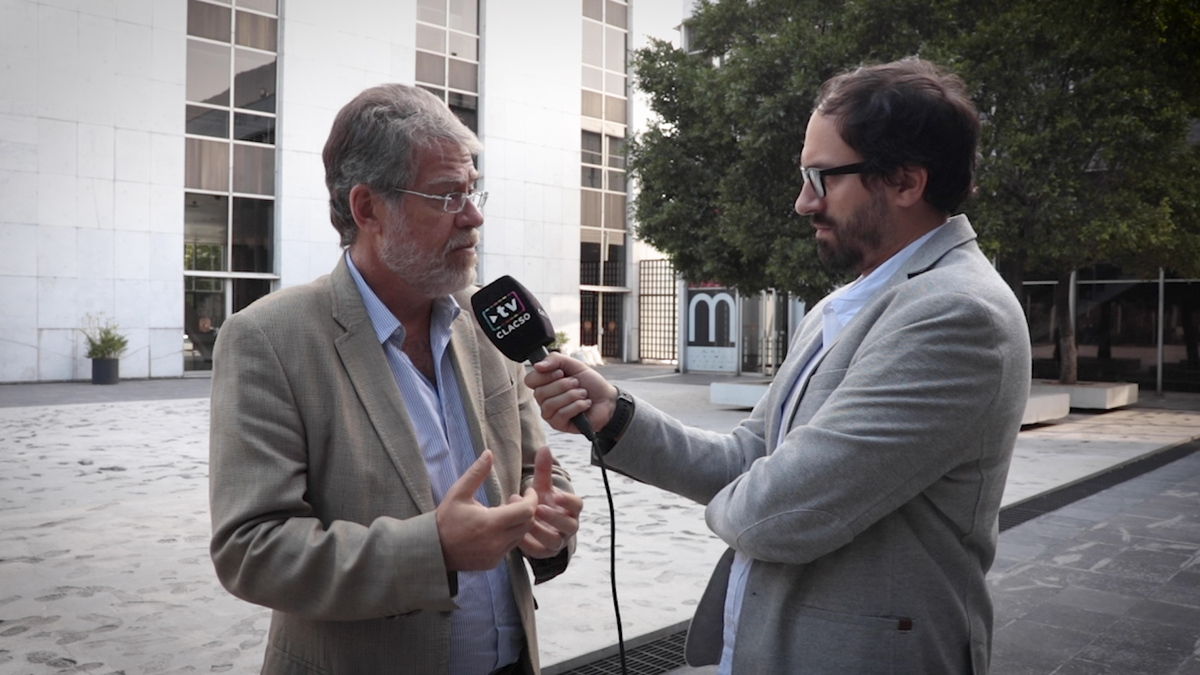
Argentine philosopher Ricardo Forster was one of the participants in the Conversation “Neoliberal Authoritarianism or Democratizing Democracy?: The Dispute for the Future in Latin America”, organized in Mexico in February by CLACSO and the “University Program of Studies on Democracy, Justice and Society” (PUEDJS-UNAM).
Forster, a member of President Alberto Fernández's Advisory Council, spoke to CLACSO TV.
Interviewed by Gustavo Lema
Forster believes that “democracy is inherently linked to politics. And politics is that which has not yet been fully resolved within society: it is evidence of a conflict related to equality, to justice, to a number of things, but which basically places at the center of democracy the dispute and the conflict that are part of its ongoing recreation. If democracy is fixed once and for all, if it is built on the logic of the mythical or the sacrosanct, it becomes something untouchable, unmodifiable, unrecreated. And therefore, the sovereign, the people, are an absolutely passive subject who every two or four years cast a vote and supposedly exercise their democratic right. But that democracy is one fixed on ahistorical and immutable principles. I believe that the experience of what was contested in Latin America, especially in the first two decades of this century, was precisely the need to place democracy within a conflict, which in Latin America is the conflict or dispute over equality.”
Then he asked: “What kind of democracy are we talking about when all the factors that organize the life of societies are placed at the service of an unjust, unequal, predatory system? Because it not only destroys people's lives, but it also destroys the life of the planet. Therefore, it seems to me that the great challenge of democratic, popular, and transformative projects is to address all these issues transversally so that democracy becomes a movement, a recreation, a vital force that knows how to persistently process conflict and not suppress it.”
He also argued that “for thirty years, neoliberalism managed to convince a large part of society that democracy as it existed was the culmination of a trajectory also linked to the global economy… Now, political experiences of mobilization are increasingly challenging the meaning of democracy, and this is also a major challenge for progressive governments.” He concluded: “There is no such thing as irreversible. It’s a politically ineffective slogan, but also extremely dangerous, because it can lead to complacency. I ask: if a right is already irreversible, why defend it?”
If you would like to receive more information about CLACSO's training programs:
[widget id=”custom_html-57″]
to our email lists.

