
“The measures taken by the Argentine government are functional to the commodification of higher education.”
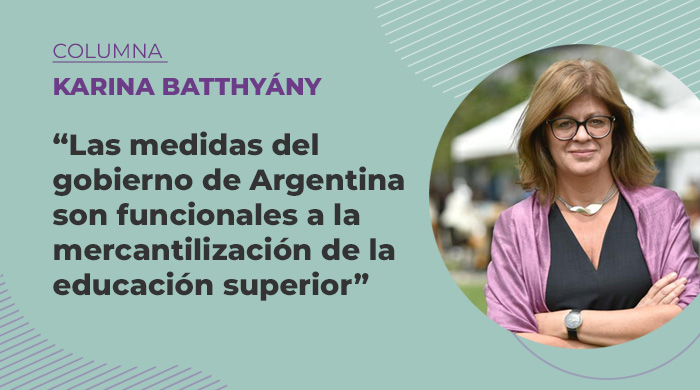
Transcript of Karina Batthyány's column
in InfoCLACSO – October 16, 2024
Talking about care issues means talking about one of the critical knots of social and gender inequalities in our countries, and the topic has a triple component: the analysis of knowledge production in different countries; how the issue of care has become central to public agendas; and the elaboration, implementation, and development of care policies or systems.
In relation to this topic, I was participating in an event in São Paulo, Brazil, related to the definitions and policies of care for Latin America and the Caribbean, organized by MECILA, one of the consortia of German and Latin American universities that have been promoting different activities of production and dissemination of knowledge around conviviality and inequality.
Academic freedom and critical thinking
The Coalition for Academic Freedom in the Americas (CLLA) and CLACSO have made progress in a new cooperation agreement around a research call on strengthening comparative research and critical thinking within the framework of academic freedom in the Americas.
Academic freedom is a central theme for the activities that we have always promoted and developed at CLACSO as the main academic network of social sciences, humanities and arts in Latin America and the Caribbean.
In this sense, it is important to ask ourselves why we are talking about academic freedom, not in terms of privilege but as a fundamental right. This is particularly important for those of us dedicated to academic life, but also for society as a whole.
We cannot have the discussion about how to move towards more just, equitable and democratic societies without guaranteeing that academic freedom, because guaranteeing academic freedom means guaranteeing the development of knowledge free from all kinds of political, economic or any other kind of pressure.
So, what do we mean by academic freedom? Of course, there are many definitions, but basically we can say that it is the right that academics, researchers, teachers, and students have to teach, research, and express their ideas without any fear of reprisals of any kind, censorship, or external interference with academic and research freedom.
Furthermore, it substantively and fundamentally includes the autonomy of academic institutions in every sense, but primarily the autonomy to establish their own research agendas and curricula independently of ideological, religious, governmental, political, and economic pressures. Let us consider the term "academic freedom" in contemporary Latin America, particularly what is happening in Argentina regarding the student movement, the defense of public universities, and their funding.
The university reforms of the 20th century, marked by the Córdoba University Reform in Argentina, established the foundations for university autonomy and academic freedom. In recent years, we have witnessed various attacks and threats against these principles in several countries of the region.
It is absolutely essential to defend this academic freedom so that universities, especially public universities, continue to be spaces for the critical production of knowledge capable of engaging with the demands, needs, and social reality of our countries.
Today, we face several challenges to academic freedom in Latin America and the Caribbean, ranging from direct political interference to more subtle forms of financial cuts to public universities. Restricting research funding, for example, curtails the ability to produce independent knowledge, particularly in critical areas such as social sciences, human rights, gender, environmental issues, and social inequalities.
Furthermore, this creates a situation of dependence on external funding, that is, the search for resources outside of public funding, which in many cases conditions the definition of research agendas and restricts that academic freedom.
In turn, we observe political interference, censorship, and university closures, where governments intervene directly in university life, imposing their authorities in the control of the allocation of professors or censoring lines of research that are inconvenient for their political interests.
We find phenomena more directly associated with the violence and persecution of people who dedicate themselves to academic life, that is, violence against academics, which, although not a new phenomenon in our region, continues to be a very serious problem: there are teachers, researchers and students who are direct targets of attacks, threats and imprisonment.
At CLACSO, we make visible and recognize the problem of academic freedom as a collective challenge that must involve the entire academic community at the regional and international level.
Based on this principle, among other things, we have signed new agreements to strengthen our work in defense of academic freedom. Our CLACSO network of networks in the social sciences, humanities, and arts, which now includes almost 1000 research centers and universities in Latin America and the Caribbean, is promoting critical analysis of these new forms of threat to academic freedom and seeking solutions for the specific cases we face in the region.
The principle of academic freedom is an essential and fundamental right for the development of more democratic, just, egalitarian and equitable societies, with the strengthening of solidarity networks, spaces for dialogue that allow visibility, denunciation and the construction of alternatives in different countries.
– In Argentina, in recent days, Milei's veto of the university budget increase was ratified. The statement from the CLACSO Argentina Member Centers, which reads "public universities continue to resist," reflects this. We are experiencing very dynamic times surrounding the multitude of universities and faculties that, in 100 years, have never before been occupied by students, education workers, and professors in the face of such a serious situation. How do you interpret what is happening in Argentina within the context of the defunding of public universities?
– The current situation in Argentina is one of the most conflictive examples of the budgetary strangulation that public universities are suffering and all that it represents in terms of academic freedom, the impossibility of the development of the university functions themselves of teaching, research, extension and the coercion of the rights to higher education of very broad sectors of the population with respect to public university education.
Academic freedom is linked to the challenges facing higher education in Latin America and the Caribbean in the face of the commodification and business interests that underpin university education. The measures being taken by the current Argentine government are functional to the advancement of privatization and the commodification of public higher education.
Of course, our CLACSO Argentina Member Centers have spoken out, and all of CLACSO supports the struggle that public universities are currently waging with the occupations in defense of that basic right to higher education, essential for the democratic development of any society, which public universities represent in our countries. Argentina is not the only country in our region experiencing defunding of public universities, but it is currently in a more dramatic situation.
Feminisms Network in the province of Buenos Aires
CLACSO was present at the Feminisms Network meeting to celebrate the agreement with the government of the Province of Buenos Aires, particularly with the Ministry of Gender and Diversity of the province, and to generate strategic reflections on feminisms and public agendas of gender equality.
Today, Argentina as a country is regressing in terms of gender equality, but not the province of Buenos Aires. Therefore, we are fostering a space for debate focused on how to strengthen strategic thinking for the development of gender policies at the provincial and national levels in the coming years. We seek to place the feminist rights agenda back at the center of discussion. The idea is to strengthen the feminist movement's network with government bodies in the Province of Buenos Aires and to incorporate the critical reflections of Latin American feminists.
If you would like to receive more information about CLACSO's training programs:
[widget id=”custom_html-57″]
to our email lists.

