
The Matildas, our national team
Jorge Knijnik [1]
In the last week of May, on the eve of the Women's World Cup in France, the Australian football world was shaken once again: Football Federation Australia (FFA) issued an official statement clarifying that the dismissal of the women's national team coach, Alen Stajcic, during the World Cup year, was based solely on a board decision and that he had always behaved professionally, never committing any wrongdoing that would justify his dismissal. Within this statement, Heather Reid—FFA Vice President and a member of the board—issued a personal statement in which she deeply apologized for the malicious insinuations she had made at the time of Stajcic's dismissal in early February 2019. By retracting all her statements, [2] Reid also apologized to the coach, his wife, and children for the stress she had caused the family.
These public demonstrations were absolutely necessary to extinguish a fire that had been smoldering since that February, with Stajcic's resignation. Known as a strict coach, but with good relationships with the players, Stajcic had led the "Matildas" since 2014. During this period, the team's technical rise transformed them into the most beloved national team in recent years on the competitive Australian sports scene: the Matildas' "stardom" [3] was consolidated after their undefeated conquest of the "Tournament of Nations," a friendly tournament held in 2017 in the United States when, in addition to thrashing Brazil 6-1, the Matildas defeated the hosts for the first time in history (1-0) and also beat Japan 4-2.
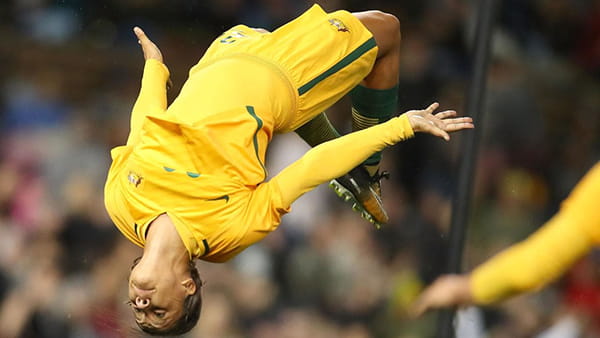
Since then, the Matildas have been the talk of the town: bets on a World Cup title in France increased even further when the Brazilian team came to Australia for a series of three friendlies at the end of 2017. Always playing to packed stadiums, the Matildas dominated Marta's team, with some players even getting into fights. The new Matildas jerseys released by the federation sold out in stores within days, including the men's versions. The Australian media and Australians in general campaigned heavily for the team's star striker, Samantha Kerr, who celebrates her goals with acrobatic jumps, to win the FIFA Ballon d'Or, and were greatly disappointed when Brazil's Marta took the award again.
Thus, Stajcic's resignation in early February caused a media firestorm and an explosion of discontent among Matildas fans and the Australian sporting world. This storm was intensified by the lack of justification for this dramatic decision in the year of the World Cup, with many lamenting the damage done to a team that had everything it needed to be champions. The successive press conferences called by the FFA only increased the furor, because since the reasons for the resignation were never made clear, many things remained unanswered, and rumors of problems such as sexual harassment, issues related to the players' homosexuality, and a possible "lesbian mafia" controlling the team only intensified when Reid—who had just started as vice president of the FFA—disseminated comments through social media and influential journalists in which he said that "if everyone knew what I know, Stajcic would never work in women's football again." Many journalists bought into this narrative, and without evidence—or at least without making it public—embarked on a campaign that truly left the coach reeling in terms of his professional and personal reputation. To make matters worse, alleged results from an online opinion poll conducted among the Matildas' athletes and staff seemed to confirm serious issues of gender-based abuse in Stajcic's management of the Matildas. On the other hand, several leading athletes on the team publicly expressed their respect and admiration for the coach through their social media accounts. In short, an embroilment that will apparently now come to an end, thanks to these statements from the FFA and Reid, which are certainly part of a legal agreement between the federation and the former Matildas coach, who has already been hired to coach a men's team in the Australian first division. However, many are commenting in the media and on social networks that Reid's apologies should have been accompanied by his resignation. We'll see how things develop, but I particularly doubt that will happen. Should his health problems, which led to his temporary leave of absence, improve, I am sure he will be seen in the VIP boxes at the World Cup in France, with his expenses paid by the FFA.
In 1994, the Australian women's team qualified for the Women's World Cup held in Sweden the following year. Thus, in February 1995, a group of players vying for a spot on the team played a preliminary match to a friendly between the Socceroos (the men's national team) and Colombia at Sydney Football Stadium. In the official program, the women's team was referred to as the "Women's Socceroos." After the game, SBS (one of Australia's largest public television channels) launched a poll among its viewers to choose a nickname for the women's team. In May 1995, the name "Matildas" was announced as the winner. Despite initial resistance, the nickname caught on, and since the 1995 World Cup, the Matildas have competed regularly at the international level.
Waltzing Matilda is a popular Australian folk song. Many consider it Australia's second national anthem and sing it enthusiastically on National Day after a few drinks. The song tells the story of a mythological Australian character, the "swagman," who wanders the country looking for work, wearing his straw hat and carrying his few clothes and belongings in a small basket—the muggle was affectionately nicknamed "Matilda." Waltzing Matilda, then, means traveling the country like a swagman , with his muggle on his shoulder, looking for work.
Many Matildas are still in this situation, selling their skills across Australia and around the world. When the short W-League season (Australia's premier women's competition) ends in the Australian summer (when they play at midday in temperatures of 40°C or higher, under temporary contracts with lower pay), they travel to the United States or Europe to play in seasons there; or they stay in Australia, now playing for second-division teams. One way or another, the Matildas are warriors: a few years ago, they fought against the Australian federation, going on strike to demand equal pay to the Socceroos, which forced the federation to cancel the team's participation in an international tournament in the United States on the eve of the competition.
As their recent results have shown, they are also warriors on the field. Constantly improving as footballers and as a team, with a growing social awareness, the Matildas have everything they need to shine in upcoming international competitions. Since all indications are that Marta and the Brazilian National Team won't go far in this World Cup, I'm already preparing my rallying cry for France 2019: #GoMatildas.
[1] Lecturer at Western Sydney University (Australia), where he is Deputy Director of the Centre for Educational Research (CER) and a research fellow at the Institute for Culture and Society (ICS). He recently published * The World Cup Chronicles: 31 Days That Rocked Brazil* (Fair Play) and *Embodied Masculinities in Global Sport* (Fit). Born in Porto Alegre, Brazil, he earned his PhD in Social Psychology from the University of São Paulo. He can be contacted on Twitter as @JorgeKni. Email: [email protected]
[2] Reid's words were pure poison, strong insinuations that there was sexual harassment and persecution of lesbian players by the coaching staff. These words truly shook the coach and his family, including his two young children.
[3] All Australian national teams have a nickname: the women in soccer are the Matildas, the men are the “Socceroos”; in netball the women are the “Diamonds”, in Rugby the men are the “Wallabies” while in basketball the women are the “Opals” and so on.

