
Masculinities between the personal and the political
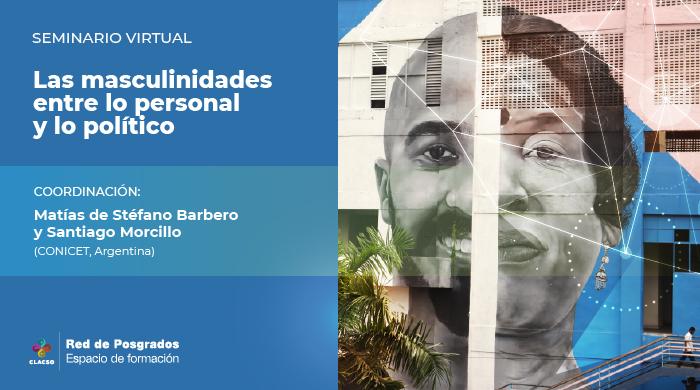
Seminar 2255
ChairCLACSO
Coordination: Matías de Stéfano Barbero and Santiago Morcillo (CONICET, Argentina)
Teaching team: Luciano Fabbri (National University of Rosario, Argentina), Daniel Eduardo Jones, Matías de Stéfano Barbero and Santiago Morcillo (CONICET, Argentina)
Start date : 27/07/2022 | Registration : 02/05/2022 to 26/07/2022
Workload: 12 weeks – 90 hours.
Feminisms have prompted the world to reflect on gender and the links between the personal and the political. However, the necessarily relational perspective that this reflection and the associated transformative practices demand are often overlooked. This seminar proposes to refocus attention on the role of men and masculinities. To this end, we will address both the seminal works in men's studies, from which the now much-discussed notion of "hegemonic masculinity" originates, and the set of critiques and questions they provoked, both globally and especially in Latin America. This approach to theoretical notions and their debates prepares us to work on the fundamental points that, traversing the personal and the political, connect masculinities in their relationships and tensions with the fields of emotions, sexualities, vulnerabilities and power, violence, and health. Finally, we propose to analyze two key links: on the one hand, the relationships between men and feminisms, their points of rupture, and historical transformations; On the other hand, we must examine the involvement of men in the masculinist (anti-feminist) backlash, both in its origins and its current manifestations. This exploration of the main issues affecting masculinities will allow us to develop an approach that considers men in all their complexity and to recover or strengthen the relational nature of the gender perspective.
Since its emergence in the mid-20th century, the category of gender has proven to be one of the main conceptual tools for denaturalizing and critically analyzing social structure, and for questioning the various ways in which inequality and violence are distributed asymmetrically in our societies. However, as several authors, such as Joan Scott, have pointed out, the approach to gender relations often takes a reductionist form that posits the equivalence between “gender” and “woman.”
While the place of men and masculinities in society and their implication in inequality and violence has been questioned since the beginnings of the feminist movement globally, it wasn't until the emergence of masculinity studies in the 1970s that different theoretical perspectives on the issue began to consolidate. From its inception, masculinity—in the singular—has been problematized. Some approaches began with a view that constructed a linear and individualizing causality in relation to power; however, it has proven to be a dynamic concept for analyzing the production and distribution of inequalities in the gender structure. Today, in the context of the so-called "fourth wave" of feminism, which presents new challenges and questions for men, the concept of masculinities has reached sufficient levels of visibility and critical analysis to transcend the academic and activist spheres, permeating different sectors and influencing the Argentine political and social agenda.
In this seminar, we propose to introduce the theoretical foundations and political possibilities of the concept of masculinity as a critical tool for analyzing and transforming gender relations, while also examining the main critiques and developments from an intersectional perspective. The program's structure involves a progression of content, with each class building upon and expanding the previous one. Following the theoretical discussion of the concept of masculinity, masculinities, and "hegemonic masculinity," we propose the analysis of thematic units, articulating theory and empirical research, with a journey that traverses the personal and the political. On the one hand, these thematic units allow us to explore fundamental dimensions for understanding the links between masculinities and emotions, sexuality, health, violence, and power. Furthermore, both the theoretical approach and the thematic units prepare and enable us to raise and discuss two current issues that function as opposing forces: feminisms and masculinism. In other words, we will address both the relationships (and tensions) between men and feminist movements, as well as men's responses and positions regarding masculinist (or anti-feminist) currents. Finally, a fundamental element of our proposal is the active participation of students; therefore, throughout the seminar, we will seek to foster reflection in spaces for debate and through special activities, thus stimulating a deeper understanding of the concepts and their sociopolitical implications through dialogue and peer exchange.
Objective
- Identify the different conceptualizations, their possibilities and limitations, and the debates in the field of masculinity studies.
Specific objectives
- To know and use the theoretical tools that enable the analysis and intervention actions in this field, considering gender and masculinity as relational concepts.
- To critically contextualize the Anglo-Saxon origins of masculinity studies and to recognize the specificities and tensions that ethnographic work from the global south has contributed to the field of study.
- To analyze the conception of hegemonic masculinity in its links with emotions and health, and in the relationships between homosociality, homophobia and sexuality.
- To analyze how violence is presented and articulated in the production of masculinity and the regulation of hierarchical relationships at the inter and intragender level.
- To critically explore the tensions, resistances, and emerging challenges that the feminist advance in our region presents for cisgender and heterosexual men.
- Current debates in masculinity studies
- Masculinities in the South
- The role of emotions in the construction of masculinity
- Desire and sexuality, between homosociality and homophobia
- Health between risk and performance
- Masculinities and violence
- Masculinity, violence and gender in men who perpetrated violence against women in their relationships
- Obstacles and cis-male resistance to the processes of depatriarchalization of organizations
- The antifeminist backlash: the defense of “men’s and fathers’ rights” and other “angry men”
- Introduction to masculinity studies
- Connell, R. (2015) From Northern to Southern perspectives in masculinity studies. In Gender Seriously. UNAM, Mexico.
- Connell, RW (2003) “The social organization of masculinity”, in RW Connell (2003) Masculinities, pp. 103-132. Mexico City: PUEG-UNAM.
- Connell, RW and Messerschmidt, JW (2022) “Hegemonic masculinity: rethinking the concept”, RELIES, in press.
- De Keijzer, Benno (1998) “Masculinity as a risk factor”.
- De Stéfano Barbero, Matías (2017) “Becoming a man in the classroom: the intersection between masculinity, homophobia and school bullying”, Cadernos Pagu nº 50. ISSN 1809-4449.
- De Stéfano Barbero, Matías. (2021) “When the violence exploded it was because I was not valued”: recognition, dependencies, (im)balances and breakdowns”. In (im)possible Masculinities. Violence and gender, between power and vulnerability, pp. 343-398. Buenos Aires: Galerna.
- Fabbri, L. (2019) The co-production of narratives with feminist women as a method-process for androcentric detachment (Chapters 5 and 6). Doctoral thesis, FSOC-UBA.
- Flood, Michael [2004] (2021). “Backlash: The Movements of Angry Men.” Translated by Martín Vainstein. In Luciano Fabbri (compiler), Uncomfortable Masculinity (pp. 213-245). Rosario: UNR Editora and Homo Sapiens.
- Fuller, Norma (2012) “Rethinking Latin American Machismo”. Masculinities and Social Change, 1(2), 114-133. doi:10.4471/MCS.2012.08
- Gutmann, M. (2011) The Fetish of Male Sexuality: Eight Common Mistakes. Hernández, O., García, A., and Contreras, K. (coord.) Masculinities in Contemporary Mexico, 29-46. Mexico: Autonomous University of Tamaulipas / UAMCEH / Plaza y Valdés.
- Kaufman, Michael (1989) “The Construction of Masculinity and the Triad of Male Violence”. In Men. Pleasure, Power and Change, pp. 19-64. Santo Domingo: CIPAF.
- Kaufman, Michael (1995) “Men, feminism and the contradictory experiences of power among men”. In L. Arango, M. León and M. Viveros (eds) Gender and identity. Essays on the feminine and the masculine, pp. 123-146. Bogotá: Tercer Mundo.
- Kimmel, M. (1997) “Homophobia, fear, shame and silence in male identity”, in T. Valdés and J. Olavarría (eds.) Masculinity/ies: power and crisis, pp. 49-62. ISIS-FLACSO: Women's Editions.
- Morcillo, Santiago; Martynoswkyj, Estefanía and De Stéfano Barbero, Matías (2021b) “'The important thing is not to put it in, but to get it out healthy and on time'. Masculinity and health among men who pay for sex in Argentina”. Working Papers, 25
- Petrocelli, Samir (2021). “The androsphere.” In Luciano Fabbri (compiler), op. cit. (pp. 195-212).
- Seidler, Victor (1995) “Heterosexual men and their emotional life”. Feminist Debate, April, pp. 78-111.
- Viveros Vigoya, Mara (2009) “Feminist theories and studies on men and masculinities. Recent dilemmas and challenges”. In JC Ramírez and G. Uribe (eds.) Masculinities. The game of men in which women participate, pp. 15-24. Madrid: Plaza y Valdés.
|
|
Discount for one payment until 15/07 |
In one payment after 15/07 |
|
CM Plenos |
$75 |
$150 |
|
CM Associates |
$95 |
$190 |
|
No link |
$95 |
$190 |
FAQ
The basic requirements for taking a seminar are:
- Availability of at least 4 hours per week to dedicate to the seminar course.
- Internet access.
- Reasonable handling of communication and computer tools.
- Language proficiency in the language in which the course will be taught. The official languages are Spanish and Portuguese.
|
|
Discount for one payment until 15/07 |
In one payment after 15/07 |
|
CM Plenos |
$75 |
$150 |
|
CM Associates |
$95 |
$190 |
|
No link |
$95 |
$190 |
More information: [email protected]

