
"Inequalities must be part of the political and electoral debate in Uruguay."
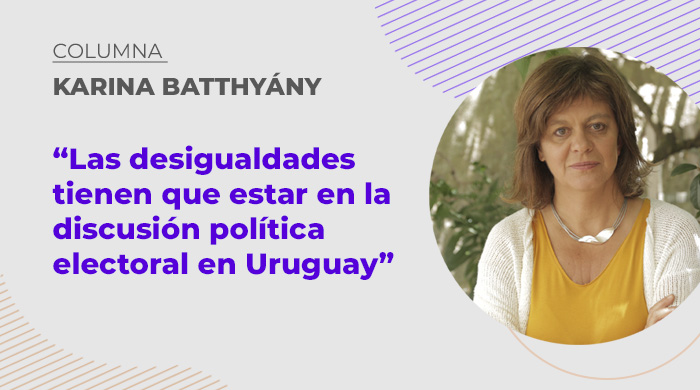
Transcript of Karina Batthyány's column
in InfoCLACSO – April 17, 2024
As part of the 175th anniversary of our University of the Republic (Udelar), it was important to bring the CLACSO Steering Committee to Uruguay. The last time the Committee met in the country was during its return to democracy in 1986, and it provided a significant boost to the development of the social sciences and humanities here.
Today, these disciplines are well-established in Uruguay, offering a high level of both training and research. Furthermore, we felt it was very important to share the experience of the CLACSO Steering Committee with our University of the Republic, so that it would have the opportunity to interact with colleagues in our disciplines across the country.
Furthermore, we had the privilege and honor of having the Rector of the University of the Republic (Udelar), Rodrigo Arim, inaugurate the Steering Committee session. He emphasized the political and academic importance of our Committee's presence in Uruguay, given the complex situation our region is currently facing, which increasingly demands rigorous, serious, and tireless work in the social sciences.
Rector Rodrigo Arim also recognized the importance of CLACSO as the main regional and global platform for social sciences and humanities.
– Among the topics there are always central priorities in each Steering Committee, however, #CLACSO2025 is beginning to emerge as one of the major areas to work on, isn't it?
Of course. The work of our Steering Committee is always focused on planning and building upon what has been accomplished in previous months and planning for the months to come. And already on the agenda is that major gathering of the social sciences and humanities that is the Latin American and Caribbean Regional Conference, leading up to #CLACSO2025 in Bogotá, Colombia. And of course, we were working alongside the Steering Committee in that direction, defining the themes, priorities, and political and academic content of our upcoming Conference.
– Why the choice of the theme of inequalities in Latin America at the International Forum in Montevideo, Uruguay?
First, because it's part of our Platforms for Social Dialogue, and also because it's a central issue in Latin America today. We also wanted to bring the discussion to Uruguay because we're in an electoral context, where the country's model and the proposals of the various political parties are being debated for the next term. Therefore, placing the discussion of inequalities in Latin America at the moment these debates are taking place is a valuable contribution in terms of knowledge, its relationship to public policies, and its connection to social movements and organizations. Furthermore, the issues mentioned, which are happening today in our region, along with their implications for Latin America and the Caribbean, must be on the agenda of the political and electoral debate in Uruguay.
– There's a very special moment that involves a book launch. It's a key recognition of the work of feminist movements in Uruguay. Tell us a little about it.
This is the presentation of the book by Rosario Aguirre, a pioneer in gender studies, particularly in the field of gender sociology in Uruguay, and also in Latin America and the Caribbean, alongside other feminist pioneers. From the CLACSO publications department, we have compiled her main contributions as a way of showcasing CLACSO's mission, because she has always connected knowledge and public policy with social movements, in this case, the feminist movement.
So, this is a tribute to a pioneer, a woman, a social scientist in Latin America and the Caribbean, among other things. It's also to showcase the work of certain voices and ideas that perhaps weren't as visible as they deserved, and which we at CLACSO are now making an effort to bring to light. Furthermore, I must mention that this publication has a very personal component, given that Rosario Aguirre is, was, and will always be my mentor. Alongside her, I trained, worked, and had the most interesting discussions from an academic, political, and human perspective.
If you would like to receive more information about CLACSO's training programs:
[widget id=”custom_html-57″]
to our email lists.

