
"Right-wing groups maintain conservative discourses on gender issues."
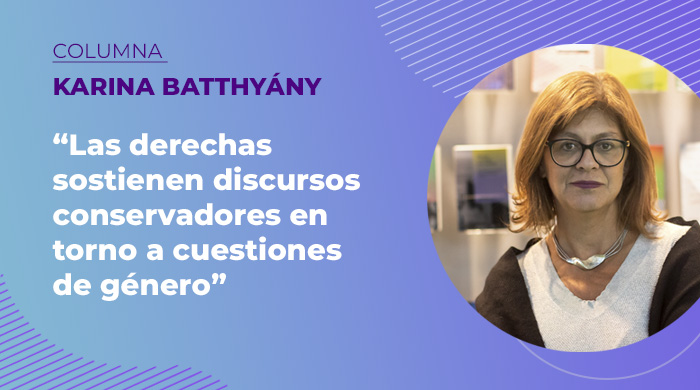
Transcript of Karina Batthyány's column
in InfoCLACSO – March 12, 2025
We are living at a crossroads marked by the rise of right-wing movements in Latin America and around the world. In the past, we saw it in Brazil with the rise of Bolsonaro, in El Salvador with Bukele, and in present-day Argentina with Milei.
The political demonstrations of the right wing are of significant concern to us. They espouse deeply conservative rhetoric surrounding gender issues and relentlessly attack those of us who seek to defend policies promoting equality for women and gender minorities. These are viscerally anti-rights expressions, especially anti-feminist ones. They are based on the notion that feminism, or those of us who work from a feminist perspective, directly threaten the traditional values that structure societies—namely, family and religion—and that we promote “gender ideology.”
Based on the construction of reactionary arguments, right-wing movements seek to advance by eliminating rights that have been won in recent decades in different regions of the world. The case of Argentina is currently paradigmatic in Latin America: the Milei government closed the Ministry of Women, Gender and Diversity. Later, it also closed the Undersecretariat for Protection against Gender Violence, prohibited inclusive language in public institutions, is seeking to end comprehensive sex education, and is attempting to defund numerous policies that promote equality.
Under Milei's government, there have been very specific actions to roll back many of the advances made in gender equality rights. The current Argentine government also promotes hate speech against women and, in particular, against the LGBTIQ+ community.
Furthermore, beyond the right-wing context and the rise of conservative governments, we are concerned about some specific figures related to gender-based violence that remain scandalous in all our countries. In terms of femicides, the latest available figures tell us that in Latin America at least 11 women lose their lives every day. To that we must add all the other forms of violence against women and gender minorities, such as economic, symbolic, and psychological violence. We have some figures for these, but the data collection remains insufficient in most countries of the region.
Furthermore, women and gender-diverse people suffer the most from the economic crises affecting our countries, crises that do not impact men in the same way. It's important to remember that 30% of women in our region live in poverty. Moreover, there are approximately 120 women living in poverty for every 100 men in those circumstances.
If we examine the situation within the women's population, we find that the figures mentioned are higher for some specific communities, such as Afro-descendant women, Indigenous women, and rural women. Economic inequalities impact women differently and are exacerbated in lower-income social classes.
One in four women has no income of their own, meaning they lack the ability to make decisions about their earnings or achieve economic autonomy. For men in this situation, the figure is one in ten, highlighting these inequality gaps once again. Furthermore, women are disproportionately affected by unemployment. When there is unemployment, the economic crisis has a greater impact on women. In addition, for those of us who are employed, there is a wage gap: in our region, women continue to earn, on average, 30% less than men. And to this we must add the entire dimension of unpaid work: women perform 75% of care work, dedicating up to 35 more hours per week than men to these tasks. Therefore, we have less time available to participate in the labor market, for our own development, or for our well-being, and this presents yet another indicator of persistent inequality.
The joint report by ECLAC and UN Women highlights the care economy as one of the main structural challenges in the Latin American and Caribbean region. Furthermore, it acknowledges that the economic value of unpaid care work, depending on the measurement, represents between 15 and 20% of the gross domestic product (GDP) of Latin American countries and that it is rendered invisible in national accounts systems.
The labor reforms being pushed by right-wing parties in several countries tend to further precarize working conditions for women, especially those in feminized sectors such as domestic service, retail, and care work. We continue to see a tremendous underrepresentation of women in all decision-making spheres of society, including parliaments, governments, education, unions, and business associations.
Despite any negative outlook, we must acknowledge some progress in women's rights, which is reflected in concrete public policies in our region. From the 90s onward, we can begin to systematically document the achievements in women's labor force participation, which has grown steadily, as well as the significant progress women have made in education, surpassing men in enrollment and completion rates at the primary, secondary, and tertiary levels. This progress translates into better working conditions, higher wages, and greater opportunities for women to find employment.
In recent years, critical issues of gender inequality have been placed at the center of the agenda. One of these is the issue of care systems. There is no country in Latin America and the Caribbean where the topic of care is not part of the public debate. Argentina is a particular case, having made significant progress in enacting a Comprehensive Care System law, but this has now stalled. Furthermore, a look at the countries of our region reveals that care has risen to the top of the public agenda for discussing the critical aspects of gender inequality.
On the international political stage, we cannot fail to mention that Mexico—the second most populous country in Latin America and the Caribbean—has its first female and feminist president, Claudia Sheinbaum. Honduras also has a feminist president, Xiomara Castro, among other feminist vice presidents in Colombia, Guatemala, and Uruguay who are staunch advocates for expanding the rights of women and gender minorities.
In short, there is still a long way to go and much to pay attention to in this context of such particular crossroads that leads us to confront gender violence decisively, guarantee the equitable participation of women in the labor market, expand the female presence in political decision-making spaces and consolidate care system policies in different countries.
It is important to look back, acknowledge the progress made, redouble our efforts, and continue defending the rights we have won, which are the result of decades of feminist organizing and struggle in its various and diverse forms. According to the United Nations, we would have to wait many years before achieving gender equality worldwide.
– While there have been significant advances, all these setbacks directly impact fundamental changes. How important are the forms of resistance in the streets, academia, and social movements in the face of these attempts to dismantle existing political and social measures?
If there's one thing the Feminist Movement has always demonstrated, in different contexts, it's its capacity for resistance and the importance of collective organization as a movement to prevent or reduce the impacts of any setbacks or cuts that are being imposed. Indeed, feminism is central to the path toward equality; it's not the "enemy" as some would have us believe, but rather a key component in building equality and democracy in our societies.
If you would like to receive more information about CLACSO's training programs:
[widget id=”custom_html-57″]
to our email lists.

