
"Trump's actions violate international agreements and human rights."
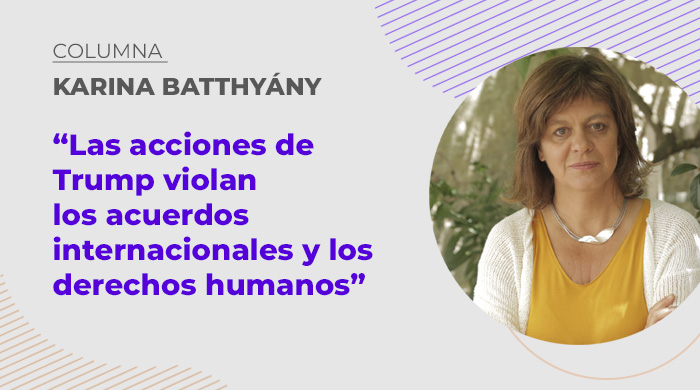
Transcript of Karina Batthyány's column
in InfoCLACSO – February 19, 2025
In the face of anti-immigrant policies, we begin the sixth season of InfoCLACSO talking about migration and human mobility, a right for everyone.
On January 20, 2025, Donald Trump began his second presidency in the United States with high levels of arrogance, defiant and authoritarian, with delusions of taking over the world after a campaign where he promised a new golden age for his country.
Surrounded by the most reactionary elements of American politics, such as Vice President James David Vance and cabinet members Marco Rubio and Elon Musk, Trump began threatening governments and peoples from day one and implementing border closure policies, not only against immigrants but also against products and goods, imposing new tariffs that violate World Trade Organization rules. In addition to outright blocking billions of dollars in humanitarian aid projects, he withdrew the United States from the World Health Organization and promised to do the same with the Paris Agreement on climate change, among other measures.
In this short period of one month in office, Trump has also reinforced his expansionist aspirations, not only with the presence of troops on the five continents but directly promising territorial annexations, such as turning Canada into a state of the Union, occupying Greenland and regaining control of the Panama Canal.
Let's focus here specifically on Donald Trump's anti-immigrant policies. I want to remind you that we already issued a statement from the CLACSO Steering Committee on January 28th, reaffirming that "Migration is not a crime, but a human right," which concluded with an urgent call to the governments of our region, international organizations, and global civil society to act together to demand the immediate cessation of mass deportation policies and any practices that promote hate speech and violence.
From his first day in office, Donald Trump spoke of ending all open border policies and implementing the largest deportation operation in his country's history. Since then, Mexican, Latin American, African, and Asian families have been living under a true legal and social apartheid, many condemned to live in hiding with the sword of Damocles hanging over their heads.
Because not only does the Trump administration expel migrants by the tens of thousands through raids that are veritable manhunts, but it also subjects them to degrading treatment, as if they were criminals, separating families and denying them the right to defend themselves. It broadened detention priorities to include anyone in the country without proper documentation, not just those with criminal convictions, whom they consider a threat to public safety, or migrants already detained at the border. The images of migrants in chains being forcibly loaded onto planes bound for their countries of origin are compelling, not to mention the initiative to use the illegal prison at Guantanamo Bay, Cuba, to house those they deem most dangerous.
In addition, Trump ended the use of a border app that allowed migrants to enter the country with two-year permits that gave them the ability to work, canceling tens of thousands of scheduled appointments for people waiting on the other side of the border in Mexico.
Trump also promises to move forward with ending birthright citizenship. Until now, anyone born in the United States has been automatically granted citizenship, a right established in the famous 14th Amendment to the Constitution, which states that all persons born or naturalized in the United States, and subject to its jurisdiction, are citizens of the United States and of the state in which they reside. Trump wants to eliminate that constitutional guarantee as well.
Faced with this bleak outlook for free human mobility, we see that countries like Colombia and Guatemala are implementing measures to repatriate their citizens in a dignified and careful manner, and not by dressing them up in prison uniforms and chains as the US authorities present them.
In the case of Mexico, which shares 3.169 kilometers of border with the United States, the government of Claudia Sheinbaum launched the program “Mexico Embraces You” aimed at Mexicans returning to the country, which includes the opening of nine migrant assistance centers on the northern border to receive assistance in processing documentation, support in social reintegration with labor incorporation and welfare programs.
It is certainly true that immigration policies that violate human rights did not begin with the current US president, nor are they an issue exclusive to the United States. What we have seen, however, is that in just a few weeks of the Trump administration, these policies have reached catastrophic proportions, fueled by increasingly virulent xenophobic and racist rhetoric that is also being echoed in other parts of the world, driven by the rise of right-wing and far-right forces and governments.
Without a doubt, what humanity demands in this first quarter of the 21st century is fewer walls and more bridges. We reaffirm, therefore, one of the premises of the Latin American Council of Social Sciences, which will be a priority theme at its 10th Conference in Bogotá in June: migration and human mobility are fundamental rights, and therefore the actions of governments like Trump's must be combated and eradicated because they represent a flagrant violation of international agreements and human rights, and reinforce dynamics of exclusion and discrimination. Furthermore, they exacerbate the sad characteristic that Latin America and the Caribbean share of being the most unequal region on the planet.
– The same solutions are always sought for the same conflicts. There's this logic of thinking that the outsider is the problem. What a surprising level of repetition some things have in our world, isn't it?
– A surprising but increasingly dramatic recurrence. Because far from simply repeating itself, the measures and the drama are intensifying. Furthermore, it generates significant consequences for everyone directly affected by these criminalization measures. We are truly at a very worrying moment for our region and for the world.
If you would like to receive more information about CLACSO's training programs:
[widget id=”custom_html-57″]
to our email lists.

