
“Gender-based violence occurs in both public and private spaces.”
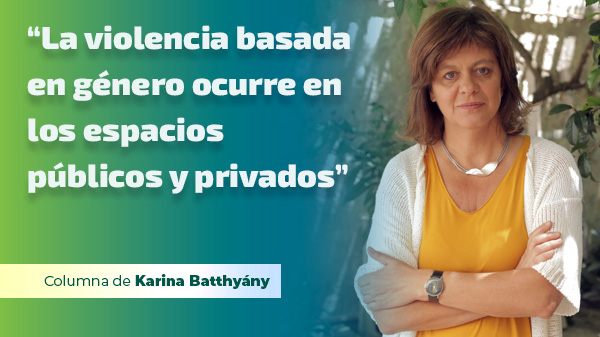
(Transcription of Karina Batthyány's Column)
(in InfoCLACSO – March 29, 2023)
We have been exploring different dimensions related to gender inequalities, the theme of feminisms in Latin America and the Caribbean, and also highlighting (which is part of the strategy for this March, Women's Month) CLACSO's activities related to the topic: Conversations, books, Research proposals, Training proposals, Communication activities, among others.
Today, we will mention one of the dimensions that we left pending, which constitutes one of the most worrying issues in terms of gender inequality and which refers to the physical autonomy of women.
Of course, there are several indicators, but I'm going to focus mainly on the one that refers to gender-based violence.
During the pandemic, and as several reports, primarily from the United Nations system, warned us, violence against women and girls is clearly a human rights violation of pandemic proportions. We said: this is the real pandemic, not a response to an emerging situation like the virus (in the case of COVID-19), but rather a daily, structural problem for which no solutions have been found.
And it is a violation of human rights towards women and girls that occurs, moreover, in plain sight of everyone: in public spaces and in private spaces.
Let's remember: According to the United Nations, one in three women worldwide has experienced physical or sexual violence. And if we add the dimension of sexual harassment to this physical or sexual violence, this figure is even higher.
Indeed, according to records from the United Nations Office on Drugs and Crime (UNODC) in Latin America, 14 of the 25 countries with the highest rates of crimes against women in the world are located here, and our region is the second most dangerous, surpassed only by Africa.
The latest UNODC report focuses on the phenomenon of gender-based killings of women and girls. It highlights that the primary setting for this violence against women and girls is within their own homes, their own families. Women and girls are disproportionately affected by these homicides—femicides, in short—in every region of the world, within the private sphere.
The latest records from this United Nations agency report that 81.000 women and girls were murdered worldwide for gender-related reasons in 2021. Of those 81, nearly 60 percent were killed by their partners or family members; these murders occurred behind closed doors in the private sphere.
Of course, we need to analyze the figures more closely and distinguish between femicides committed by current or former partners and those committed by other family members of the murdered women. But I want to emphasize that the largest group of perpetrators of these femicides are indeed the current or former partners of the women I just mentioned.
According to the same report, our region is characterized by having the highest rate of intimate partner homicide and femicide in the world. In Latin America and the Caribbean, women are far more likely to be murdered by their current or former intimate partners than by other family members.
Femicide is clearly one of the main problems of gender-based violence, the most acute, but it is certainly not the only one. This gender-based violence is a manifestation of the gender inequalities imposed on women and girls due to their subordinate and dominant position within the gender system and social systems. This is also expressed in other dimensions such as physical, sexual, emotional, economic, institutional, and patrimonial violence, among others.
Furthermore, it is also important to mention that in recent years these other forms of violence, which were long invisible, have begun to be recognized, such as the criminalization of abortion, obstetric violence, forced sterilization, sexual harassment in the workplace, street harassment, digital harassment, or violence linked to expressions of hate, such as transphobic and antifeminist expressions, which we also observe so much in our region.
Many forms of violence are heavily influenced by gender inequalities. One such phenomenon is human trafficking: 72 percent of all trafficking victims worldwide are women and girls; and four out of five women trafficked are also exploited for sexual purposes.
I want to add one last perspective on this same topic, linked to what the United Nations determined for International Women's Day (last March 8th) regarding digital issues, with the slogan "For an inclusive digital world: innovation, technology for gender equality." There, too, is violence.
We can clearly see that the various reports released recently mention the dimension of gender-based violence facilitated by technology. They include different examples with terms we're not so used to, related to online stalking, grooming, the unauthorized distribution of intimate images, and other forms of abuse. These often occur in everyday settings, but they are manifestations of gender-based violence that undoubtedly cause very tangible harm (not just virtual harm) and that don't end when someone disconnects from those spaces. There is a misuse of digital technology that manifests itself in these new types of violence, new types of crimes. These digital and virtual media are also frequently used to spread sexist hate speech, hate speech related to gender issues, to disseminate images or figures that objectify women, and other messages that normalize violence and the limitation of women's rights.
We must also take into account the less tangible digital dimension, which is undoubtedly a form of expression of violence towards us, women.

