
“The university has a central role in promoting democracy and critical thinking.”
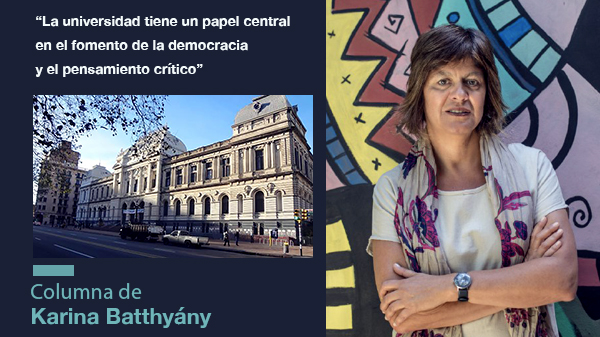
(Transcription of Karina Batthyány's Column)
(In InfoCLACSO – September 22, 2021)
Following this line of work and preparation as we head towards our ninth Conference at UNAM next June, I propose we continue exploring some of the key themes that will be addressed, discussed, and used to develop alternatives and perspectives during those days of work at the Conference. In this case, the focus is on Higher Education and Universities, and particularly Public Universities.
Before beginning the discussion, I want to express my solidarity with Gerardo Caetano and the solidarity of CLACSO and its Steering Committee with Gerardo Caetano, a leading figure in the Uruguayan public university system, the University of the Republic, who has been the victim of insults and intimidating actions. We want to express our solidarity with him and also condemn these types of actions, which do nothing to contribute to democracies, to strengthening democracy and pluralism, and to the pluralistic expression of ideas in our countries.
Let's turn to today's topic: higher education, universities, and the challenges they face. First, I should mention that this topic will be one of the central themes of our #CLACSO2022 Conference at UNAM (National Autonomous University of Mexico), where we will be discussing the role of public universities, the role of knowledge as a public good, and the human right to higher education. Ultimately, we will be examining the role of universities in the world today and in our Latin American and Caribbean region, which, as we know, is at a very complex crossroads due to a series of phenomena that we have been discussing in these columns. These phenomena are related to economic, environmental, political, ideological, cultural, and social issues, as well as, of course, health and healthcare systems.
These complexities, which also highlight the need to analytically address dimensions such as human rights, inequalities, migration, corruption, violence, insecurity, and much more, ultimately make universities and higher education systems the places where alternatives are discussed and developed. Therefore, we believe it is crucial, within this framework and understanding the crossroads we are facing, to deepen and enrich the analysis and critical reflection on the role of higher education, particularly public higher education, and higher education as a human right.
To analyze the scope, limitations, and challenges that higher education faces today at both the local and regional levels, especially in those models where neoliberal patterns still prevail and where higher education is also treated as a commodity. To emphatically state the need to defend higher education as a human right, as agreed upon at the Regional Conference on Higher Education (CRES) in 2018. It is worth recalling that the CRES in 2018 specifically addressed access to, use of, and democratization of knowledge as a social good, a collective good, and a strategic asset, essential for guaranteeing basic human rights. It presented education, science, technology, and the arts as a means to freedom and equality, guaranteeing them to everyone without distinction based on social status, gender, ethnicity, religion, or age.
Education, CRES stated in 2018, is not a commodity, and for this reason we urge national states not to sign bilateral or multilateral Free Trade agreements that imply conceiving education as a lucrative service or encourage forms of commodification at any level of the education system.
We are well aware of this reality because, since the 80s, higher education in our region has become a commodity, undergoing a process of increasing commercialization in accordance with the dynamics and rules of local and international markets. And because, in most countries, even those with a strong tradition of public universities, such as Uruguay, with its public, secular, and tuition-free universities, the issue of how higher education is financed has not yet been properly addressed. It remains marginally funded from a public perspective and is still largely a private business—if we can call it that—operating within the market.
We want to place life and education at the center and shift the focus away from the market, which is currently central to this sphere. That is why CLACSO and the public universities of Latin America and the Caribbean have always championed this cause, also promoting new horizons of critical and emancipatory reflection from within these public educational institutions. To this end, we insist on the idea of positioning knowledge as a public good, as a common good—as it is sometimes called—in this ongoing regional and international debate, which also involves the concept of open access and open science.
We believe that these debates contribute to effectively designing educational models that allow us to link research, teaching, and outreach within a framework of regional cooperation, open to communities, including non-university communities, and that also allow us to recover other forms of knowledge that ultimately enrich the much-needed dialogues surrounding higher education and universities, particularly in our region today.
Finally, I want to draw attention to the political instability occurring in some countries of our region, which also threatens the development of knowledge, and particularly this idea of knowledge as a public good and universities as places of knowledge production. This threat comes in the form of budget reductions or cuts, or through political restrictions on intellectual freedom and professional practice.
In short, then, we want to place this axis as one of the central axes of our Conference # to continue from CLACSO promoting a space for encounter, for critical voices, for voices that promote reflection and debate around the role of higher education and public universities, in order to think together about alternatives to advance in this idea of strengthening the public higher education system in Latin America and the Caribbean.
We believe that the university also has a central role in promoting democracy, solidarity, interdependence, responsibility and of course critical thinking, which, as we always say, is a type of thinking that also promotes or implies the idea of social transformation.
If you would like to receive more information about CLACSO's training programs:
[widget id=”custom_html-57″]
to our email lists.

