
The university should be a strategic ally of the public sector
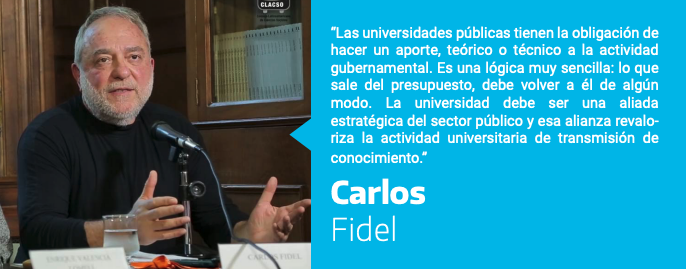
Carlos Fidel is an economist, professor and researcher at the National University of Quilmes (UNQ), producer and interviewer of the series “Close Dialogues” on UNQUI TV, and Coordinator of the CLACSO Working Group on Poverty and Social Policies, recently incorporated into the Public Works Observatory.
¿How have these first steps been, and what are your expectations?
We recently attended two meetings related to the Bank of Experiences in Citizen Participation and Oversight, and as such, we are now full and active members of the Observatory, which makes us happy and proud. CLACSO is a network of networks and, as such, brings together experiences, knowledge, and trajectories.
very vast and diverse, with much to contribute.
Public universities have an obligation to contribute, theoretically or technically, to government activity. It's a very simple logic: what comes out of the budget must somehow return to it. The university should be a strategic ally of the public sector, and this alliance enhances the value of the university's role in transmitting knowledge.
How does our country compare to the region?
First, we must acknowledge that Latin America is not a homogeneous bloc. There are very disparate realities, in terms of GDP size, level of development, and other factors. For example, Mexico, Brazil, and Argentina cannot be compared with other economies of much smaller size; there are also other differences in institutional design, for instance.
Even so, I understand that transparency policies applied to public works management is an interesting field of research that, in our region, could be explored in greater depth.
What aspects or approaches does it highlight?
We must analyze separately the two major stages of public works: design and execution. Regarding execution, transparency policies, broadly defined, can contribute to the training, organization, and employability of historically marginalized sectors, improving existing capacity and reducing informality, thereby generating an economic and redistributive impact.
But before that, it's crucial to involve the user or citizen in the process from the very beginning: from choosing the project, through its design—type and quality—to finally reaching construction. How important are these mechanisms for institutionalized dialogue?
Let me illustrate this with a counterexample. The previous government invested $650 million in the “Paseo del Bajo,” of which $400 million corresponds to loans from international institutions that must be repaid.
Who made that decision? Based on what priority criteria? Where is the strategic plan or master plan? What other uses could that money have had? What impact would it have had if it had been allocated to the urbanization of informal settlements and slums within the city itself, assuming that diversifying tasks increases the economic impact?
And, even more dramatically, how would the inhabitants of those neighborhoods have fared during the Covid-19 pandemic if they had benefited from such a public investment?
Interview published in: https://www.argentina.gob.ar/sites/default/files/2021/10/8_4_entrevista_a_carlos_fidel_0.pdf

