
“The earth is running out of time”
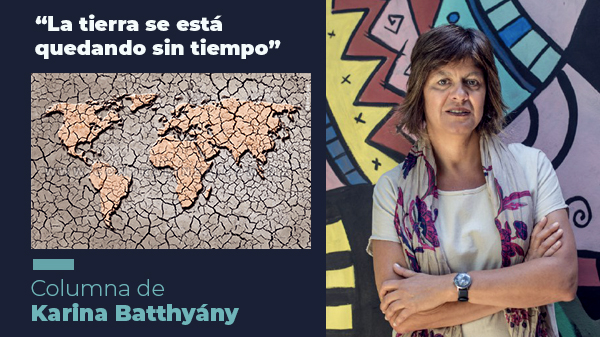
(Transcription of Karina Batthyány's Column)
(In InfoCLACSO – August 25, 2021)
I propose we talk about the environment. We left that topic open two weeks ago when we discussed the ECLAC report on “The Recovery Paradox in Latin America and the Caribbean: Growth with Persistent Structural Problems: Inequality, Poverty, Low Investment, and Low Productivity” on InfoCLACO. At the end of that discussion, we mentioned that the report also highlights how the pandemic has left 2021 in a worse environmental state, one that will be difficult to reverse. While some temporary improvements in air quality and emissions reductions were observed during 2020, likely due to lockdowns, these were rapidly rebounding. Therefore, based on that conclusion, I propose we expand on that perspective, because the Intergovernmental Panel on Climate Change (IPCC) report was also released a few days ago, and some of its conclusions are specifically linked to global warming.
This report from the Intergovernmental Panel on Climate Change (IPCC) compiles over 14.000 scientific articles and is one of the most comprehensive to date. The conclusions reached by the various scientists point to the continued emissions of greenhouse gases, which are projected to exceed a key threshold for global temperature in just over a decade.
Let's elaborate on this idea: the first known report from a group similar to this one (the Intergovernmental Panel on Climate Change) dates back to 1990. It already pointed to the repercussions or consequences of human activity on the climate, although they couldn't be scientifically confirmed, but it stated that they would soon become evident. Today, this 2021 report presents undeniable evidence and observations that the climate has changed significantly compared to the pre-industrial era, and that human activity is the primary cause of this change.
This report also suggests that the environmental impact of our current development model undoubtedly jeopardizes the well-being of a large part of humanity, and in many cases, not only their well-being but also their very survival. This is presented as one of the great challenges of our time, as it puts the world's common resources at risk—what we have also referred to in other InfoCLACO columns as Global Public Goods, such as the atmosphere, the oceans, the polar ice caps, biodiversity, and many others.
These climate changes we are seeing exceed the ranges of sustainable variability in terms of temperature, precipitation, and atmospheric composition, which—as I already mentioned—threatens all living beings on land and in the sea. And this evidence of global warming, unlike what was said in the 90s, is now unequivocal. Throughout the conclusions of this report, it is emphasized that one of the main causes of this phenomenon is human activity, specifically the increased concentration of greenhouse gases produced by our activities (human activities), primarily the burning of fossil fuels, changes in land use, and other factors also addressed in this report.
Let's also mention that this climate change is manifested, or can be observed, primarily in the increase in average global temperatures; this is perhaps one of the most visible elements, along with the alteration of rainfall patterns. These transformations also influence economic activities, social well-being, and, of course, ecosystems.
What exactly are we talking about when we talk about rising temperatures? According to this report, unless large-scale, immediate action is taken (isolated measures in some countries to reduce emissions are insufficient), the global average temperature is likely to exceed the warming threshold by 1.5 degrees Celsius within the next 20 years. Furthermore, it shows how the commitments made so far by various countries to reduce emissions, and therefore to mitigate global warming, have been woefully inadequate and have had little impact on curbing climate change.
They are telling us in very clear terms, with very clear statements: the Earth is running out of time. If the planet drastically reduces emissions today, over the next decade—I repeat—the average temperature could rise by 1.5 degrees Celsius in 2040 and 1.6 degrees in 2060 before we can even think about it stabilizing again. And if nothing is done, or if we continue with what we are doing now—that is, if we maintain the current trajectory—the planet could experience a warming of 2 degrees Celsius in 2060 and 2.7 degrees by the end of this century, making this situation unsustainable.
Therefore, we reiterate, as we have stated in other columns, that the environmental issue and climate change are among the greatest challenges of our time. Furthermore, none of our countries are immune to the effects of climate change, and we are already seeing the consequences in the economy, health, food production, and overall well-being.
Finally, it's worth mentioning that this report also draws a connection to the current pandemic situation in terms of the overall capacity of countries to respond to an emergency like this one. Let's consider whether we shouldn't ultimately view the climate change situation as an emergency that requires an immediate response from the entire international community to begin building alternatives. If we do nothing, this climate crisis will obviously cost much more and have even worse impacts than those we are already witnessing.
So, once again, CLACSO calls for incorporating the environment and climate change into our reflections and our work; CLACSO considers them one of its priority areas of concern, research, and action. And I believe the data in this report are compelling and compel us all to act in this direction.
The phrase "The Earth is running out of time" and the concrete impacts that many societies are already beginning to experience—floods, much stronger climate effects than before—are relevant. But related to what you were saying about how the pandemic, likely due to reduced social activity and factory activity, led to a decrease in pollution, I read a recent survey in Spain of 5.000 people that revealed a growing apathy towards environmental issues. While the pandemic improved the environmental situation in some ways, there's less concern about environmental phenomena, specifically in Spain, but I fear this is happening in other parts of the world. And that's where the analysis of Latin America and the Caribbean comes in, without resorting to simplistic analysis. The responsibility for reduced pollution lies primarily with large corporations and government decisions. What role do you think societies that set these issues play when they vote, protest, and demonstrate?
First of all, a clarification: The idea that the Earth is running out of time isn't mine to say, but rather this report, which compiles all the scientific evidence on this issue. And it states very clearly that we are running out of time. On this issue, as on others, Gustavo, I believe the key is always to think precisely at different levels, both micro and macro, about what each of us can do, and also, of course, what can be done at the level of states, governments, and international organizations. I believe we are all called upon to adopt a responsible attitude—once again, that concept we've also discussed here: co-responsibility, solidarity, and collective action—to understand that these three words are also key to how we address our concerns and our actions regarding the environment and climate change specifically, which is what this report we're discussing today addresses. There is no more time. We need to incorporate climate change as one of the central dimensions of well-being, development, and ultimately, the future.
If you would like to receive more information about CLACSO's training programs:
[widget id=”custom_html-57″]
to our email lists.

