
“The Earth is in danger”
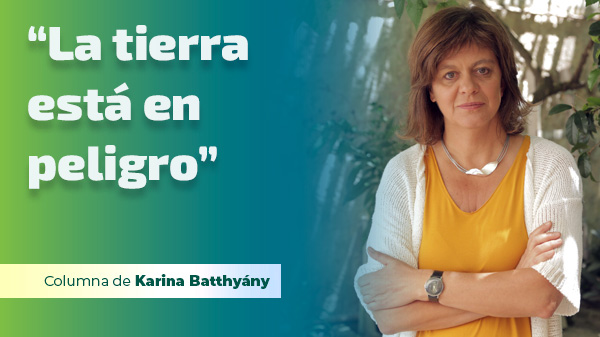
(Transcription of Karina Batthyány's Column)
(In InfoCLACSO – April 5, 2023)
In 2021, the United Nations Intergovernmental Panel on Climate Change, which compiled thousands of scientific articles, warned that continued greenhouse gas emissions would exceed a key global temperature threshold in just over a decade. Since then, the situation has worsened, as evidenced by the waves of drought that affect countries every summer, such as Uruguay, Argentina, and, of course, much of the planet.
This report confirms that the climate has changed since the pre-industrial era and that human activity is the primary cause of this change. We must acknowledge this and pay close attention to it.
The environmental impact of our current development model undoubtedly jeopardizes the well-being of a large part of humanity and, in many cases, even its very survival. It is certainly one of the greatest challenges we must urgently address, as it puts the world's common resources—what we call Global Public Goods, such as the atmosphere, oceans, polar ice caps, biodiversity, and many others—at risk.
These climate changes we are seeing exceed the ranges of sustainable variability in terms of temperature, precipitation, and atmospheric composition, threatening all living beings on land and in the sea. This evidence of global warming is now indisputable and unequivocal, largely a result of human activity, the increased concentration of greenhouse gases produced by the burning of fossil fuels, changes in land use, and other factors related to human activity.
We can observe this climate change in the increase in average global temperatures; this is one of the elements that is perhaps easiest for us to see, along with the alteration of rainfall patterns. These transformations also influence economic activities, social well-being, and, of course, ecosystems.
What exactly are we talking about when we talk about rising temperatures? Unless urgent and large-scale measures are taken, the global average temperature is likely to exceed the warming threshold by 1.5 degrees Celsius in the next 20 years and 1.6 degrees by 2060. In this regard, the commitments made so far by different countries to reduce emissions and mitigate global warming have been woefully inadequate and have had little impact on curbing climate change.
In short: we are running out of time, the Earth is running out of time. This environmental and climate change issue is one of the greatest challenges of our time, as none of our countries are immune to the effects of climate change, which have global repercussions on the economy, health, food production, and overall well-being.
The key is to think at both the micro and macro levels about what each of us can do. We must remember that the micro level is very important, but also that the greatest responsibility lies at the macro level. That is, it belongs to states, governments, and international organizations. We work at both levels, but keeping in mind the different levels of responsibility that affect each of these levels of analysis.
We must incorporate climate change as a central dimension of development, well-being, and ultimately, the future that awaits us. CLACSO is integrating this issue of the environment and climate change into our reflections and work; it is an essential part of our Platforms for Social Dialogue.
Today in particular we are going to discuss the current worrying situation of the Amazon, which is the most widespread tropical forest in the world and which has suffered for decades from the onslaught of business, agricultural and mining appetites with their consequences on deforestation to the detriment of the ecosystem and the indigenous populations that live there.
There are nine points we can highlight in terms of concern:
The first, deforestation: By 2030, the Amazon could have lost about a third of its current vegetation density, which translates to more than 85 million hectares.
Second, the fires: Given the vast expanse of the Amazon rainforest, fires pose another serious threat to the ecosystem. In fact, for example, August 2022 saw the highest number of simultaneous fires in the region since 2017. On that occasion, 3.358 fires were recorded across the territory, mostly attributed to deforestation and the clearing of grazing land, as natural fires in the Amazon, due to its characteristics, are quite rare.
Third point, mining and exploitation of hydrocarbons: Because it was a relatively inaccessible region in the past, the Amazon still holds some of the world's largest mineral and hydrocarbon reserves. Currently, 15% of the Amazon biome is affected by some type of mining or oil and gas extraction. Of all these threats, the most significant is gold mining, due to the use of mercury in its refining process: a potent water and soil pollutant.
Fourth, hydroelectric dams: The increase in dam construction for hydroelectric power generation is another serious threat facing the bioregion, as it disrupts the natural flow of rivers, sediment transport processes, and endangers the migration patterns of some fish and iconic species such as the Amazon river dolphin. Currently, there are 154 hydroelectric dams in the region, and up to 277 projects are planned for the construction of new dams.
Fifth, intensive agriculture: With deforestation, in recent years large tracts of land have been cleared of trees to be used for agriculture, primarily for soybean production or livestock feed. Oil palm is another crop that is rapidly expanding in the Amazon, along with an increase in land dedicated to cattle ranching for milk and meat production.
Sixth, transport routes: Another major impact in the Amazon comes from the construction of new transport routes, whether roads, railways or the use of waterways, most of which are related to the increase in the export of products to new markets, especially Asian ones.
Seventh, indiscriminate fishing: Many of the Amazon's indigenous communities survive by engaging in small-scale activities such as fishing and hunting. However, in recent years we have seen large corporations overexploiting the river ecosystem.
Eighth, climate change: Today, one of the greatest threats to the Amazon is climate change, coupled with the loss of forest cover and the increase in both man-made and natural fires.
And finally, most importantly, there are the last tribes of the Amazon that are in danger of extinction: In the Amazon rainforest of Peru and Brazil, miners, ranchers, and illegal loggers are invading the ancestral territories of the last isolated tribes. Throughout the Amazon basin, there are between 50 and 100 isolated and uncontacted tribes, representing the majority of the world's remaining isolated tribes, who face serious dangers of disappearing due to the rampant encroachment of human activity into the rainforest.
I think these points are important to mention, and I should also say that the framework of the upcoming Forum that we at CLACSO will be holding in the Caribbean is linked to the theme of care, but we will be there precisely to establish a dialogue between this platform related to the issue of care and the environmental platform. And we will also be presenting the poster “Amazon – Threatened Diversity"with text by the Brazilian philosopher Leonardo Boff and illustration by the Argentine cartoonist REP."
There, Boff argues: “The Earth belongs to no one. It is a common good of all humanity and the entire community of life (animals, trees, microorganisms, etc.). The Amazon, which spans nine countries and nearly eight million square kilometers, is part of the Earth; Brazil and other countries are not the lords of the Amazon. The Amazon belongs to the entire Earth, to all humanity.” At this point, he should call upon us to strengthen our work in this environmental and climate change context.
-What is the impact of specific policies in the context of climate change? We saw in Brazil a government prior to Lula's, such as Bolsonaro's, where there was a logic of destruction of the Amazon, but also persecution of these ancestral communities that live there; it was really very complex also in the destruction of the territories.
Absolutely. It's all based on purely commercial interests. The important thing here is to grasp the concept of these global public goods, to understand that they are, precisely, public goods. Therefore, they should not be treated as commodities, nor should they become tradable goods on the market. We are all called upon to act responsibly, but the primary responsibility lies with states through their public policies to preserve these essential global public goods, because their preservation is at stake. Unfortunately, we must acknowledge that, of course, there are some governments, like the one you mentioned under Bolsonaro, that have focused little on preserving these global public goods, and have even acted in the opposite direction. But generally speaking, we don't see much action from states today in protecting these global public goods. And that is why the report I cited at the beginning from the United Nations Intergovernmental Panel on Climate Change calls our attention once again, saying: all these agreements, all these elements, which have supposedly been agreed upon globally, are being largely disregarded, because climate change continues to advance, the average temperature of the planet continues to rise, and they tell us that the Earth is in danger; the Earth is running out of time to react.
If you would like to receive more information about CLACSO's training programs:
[widget id=”custom_html-57″]
to our email lists.

