
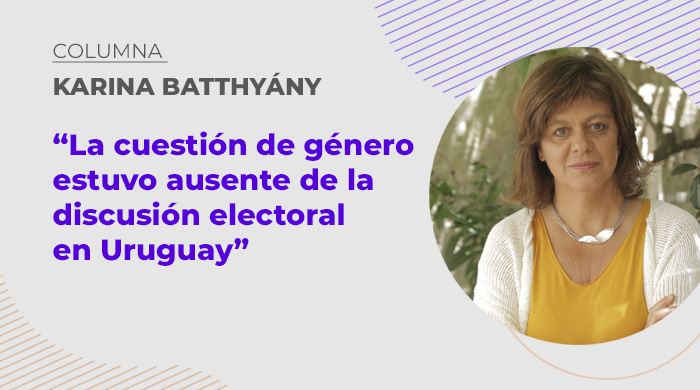
"Gender issues were absent from the electoral debate in Uruguay."
October 29th marked International Care and Support Day, celebrated with a highly visible campaign across all media outlets and social networks, particularly within academic circles in our region. My initial reflection is that care has become central to the sustainability of everyone's lives. It is a key issue in gender and social inequalities and injustices, and it deserves analysis in academic circles, in conjunction with public policy, social movements, and organizations.
At CLACSO, we are very actively involved in the issue of care and in research, training, and dissemination through our various communication channels. Care is a strategic focus that countries in the region began discussing several years ago and have already started developing public policy proposals.
Elections in Uruguay
Gender issues were virtually absent from the discussion of proposals and the agenda leading up to Uruguay's presidential elections, which I find striking. Because Uruguay, like many countries in Latin America and the Caribbean, has outstanding issues regarding gender equality in matters such as political participation, decision-making, and others more closely linked to the economic sphere, such as participation in the paid and unpaid labor market (including care work), as well as in matters of sexual and reproductive rights.
Last Sunday, in addition to the Uruguayan presidential election, voters elected members of Parliament, both in the Senate and the Chamber of Deputies. The first notable result was a resounding victory for the Broad Front, with the ticket of Yamandú Orsi and Carolina Cosse obtaining 44% of the total vote. Their closest competitor, the National Party (currently in government), garnered 27%. The Broad Front's decisive victory gives them a majority in the Senate with 16 of the 30 seats, but not in the Chamber of Deputies, where they secured 48 seats.
The interpretation depends on how the news is presented. Some media outlets attempted to portray a victory for the Republican Coalition based on the sum of all votes obtained by parties other than the Broad Front. While it is true that adding up all the other percentages yields a figure slightly higher than the Broad Front's 44%, in Latin America and the Caribbean, only Uruguay has a progressive party reached that 44%.
On November 24th, we will have a second round. The runoff system is very strict in that it requires 50% plus one of the votes to win in the first round, unlike other countries such as Argentina, where if there is a significant difference between the first and second candidates, the first candidate is declared the winner.
These Uruguayan presidential elections also brought other news worth mentioning. The first is that Cabildo Abierto, an ultraright-wing party with strong military roots, significantly reduced its support, a fact that greatly concerned Uruguayans. It went from obtaining around 11% of the vote in the previous election to just 2% this time. That is, it went from having three senators to having none, with representation only in the lower house. This is good news because it puts a stop to these kinds of movements. So, there will be no representatives of the military sector in the Uruguayan Senate, something worth highlighting.
The second piece of news is that the Broad Front managed to win in most of Uruguay's departments, beyond Montevideo and its metropolitan area. Furthermore, it was the only political force that significantly improved its vote share between 2019 and 2024, rising from 39% to 44%.
Now, with just a few weeks until the second round, the presidential tickets will have to do their job to determine who will be Uruguay's next president. And speaking of the next president, I return to the issue of gender to point out that neither of the two options includes a woman as a presidential candidate. This also highlights the difficulty in achieving true equality of rights between men and women in political representation and participation.
This is a fact that we can also see not just in the Chamber of Deputies, but in the Senate. We will have 9 female senators out of a total of 30, 7 of whom belong to the Broad Front, the only party that has approved gender parity in the composition of its electoral lists. Only 2 women will enter the Senate from the National Party, and none from the Colorado Party. Therefore, this issue should continue to prompt us to reflect when we talk about the representation and participation of women in all areas of Uruguayan society.
– In these remaining days of the campaign leading up to the second round of elections, what are the main themes that can be raised in the discussion?
– In terms of specific programs, we'll have to wait a few days to see what agreements will be included in the joint proposal between the Broad Front and the National Party. In any case, the discussion will primarily revolve around public opinion issues related to security, various forms of violence, employment, and especially wages.
The first stage of the election was marked by a debate over social security, as the government approved a reform to the pension system, and the labor unions proposed its repeal. Through a plebiscite, the law was not approved but garnered nearly 40% of the vote. This means that four out of ten Uruguayans disagree with this reform.
This issue will remain on the agenda because the Broad Front, which was previously divided, with some sectors supporting the repeal of the law and others opposing it, now has an agreement to promote broad social dialogue for its modification. The current law extended the retirement age based on budgetary justifications.
Last Sunday, another referendum was held on the possibility of repealing the constitutional prohibition on nighttime raids on homes. This is a long-standing provision in our constitution and was particularly sensitive during the last military dictatorship in Uruguay.
The amendment to that constitutional provision was also not approved. These decisions reveal two very strong ideological and opinion currents: one that unites 40% of the population around progressive proposals, and another that corresponds to 40% of the population with a more conservative profile.
I want to emphasize that there were no incidents during election day. There was a free expression of democracy in peaceful and harmonious coexistence among the different ideological currents in Uruguay. Furthermore, in the streets of Montevideo and throughout the country, caravans supporting the Broad Front and the National Party crossed paths without any violence or insults, but rather with respect and tolerance for each other's political positions.
If you would like to receive more information about CLACSO's training programs:
[widget id=”custom_html-57″]
to our email lists.

