
"The situation of Haitian migrants in the Dominican Republic is dramatic."
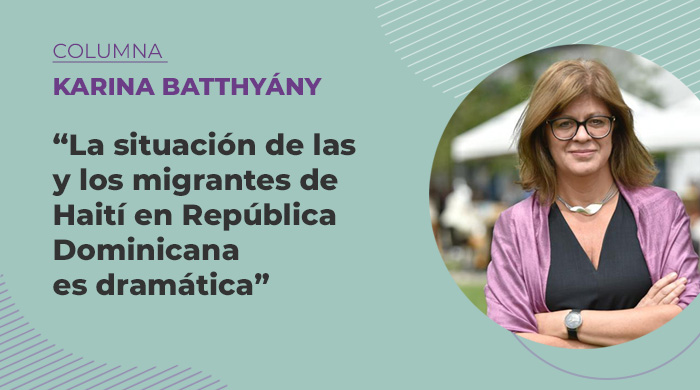
Transcript of Karina Batthyány's column
in InfoCLACSO – May 14, 2025
Tribute to Pepe Mujica
Today we remember José "Pepe" Mujica, "El Viejo," as he is known in Uruguay. A man who undoubtedly leaves us a legacy of hope, social transformation, and a history of struggle. His passing marks a turning point in the political and social history of Uruguay, but also in the history of all of Latin America.
Mujica, known worldwide as "the poorest president in the world," not only left a deep political mark on my country but also embodied the ideals of that first progressive wave that our region experienced at the beginning of the 21st century.
He was born in Montevideo around 1935, was just a few days shy of his 90th birthday, and grew up in working-class neighborhoods of Montevideo. From a very young age, he joined social and political activism, first in the National Party and later in the Túpac Amaru National Liberation Movement, a Latin American guerrilla group that fought against dictatorial governments.
Pepe was a direct victim of the military repression in Uruguay that marked Latin America in the 60s and 70s. He spent 13 years in prison under inhumane conditions as a hostage and in extreme isolation by the dictatorship. Far from breaking him, this situation shaped his character and personality and deepened his commitment to popular causes.
Mujica was released after the return of democracy to Uruguay in 1985 and from then on became one of the most charismatic political figures, formally joining the Broad Front. He came to power in 2005 alongside Tabaré Vázquez, then in 2010 as President of Uruguay, a position he held until 2015, and was part of that progressive project that profoundly transformed Uruguay.
Within the framework of that progressive wave, a series of laws and reforms were enacted and passed that truly changed the recent history of my country. To name a few: the decriminalization of abortion, the regulation of cannabis, same-sex marriage, welfare and poverty reduction policies (initiated during Tabaré Vázquez's first term and expanded during Mujica's administration), among other very important laws.
Mujica's victory and presidency were part of the aforementioned wave of progressive governments in the early 2000s in Latin America and marked a shift towards more inclusive social policies, particularly a strong and firm rejection of the neoliberal policies that had prevailed in previous decades. This wave included leaders such as Luiz Inácio Lula da Silva in Brazil, Néstor and Cristina Kirchner in Argentina, Evo Morales in Bolivia, and Rafael Correa in Ecuador, among other progressive leaders, and represented a break with the structural adjustment policies that had severely impacted the working class at the end of the 20th century.
Mujica will not only be remembered for his advocacy of progressive policies, but also for his austere lifestyle, his ethical conduct in politics, and his consistency between thought and action. One of his famous quotes is, "Only those who see money are poor," as well as his references to giving meaning or purpose to life, which reflected his vision of how to act and exist in an increasingly polarized and unequal world in the face of political and social action, in order to build more just, inclusive, democratic, and compassionate societies.
That, ultimately, is what we also strive for in our daily work at CLACSO. His life is a testament to constant struggle, from his beginnings in politics to his role as president with a Latin Americanist vision, always faithful to his principles in defending the most vulnerable and marginalized sectors of society.
We bid farewell to a leader who leaves an indelible mark on the history of the continent, the history of Uruguayans, a symbol of resistance and hope for current and future generations. From CLACSO, we extend our warmest condolences and solidarity to his partner Lucía Topolansky, his fellow activists, his family and friends, and to all the people of Uruguay who are deeply saddened by the passing of José "Pepe" Mujica.
Finally, I want to tell you about a video released by Uruguayan public television, narrated by Gerardo Caetano, a member of CLACSO, which covers the history and life of José "Pepe" Mujica. You can find it on the social media and website of Channel 5 in Uruguay.https://mediospublicos.uy/category/television/canal-5/).
Haitian migrants in the Dominican Republic
Since October of last year, the government of Dominican President Luis Abinader has been tightening its anti-immigrant policies, deporting approximately 10.000 Haitians per week, and ending 2024 with 276.215 expulsions. This policy intensified in early April when Abinader launched a series of measures that violate basic human rights.
Among his new measures, the Dominican president ordered the acceleration of construction on a border fence with Haiti that will run along part of the more than 390 kilometers of shared border between the two countries. He also announced the addition of 1.500 soldiers to the more than 9.500 already serving on the border. Even more concerning is the protocol that requires staff at National Health Service hospitals to demand identification, proof of employment in the country, and a negative COVID-19 test result from each patient, in addition to charging a fee for all services provided. This has already led to the deportation of dozens of pregnant women and women in labor.
Increasing deportations to Haiti, the poorest country in the region and plagued by gang violence, was one of President Luis Abinader's campaign promises. He was re-elected in May 2024 for a second term. As such, in the first four months of this year (January-April), more than 119.00 people have already been deported, a 71% increase compared to the same period in 2024.
The worrying reality of Haitian migrants in the Dominican Republic warranted a statement from our Steering Committee on May 5th, where we expressed our “Deep concern regarding the implementation of the 15 measures recently adopted by the Dominican Government on migration control. These provisions, in effect since April 21, could have serious implications for the rights and dignity of Haitian migrants, particularly affecting women in vulnerable situations.”
In this regard, the Steering Committee respectfully calls upon the Dominican authorities to review the scope and application of these measures, especially those related to the health protocol currently implemented by the General Directorate of Migration and the National Health Service. The denial of medical care to pregnant women or women in labor not only endangers their lives and the lives of their children, but also violates international agreements on human rights and health.
The statement continues, saying that:We are also concerned about the increase in actions by groups that, in the name of national defense, are restricting freedom of expression and promoting violence against human rights defenders, their offices, and workplaces. These practices, characterized by rhetoric that promotes negative and discriminatory images, must be widely rejected in our democratic and pluralistic societies."
"At CLACSO, we reaffirm our commitment to defending human rights, the dignity of all people, and the principle of non-discrimination. At times like these, we reiterate that the protection of life must take precedence over any regulation or administrative provision.”, concludes our Steering Committee.
While migration between Haiti and the Dominican Republic dates back to ancient times, contemporary Haitian immigration to the neighboring Dominican Republic became more frequent starting in the second decade of the 20th century, gradually increasing after the January 12, 2010 earthquake, one of the most devastating in recorded human history, with over two hundred thousand fatalities and destruction from which the country never recovered. This situation was soon exacerbated by a cholera epidemic brought by a Nepalese contingent of UN peacekeepers, which left at least 10,000 more dead in a country already battered by increasingly violent hurricanes due to climate change.
Since then, hundreds of thousands of Haitians have crossed the border to the east of the island of Hispaniola, which is shared by both countries, to flee violence, political instability, and extreme poverty, and then find work in the Dominican Republic in low-wage, unskilled jobs in construction, domestic services, and on plantations such as coffee, sugar cane, rice, and tobacco, among others.
Another worrying issue is that of the children of Haitian immigrants who are also victims of a discriminatory regime with their immigration status. Their situation became much more complex after September 23, 2013, when the Dominican Constitutional Court ruled that Dominican nationality would not be granted to the children of undocumented immigrants born after 1929, based on a retroactive reinterpretation of local laws. Since their Haitian parents are denied Dominican nationality and are therefore considered temporary residents, their descendants born in the Dominican Republic are trapped in a legal limbo, unable to enroll in schools, access formal employment, marry, register their children, vote, obtain insurance or a credit card, and without any real options for regularizing their status. For this reason, they are considered foreigners in their own country. Or worse, as many non-governmental organizations define it: stateless.
The “Sentence 168-13” directly affected up to three generations of Dominicans with Haitian ancestry, burying the principle of Ius alone —or birthright— by which, until 2010, the Dominican Republic granted citizenship to anyone born in the country. In response, the Office of the United Nations High Commissioner for Human Rights urged the Dominican government to adopt the necessary measures to guarantee their right to citizenship and expressed its deep concern that the legislation leaves tens of thousands of people without essential services. The most recent measures adopted by the Dominican government run counter to these calls for the full inclusion of Haitian migrants in the social and labor life of the Dominican Republic.
Therefore, as the CLACSO statement I mentioned earlier rightly says, we reaffirm that the protection of life must always take precedence over any regulations or administrative provisions, reiterating our commitment to the defense of human rights, the dignity of all people and the principle of non-discrimination, all of which will be key topics of discussion at our X Conference in a few weeks in Bogotá, Colombia.
– The situation you describe regarding Haitian migrants is appalling, because it has so many complex facets. And I was thinking about the inherent contradiction between the many people who drive the economy and those who are mistreated, hidden away, expelled, and effectively illegalized within the legal framework surrounding their work, right?
– Absolutely. This is a situation that, of course, is faced by people in irregular migration situations in other countries, but in the Dominican Republic it is aggravated by the retroactive law, removing the right to Ius alone...as well as by the 15 recent measures taken by the current Dominican government. Furthermore, basic healthcare needs are being jeopardized, even for pregnant women and those in labor. The situation facing Haitians in the Dominican Republic right now is truly dire.
If you would like to receive more information about CLACSO's training programs:
[widget id=”custom_html-57″]
to our email lists.

