
The post-pandemic reconstruction
On Monday, June 1, the round table “Post-pandemic reconstruction” was held within the framework of the Science and Society colloquium called “COVID-19 – Science, social participation, political decisions”, organized by the National Council of Science, Technology and Technological Innovation (Concytec) of Peru, through the Special Program for the Popularization of Science, Technology and Innovation.
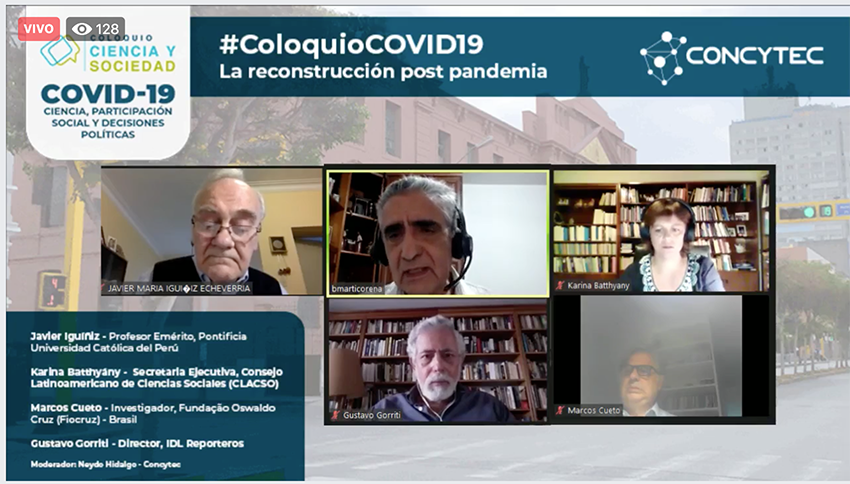
It featured the participation of Karina Batthyány, Executive Secretary of CLACSO, Marcos Cueto, Researcher at Fundação Oswaldo Cruz (Fiocruz) of Brazil, Javier Iguíñiz (National Accord) and Gustavo Gorriti (Director of IDL Reporteros); it was moderated by Benjamín Marticorena of Concytec, who pointed out that the objective of the meeting was to offer a relevant dialogue and coherent and effective responses to the current crisis and for the prevention and mitigation of other future ones.
Regarding the pandemic, Javier Iguíñiz stated: “I don't know exactly what it means, but whatever it is, it's going to last for quite a few years. I think we have a horizon defined by the reality of this experience, by the things we have to do again or start doing, without any certainty about how long it will last or what those things are. In that sense, the expression 'uncertainty' is indeed correct, because uncertainty implies that the terms are not clear and, therefore, one cannot even calculate risks. With risks, one knows what it's about, even if one doesn't know it quantitatively, precisely, but one can venture a guess at the risks of one action or another.”
Javier Iguíñiz, after conducting a detailed analysis of the economic landscape in Peru and the region, stated: “What we have to rebuild going forward is the end of a country so discriminatory—racially, culturally, and regionally—and I think that is essential for the main economic actors—and some in politics—to gain social legitimacy. I believe that businesses have a very serious legitimacy problem, as do politicians. And we need to start thinking, imagining, and fighting for a country where there is room for everyone, with the same status, the appropriate treatment, and the consideration that is due to people who are not only citizens, but also beloved for being from the same country and having lived alongside the landscapes, the reality, and the history that are ours.”
Marcos Cueto warned of “the danger that, at the end of epidemics, temporary and ephemeral solutions to the crisis will emerge, leading to a return to authoritarian practices.” He recalled the 1991 cholera epidemic in Peru under Alberto Fujimori, which paved the way for “an authoritarian government and failed to address the problem of social inequality, revealed by the fact that nearly 50% of the population lacked access to safe water.” Following this, he proposed compiling “a list of essential issues that need to change, which could be started now… and trying to secure political and media commitment to this list, one that considers the medium term and not just the immediate response to the epidemic.”
According to historian Gustavo Gorriti, “to see how to build the future, we must first examine the destruction of the present. Simply attempting to make an accurate and appropriate diagnosis is a significant challenge to our capabilities and puts a strain on many of the cognitive paradigms upon which we have operated. In Latin America, it is clear at this moment that the pandemic has hit the poorest hardest.” Reviewing the effects of COVID-19 in different regions, he stated that “if anything is clear from looking at global experience before the plague reached Latin America, it is that the best responses have come from more efficient states and those with relatively recent experience in confronting similar epidemics.” He cited Taiwan as an example, “perhaps the one that has had the greatest success worldwide with a rapid response from an efficient state.”
In response to the pandemic, Karina Batthyány called for “developing regional and collective solutions. And I believe that at this moment our region is indeed in a position to join forces to redefine a new equation for the way out, which is a new equation in the relationship between society and the State. We need to consider the riches our region possesses in human, scientific, cultural, and social terms, and ensure that our states—ideally in an integrated and regional manner—take the lead in the necessary changes.” He then posed the dilemma of “whether we move towards more equitable models or continue to increase and deepen the inequality that is a structural characteristic of our region. Do we bail out corporations or protect workers? Do we implement structural adjustment models that legitimize the concentration of wealth—which, incidentally, is also a characteristic of our region—or, on the contrary, do we foster empowerment at the social and community levels to, among other things, guarantee a minimum income, a basic income with universal characteristics? Do we defend health, education, and care as rights, or do we allow private enterprise to commodify them, that is, consolidate them as a commodity? Ultimately, it's a question of whether we strengthen the State or weaken it.”
Karina Batthyány added that, in the post-pandemic perspective, “we have to ask ourselves what kind of states the societies that emerge from this crisis will need—the greatest crisis in recent history, not only in our region but worldwide. Perhaps this is therefore a good time to start thinking about this new model and, in turn, a new social contract that allows for the construction of a more egalitarian, fairer, and more equitable world, far removed from the neoliberal narrative that, starting in the 80s, became the dominant narrative in our region. And for which, let's remember—and this, of course, predates the pandemic—human beings, people, are the least important thing because everything is governed by the market; that is, what is at the center is the market, not people. Perhaps the first challenge we face is precisely this: to shift the model so that people's lives, the environment, and the surroundings are at the center. There, the social sciences have a leading role to play, working with the tools we have as social scientists to guide this process.” decision-making, to think about structural public policies and also to outline some collective proposals in the region.”
If you would like to receive more information about CLACSO's training programs:
[widget id=”custom_html-57″]
to our email lists.

