
The rebellion of native flowers in Argentina
By Karina Bidaseca*
Tuesday, October 15th, marks the sixth day of the peaceful occupation of the Ministry of the Interior of the Argentine Republic. Indigenous women from territories in conflict, who have organized themselves, are demanding concrete solutions to protect the lives of their people and their communities, who are threatened with death by destructive policies.
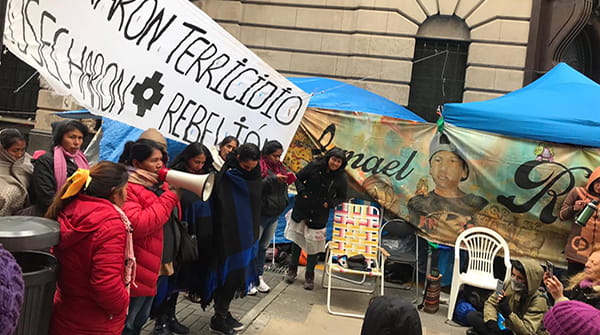
“We decree the rebellion of the Native Flowers.” Under this poetic-performative cry, the indigenous women peacefully occupied the Ministry of the Interior in the city of Buenos Aires.
The Mapuche huerquén Moira Millán She chained herself inside. Outside, the banners blocking the street announce that “the war for us is not over”: “They sowed terror, they reaped rebellion.”
“We are self-organized women from the Indigenous communities of Argentina, peacefully occupying a wing of the Ministry of the Interior, demanding that the Minister of the Interior come and engage in dialogue with us. We have complaints, demands, and proposals for our territories. We are extremely concerned about the increase in repression, the ongoing deaths in our territories, and the growing rate of Indigenous femicide. This is a historically racist state. We are concerned that death continues to be perpetuated as a model of economic development. We are here to say 'Enough' to so much death for our people! And we are contributing to the climate change agenda by demanding respect for life.” exclaims Moira Millán.
His sharp and powerful words warn that "Never, since the establishment of the Argentine state, has any government addressed our demands or respected our rights. Not one. A genocide is being carried out against Indigenous peoples, with the complicity of a society indifferent to this tragedy.”
The Eve #YouAreNotAlone It began on October 9th when more than twenty women from the Mapuche, Qom, and Guarani indigenous communities locked themselves inside the Ministry of the Interior. They have now been holding a vigil for over 190 hours, demanding an end to the criminalization of their rights and respect for their indigenous heritage.
The March originated in Epuyén in 2015. They drafted a preliminary bill to be presented to the National Congress. In 2016, they held a second march and submitted a petition, but again their demands were ignored. They returned to the area to hold a forum on "Genocide, Indigenous Peoples, and Argentinization." They demanded justice for the murders that occurred during Mauricio Macri's administration: Santiago Maldonado and Rafael Nahuel. The former was killed by the Gendarmerie, and the latter by the Coast Guard.
They denounce the exclusion from their territories appropriated by multinational corporations, the femicides that are rendered invisible, and the daily persecution and harassment they face in their territories. The bodies-territories of the women who inhabit these lands, plundered by extractive capitalism, are susceptible to colonial violence in the zones of non-being.
“We are givers and guardians of life; we come to say enough to this capitalist, racist, and patriarchal system that is endangering the life of the planet. Historically, it falls to us to sustain and protect life and the lives of our families, which is why the cruelty against Indigenous women is greater.” they wrote in a statement.
Colonialism and racism are present, although they are not discussed in Argentina, a country that legitimized the Eurocentric discourse of whiteness in the midst of a black and indigenous Latin America and Caribbean.
The women in captivity also denounce an “extermination” by the State and extractive companies. Coining a new term, “terricide,” they reaffirm their plurinational territorial identity, demanding that the State cease violating their rights. They call terricide “the murder not only of tangible ecosystems and the peoples who inhabit them, but also the murder of all the forces that regulate life on Earth, what we call the perceptible ecosystem.”
“Some of the proposals we are bringing are fundamental to including them on the political agenda, regardless of what happens in the next elections. (…) Life is not negotiable.” affirm
Appealing to a network of women mediators, they are calling on other women's organizations: “We regret that white and Indigenous women continue to be estranged for 500 years. We are alone. The anti-patriarchal struggle is anti-colonial. White and employer oppression of our bodies continues. Where are you, white Argentine feminist sisters? Where?” Safeguarding the life of the territories, halting climate change, is our obligation.”
Understanding this process is important for the development of solidarity among the beings who responsibly inhabit this planet; because it allows us to increase awareness of the epistemological changes necessary to expand the limits towards new and opposing directions, recovering the knowledge of the native peoples; critical knowledge today is not only in a deep crisis in the face of conservative and right-wing discourses but is dangerously in open retreat.
The work on anti-racist and anti-sexist struggles stems from a sincere commitment to cultural transformation. There is a great need for immediate and persistent self-criticism, which compels us to examine the tensions at the National Women's Meeting regarding the slogan #Somosplurinacional and its subsequent withdrawal.
See the article in Página 12:
https://www.pagina12.com.ar/217771-moira-millan-guardiana-de-la-memoria
The possibilities that the consciousness of the future finds us entails this act of critical intervention, that of an attitude of vigilance instead of indifference or omission, silencing or stifling of the plurality that we are.
Global progressive thought is progressive until it whispers, “except for Palestine,” as Edward W. Said used to say. Doesn’t this idea suggest that the colonizing-colonized paradigm of the West continues to reproduce the discourse on race and otherness within our nations? “Except for Indigenous peoples”—doesn’t this indicate that Argentina’s racist colonialism lies in erasing other discourses, such as those on speciesism and animal rights, Pachamama and nature, or Indigenous femicide, or relegating them to the archaic past or to the “terrorism” of the present?
Some points of the claim:
-Indigenous job quotas in the public and private labor market.
-Indigenous rights within collective bargaining negotiations and labor rights.
-Legal recognition of indigenous medicine.
-Educational transformation for the recognition of autonomous indigenous education.
-That all indigenous territories be recognized and granted as communal property and that they be under the control of indigenous peoples without the interference of mega-extractive projects.
-We demand recognition of the severity of malnutrition among Indigenous children, as part of an ongoing Indigenous infanticide; our children are not only dying from police repression or repression by institutional forces, but also from hunger. In response, we demand a nutrition program with community kitchens and the cultivation of traditional, protein-rich foods.
-Investigation of each and every missing person, survey of the number of missing indigenous people, survey and investigation of indigenous femicide. Dismantling of contract killings in Argentina, including those carried out by transnational corporations against indigenous populations.
-Decriminalization of indigenous fighters, that all eviction orders be nullified, that the indigenous struggle be decriminalized.
-Formation of a commission to investigate the case of the disappearance of Marcelino Olaire.
-Trial and punishment now for the murderers of Ismael Ramírez.
Facebook: Indigenous Women's Movement for Good Living
Moira Millán
Instagram: indigenous women
* (Coordinator of the South-South Program of CLACSO)
If you would like to receive more information about CLACSO's training programs:
[widget id=”custom_html-57″]
to our email lists.

