
The agrarian issues in the demands of CONAIE for the national strike of June 2022
Francisco Hidalgo Flor[1]
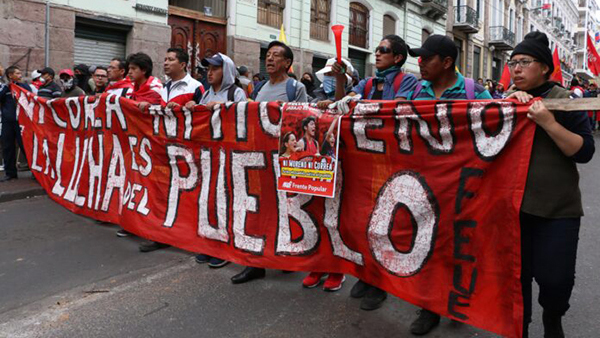
At the time of presenting this brief text[2] The context is the consolidation of the National Uprising of CONAIE and other Indigenous and peasant organizations, now in its fourth day, which began on June 13. It has regional strength: the northern highlands, the central highlands, and parts of the Amazon, particularly around oil-producing areas.
The government of Guillermo Lasso has responded with repression, as evidenced by the nearly 24-hour detention of the president of Conaie: Leonidas Iza, and the implementation of a legal and police apparatus that condemns social activists.
There are voices from civil society entities that have proposed opening a dialogue, such as the Episcopal Conference, but there is no official information that it has been opened.
The article aims to analyze the agrarian context and the agrarian demands contained in the list of demands presented by the Confederation of Indigenous Nationalities – Conaie and other peasant and indigenous organizations, such as Fenocin, Feine[3].
Let's begin by stating that a strike called by these organizations inherently has a strong agrarian component; its social base largely stems from peasant and indigenous sectors, and these sectors are the first to mobilize, though not the only ones, as other rural and urban sectors also participate. In fact, the likelihood of success or failure in the struggle depends heavily on the incorporation of other social sectors that join the demands of the indigenous and peasant movement.
To analyze the rationality of the agrarian demands of the National Strike, we will go from the general to the particular, therefore we start by locating the global agrarian context, then the current agrarian policies of the Guillermo Lasso government, next, reflect on the pertinent points of the list of demands and their meaning in the leadership of the uprising and the indigenous movement.
The global agricultural context as of June 2022 is marked by the novel impacts on agriculture and food security of the war in Russia and Ukraine – NATO (which we understand as an inter-imperialist war). This conflict is triggering a deepening of the food crisis, especially in food-dependent countries of the Global South, meaning those with little or no national or local food production. Simultaneously, it is creating a crisis for agriculture heavily reliant on petroleum-derived fertilizers, thus broadening the scope of impact to all countries with "petroleum-dependent agriculture." Thirdly, it calls into question the entire model of "globalization of agriculture" embodied in the policies of the World Trade Organization. It is clear that the vision of a global world has been shattered, and the emergence of two blocs is evident: on one side, the United States and Western Europe, under the NATO umbrella; and on the other, Russia and China. Each seeks to secure its sphere of influence.
The impacts of these transformations on the global agricultural context are most relevant for countries of the Global South, such as Ecuador, marked by an old pattern of primary-export accumulation. A fragile vessel in the current turbulent waters of great power upheavals.
In this scenario, the main economic and political strategy proposed by the Lasso government, and the entire right wing, as an alternative to the economic crisis after the pandemic, is left out of place. This strategy is an accelerated and hasty insertion into globalization, under the marketing slogan: "more Ecuador in the world, more world in Ecuador," obsessed with signing one and a thousand free trade agreements with the phantom of a global world that no longer exists.
We have already addressed one aspect of the Lasso government's agricultural policy; the other aspects involve dismantling what little remains of state agricultural policies, such as state price controls for key agricultural products like bananas, milk, and corn. And they also involve discarding any proposals for public support to address structural problems such as land and water issues.
In the context of a highly dependent agriculture, with an upward trend in the price of imported agricultural products, such as wheat and flour, and a downward trend in the prices of export products, such as bananas, this only exacerbates the situation of peasant and family farms, those that produce for the external market, and also those oriented towards national supply.
It is so obvious that Lasso's agricultural policy has no political or social basis other than the Chambers of Production, which, in just over a year of government, have already had three different Ministers of Agriculture and the current one is also "not getting anything right".
We have already outlined the international and national scenarios; now it is time to address the heart of the matter at hand, namely: What are the agrarian proposals within the list of demands of the Conaie for the National Strike?
The Platform for Struggle presented by CONAIE in June 2022 has ten points, the first of which addresses the reduction of fuel prices and the expansion of state subsidies for hydrocarbons. It should be noted that this list of demands falls within the realm of political economy concerns, and includes two points clearly related to agrarian issues: demands 3 and 8.
- Fair prices for agricultural products: milk, rice, bananas, onions, fertilizers, potatoes, corn, tomatoes, and more; no to royalty payments on flowers. So that millions of farmers, small and medium-sized producers can have a guaranteed livelihood and continue producing.
- Price control policies and speculation in the market for basic necessities, carried out by intermediaries, and price gouging in industrialized products in supermarket chains.
At the heart of the concerns of peasant and indigenous organizations (the weight of the peasant vision in relation to the overall demands is clear) is the issue of prices: support prices, price controls, unequal exchange between peasant production and industrialized production.
The backdrop is the market-state relationship, and these versus the peasants, versus the common good of the entire Ecuadorian population.
For neoliberals, like Lasso and his government team, there is no room for controls on markets; the role of the state is to guarantee their free flow. But in Ecuador today, that means leading to the destruction of peasant and family economies.
Therefore, what is needed is state intervention in the agricultural and food market. And truly effective state intervention involves more than just decrees that set prices on paper; it requires the state to influence the market by purchasing significant quantities of agricultural production, especially that which affects the population's food basket. This intervention should involve both purchasing and intervention in the retail market, through public enterprises, whether from the Ministry or municipalities.
This raises the obvious question: are there sufficient financial resources for such an intervention? The answer is yes, coming from the additional funds entering the state coffers due to the price of oil on the international market, which currently exceeds $100 per barrel exported.
What is needed now is to bolster local, national, and regional agriculture and food production, with food self-sufficiency as the priority. It is also crucial to support and promote agroecological farming practices and gradually reduce the intensive use of polluting fertilizers that make the country more dependent on foreign markets.
The specific observations aim to provide very concrete points of real support for farmers; for example, there is the demand that President Lasso give full approval to the Law of Support for the Dairy Sector, which establishes state-backed support prices, already agreed upon by the National Assembly[4], a legal body that is on the right track.
[1] Professor of Agrarian Sociology at the Central University of Ecuador. Member of the CLACSO Working Group on Critical Studies of Rural Development.
[2] This article was presented to the Assembly of teachers of the Faculty of Social Sciences and Humanities of the Central University, held on June 16, 2022.
[3] See: El Comercio newspaper, June 13, 2022: https://www.elcomercio.com/actualidad/puntos-conaie-protestas-ecuador-lasso.html
[4] See El Universo newspaper from 31/05/2022: https://www.eluniverso.com/noticias/economia/asamblea-aprueba-la-ley-que-regula-el-precio-de-la-leche-en-finca-que-no-sera-menor-a-los-524-nota/
[+] Latin American and Caribbean Front
in the struggle for democracy and the people
If you would like to receive more information about CLACSO's training programs:
[widget id=”custom_html-57″]
to our email lists.

