
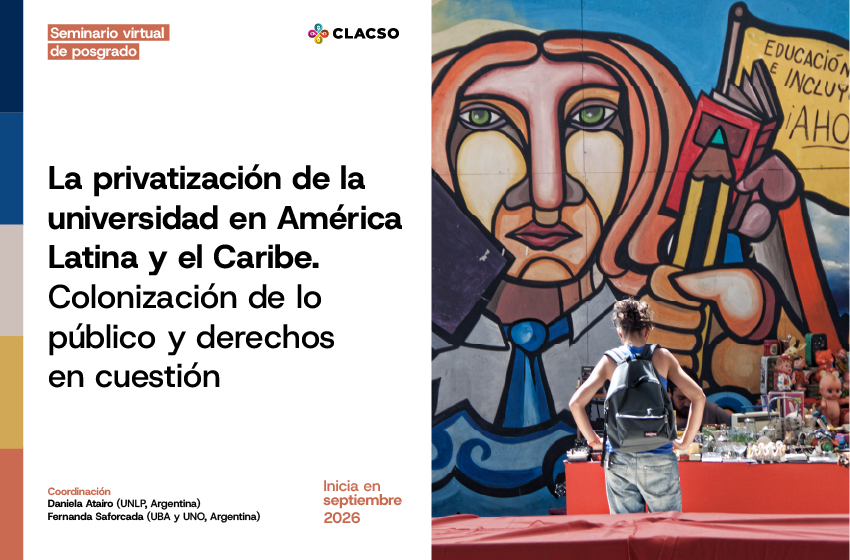
The privatization of universities in Latin America and the Caribbean: Colonization of the public sphere and rights in question
Seminar 2613
Coordination: Daniela Atairo (UNLP, Argentina) and Fernanda Saforcada (UBA and UNO, Argentina)
Teaching team: María Yamile Socolovsky (UNLP, Argentina) and Lucía Trotta (FaHCE – UNLP, Argentina)
Start date : 17/09/2026 | Registration : 06/07/2026 to 16/09/2026
Workload: 10 weeks – 90 hours.
The university systems of Latin America and the Caribbean (LAC) constitute one of the territories in which a substantive dispute unfolds over the meaning of the university, knowledge and the public sphere.
The extraordinary expansion of higher education (HE) systems that characterized the region in recent decades – even with the persistence of strong inequalities – within the framework of the definition of HE as a social public good, a universal human right and a duty of the State (CRES, 2008); is contrasted with the privatization of the systems, not only by a greater supply from the private sector, but also by new modalities that involve the introduction of a market logic in the public sphere as well as the presence of new actors disputing the meaning of HE.
The seminar aims to address various dimensions of university privatization, some more traditional, reflecting a "hyper-privatized" region, and others such as: the privatization of public policy, public-private partnerships, new funding models and the appropriation of public resources, new forms of governance and management, the productivist model in research, the precariousness of teaching positions, and the capture of public decision-making. This leads us to posit the idea of privatization as the colonization of the public sphere.
A comparative perspective is proposed that recognizes general trends in the region but specific formats of deployment in national cases
From its origins, the Latin American university assumed particular characteristics. Based on dispersed institutional experiences, a framework with common elements gradually emerged, defining a regional university model, albeit with dissimilar manifestations in each country. The characteristics of this model are based on public institutions; autonomy, a feature that tended—even with many interruptions—to shape their relationship with the State; an "open-door" approach that enabled significant processes of social mobility in several countries; and reformism. That is, a model of university that is self-governing, where students, graduates, faculty, and non-teaching staff participate in a form of co-governance; and a highly politicized institution with a strong commitment to social issues, which fostered an important role for the student movement in the political arena. The Latin American university thus served as a democratizing factor in the political life of the region's countries, contributing to the strengthening of the public sphere in societies where democracies were precarious and unstable (Krotsch, 2001). This identity was challenged repeatedly through reforms driven by governments within the framework of guidelines promoted by international financial organizations, through the creation of alternative institutional models and more recently through strong processes of privatization and commodification.
In the 21st century, two concomitant processes occurred: on the one hand, there was a redefinition of the meaning of the university that contributes to its democratization, promoted both by the recognition of higher education as a social public good, a universal human right and a duty of the State (CRES 2008), as well as by the policies that were developed within the framework of post-neoliberal governments, aimed at expanding access and strengthening the public sector in regional higher education. But at the same time, much of the expansion of access to higher education in the region was through the private sector, which increased its share of enrollment in absolute and relative terms and came to represent more than 50% from 2003 onwards. This positions Latin America and the Caribbean as the region in which the privatization and commodification of higher education has grown most acutely and sustainably in recent decades, giving it the character of “hyper-privatized” (Atairo, Trotta and Saforcada, 2025), not only because more than 50% of its enrollment (54%), its graduates (59%) and its institutions (67%) belong to the private sector but also because there is a clear trend towards sustained growth of the sector, both in countries with highly privatized systems and in those with a strong tradition of the public sector.
Recent years have been characterized by pendulum swings in the governments of the region, which express competing social models and which, in many cases, involved a cycle of conservative restoration that brought new impetus to the reappearance of the market as the organizer of the social, establishing strong disputes of meaning around education and the emergence of new forms of privatization.
In this sense, it is necessary to develop critical analyses of the underlying logics of the privatization and commodification of the social economy in the region in order to help clarify processes that contribute to an impoverishment of the public sphere and a weakening of the commons.
The proposal stems from the conviction of the need to build bridges of dialogue between the production of knowledge about the university with public and institutional policies, and with teacher training, in order to improve our practices from a political-pedagogical sense and, from there, build keys for collective action and the development of autonomous and sovereign projects.
GENERAL PURPOSE:
To analyze from a critical perspective the processes of privatization of and in the university in order to contribute to the understanding of current disputes surrounding the Latin American university
SPECIFIC OBJECTIVES:
- To problematize the different dimensions of the processes of commodification and privatization of higher education
- To understand the privatization and commodification trends that prevail in the region, as well as the local forms they take in different national cases.
- Identify the actors driving privatization processes and their local strategies
- Analyze the role of the state and public policy in each national case
- Understanding the changes and challenges that university institutions and their actors face in the face of the questioning of the expansion of rights that the commodification and privatization of higher education entails.
- Theoretical and methodological perspectives for the analysis of university privatization
- The privatization of higher education from a regional perspective and the right in question
- Privatization of public resources through demand financing
- Public-private partnerships and the virtualization of education
- Symbolic privatization: the idea of the university as a business and the centrality of university management
- Privatization and commodification in research: the centrality of the productivist model
- The precarization of university teaching work as a dimension of the privatization process
- The colonization of the public sphere: privatization as a political strategy
- Ball, Stephen (2014). Globalization, commodification and privatization: international trends in education and educational policy. Education Policy Analysis Archives/Archivos Analíticos de Políticas Educativas, 22(1).
- Krotsch, Pedro. (1993). The Argentine university in transition: from the State to the market? Revista Sociedad, (3), 5-29.
- Moschetti, Mauro; Fontdevila, Clara and Verger, Antoni (2017). What is educational privatization? Concepts and definitions regarding privatization in the field of education. In Handbook for the study of privatization in education. Autonomous University of Barcelona / Education International.
- Gentili, Pablo (ed.) (1997). Goodbye to public school. Neoliberal disorder, market violence, and the fate of education for the majority. In Culture, politics, and curriculum. Essays on the crisis of public school. Buenos Aires: Losada
- Verger, Antoni (2013). Market policies, State and university: towards a conceptualization and explanation of the phenomenon of the commodification of Higher Education. Journal of Education, (360). January-April 2013, pp. 268-291.
- Whitty, Geoff (1984). The Privatization of Education. Educational Leadership, 41(7), 51-54.
- Levy, Daniel (1991). Evaluation of private universities in Latin America: a comparative perspective of the Dominican Republic. Science and society, 16(1), 57-90.
- Rama, Claudio (2017). The new phase of private education in Latin America. Buenos Aires: Teseo / UAI.
- Trotta, Lucía; Saforcada, Fernanda. (2024). The Latin American university in tension. Between privatization strategies and disputes surrounding rights. In Martín Unzué, Karina Batthyány and Pablo Vommaro (Eds.), The Latin American university between commodification, rights and evaluation. Pedro Krotsch Prize 2023. (pp. 121-179) Buenos Aires: CLACSO.
- Atairo, Daniela; Trotta, Lucía and Saforcada, Fernanda (2023). The privatization of the Latin American university and financing mechanisms as a political strategy. A case study. Spanish Journal of Comparative Education, (42), 261–283.
- García de Fanelli, Ana María (2019). The financing of higher education in Latin America: trends and financing instruments. Propuesta Educativa, 28(52), 111-126.
- García Guadilla, Carmen (June 2007). Financing of higher education in Latin America. Sociologies, (17).
- Atairo Daniela (2022) Trends in the privatization of higher education during the pandemic: the role of international organizations and technological agents in Latin America and the Caribbean. In: Saforcada, F., Atairo, D., and Trotta, L. (2022) The privatization of the university in Latin America and the Caribbean. Autonomous City of Buenos Aires: CLACSO; IEC-CONADU (Que se pinte de pueblo).
- Latin American Observatory of Educational Policies [OLPE] (2022) International organizations and global policy oriented towards private participation in the education sector. Sum of threats against the right to education. In: Saforcada, F., Atairo, D., and Trotta, L. (2022) The privatization of the university in Latin America and the Caribbean Autonomous City of Buenos Aires: CLACSO; IEC-CONADU (Que se pinte de pueblo).
- Rama, Claudio and Cevallos Vallejo, Marcelo (2015). The metamorphosis of distance education in Latin America. A new phase marked by the entry of international providers. Spanish Journal of Comparative Education, (26), 41-60.
- Acosta Silva, Adrián; Atairo, Daniela and Camou, Antonio (2015). Governance and democracy in the Latin American public university: Argentina and Mexico in comparative perspective. Buenos Aires: CLACSO.
- Ibarra Colado, Eduardo (April-June 2005). Origin of the entrepreneurship of the university: the past of business management in the present of university management. Journal of Higher Education, 34(134), 13-37.
- Krotsch, Pedro (1997). The weight of tradition and recent privatization trends in the Argentine university: towards a public-private relationship. Avaliação: Revista da Avaliação da Educação Superior, 2(4), 31-43.
- Acosta Silva, Adrián; Atairo, Daniela and Camou, Antonio (2015). Governance and democracy in the Latin American public university: Argentina and Mexico in comparative perspective. Buenos Aires: CLACSO.
- Ibarra Colado, Eduardo (April-June 2005). Origin of the entrepreneurship of the university: the past of business management in the present of university management. Journal of Higher Education, 34(134), 13-37.
- Krotsch, Pedro (1997). The weight of tradition and recent privatization trends in the Argentine university: towards a public-private relationship. Avaliação: Revista da Avaliação da Educação Superior, 2(4), 31-43.
- Socolovsky, Yamile (2016). “Equality in the university: a union task”, in Retratos da Escola, Brasília, v.10, n.18, Pg. 321-328
- Stevenson, Howard and others (2025). In the eye of the storm. Higher education in times of crisis, Education International.
- Walker, Verónica (2024). “What do we talk about when we talk about precarity?: a look at the working conditions of university teaching in a regional perspective” in Cabrera, Cano, Fanchineti and Marrero (eds), Precarity of teaching work, privatization of higher education and defense of the public university, Montevideo: ADUR
- Atairo, Daniela; Trotta, Lucía and Saforcada Fernanda (2025). The colonization of the public sphere. Privatization of the university in Latin America and the Caribbean. Institute of Studies and Training – National Federation of University Teachers (IEC - CONADU). Introduction and Conclusions.
- Ball, Stephen J. (2022). Money or ideas: the struggle for meaning in the neoliberal university. Integration and Knowledge, 11(2), 98-110. Introduction and conclusions
| Early registration (until 10/08) | General registration (11/08 to 10/09) | Registration without discount (11/09 to 16/09) | |
| Full or Associate Member Center | $100 | USD 150 | $200 |
| No link | $150 | USD 225 | $300 |
FAQ
The basic requirements for taking a seminar are:
- Availability of at least 4 hours per week to dedicate to the seminar course.
- Internet access.
- Reasonable handling of communication and computer tools.
- Language proficiency in the language in which the course will be taught. The official languages are Spanish and Portuguese.
The seminars last 10 weeks, plus the completion of a final project. A total of 90 hours of dedication will be credited.
A course consists of ten classes, each accompanied by required reading bibliography, supplementary bibliography, discussion forums and training activities proposed by the teaching team, partial deliveries and a final project.
The course is online and asynchronous. Some instructors may propose synchronous activities. In those cases, the time and date will be agreed upon beforehand between the instructors and the students to ensure everyone's participation. Attendance at synchronous sessions is not mandatory.
To pass the seminar, you must participate in at least 80% of the discussion forums and activities proposed by the teachers, have completed the scheduled partial deliveries, and pass the final work.
| Early registration (until 10/08) | General registration (11/08 to 10/09) | Registration without discount (11/09 to 16/09) | |
| Full or Associate Member Center | $100 | USD 150 | $200 |
| No link | $150 | USD 225 | $300 |
The possible payment methods are by credit card or bank transfer.
Inquiries: [email protected]

