
“The presence of women leaders in decision-making processes improves the performance of public policies”
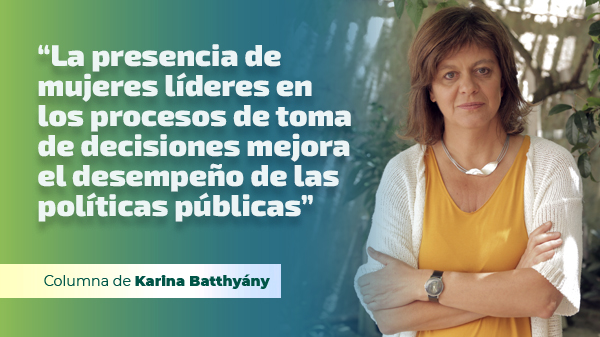
(Transcription of Karina Batthyány's Column)
(in InfoCLACSO – March 23, 2022)
This March, Women's History Month, we will continue exploring some of the gender inequalities that affect women in Latin America and the Caribbean. Today's topic is women's political participation, but in a broader sense, in terms of decision-making in different spheres of society.
When we look specifically at the data related to the representation of women in the political sphere, the first conclusion we reach is that it is insufficient at all levels of decision-making in Latin America and the Caribbean and throughout the world.
The latest UN Women report shows that only 22 countries in the world have female heads of state or government. It also reveals that 119 countries have never had a female president, and that only 14 countries worldwide currently have cabinets (ministries) with 50% (or more) female representation.
These are the first hard numbers we can give and we always have to start from the premise or assumption that in the total population there are approximately the same number of women as men (50% and 50%).
When we look at political representation, we find these very low levels in our region and in the world. If we look specifically at Latin America and the Caribbean—for which we rely on the ECLAC Gender Equality Observatory—women hold only 28% of ministerial portfolios in the executive branches of our region. That is, less than one in three.
We must mention some specific cases in our region that go in the opposite direction, such as Costa Rica, which since 2018 has had a cabinet composed of 55% women, and recently Chile, with a cabinet where 14 of the 24 positions are now held by women. That is, 58%.
It is also worth mentioning the Colombian case, with one particularity: when Iván Duque (the current president) took office, he began his term with a gender-balanced cabinet. However, during a period of rapid cabinet reshuffles, Duque abandoned his campaign and initial commitment to gender parity, and today only 6 of the 18 ministries in Colombia are headed by women.
This lack of parity is not exclusive to the Executive Branch: we can also look at the presence of women in Supreme Courts. In many countries in the region, women do not even occupy a fifth of the positions or seats on the courts. We find this situation in Mexico, Brazil, Colombia, and Argentina, which are also the most populous and largest countries in our region. Indeed, the Argentine case is quite paradigmatic (the most serious) today, because since November 2021 it has had no female members on its highest court.
Looking at the other extreme, we must highlight the progress of women in many of the highest courts of justice in the Caribbean, in countries such as Cuba, Jamaica and Guyana; and in the Eastern Supreme Court the presence of women exceeds 60% in those cases.
Perhaps the area where the most progress has been seen in recent years is the third branch of government, the legislature. This is undoubtedly due to the gender quota systems that have been implemented in various countries and that influence the composition of the candidate lists submitted for legislative elections.
While it is true that these positions are still predominantly held by men, the region remains at the forefront of the path toward parity in national parliaments worldwide. In other words, Latin America stands out on this journey toward parity in parliaments globally. And today, on average, 33% of parliamentarians are women. Of the four countries worldwide that have achieved (or surpassed) parity in the distribution of parliamentary seats, two are Latin American and Caribbean: Cuba and Bolivia. Meanwhile, Mexico, Costa Rica, Argentina, Peru, and Ecuador have numbers that are not yet equal but are close at around 40%. At the other end of the spectrum, we can mention Brazil and Paraguay, where women have very little participation in the distribution of parliamentary seats.
Let us remember that all countries of the world have made commitments to achieve political participation and the balanced distribution of power between men and women in decision-making in the various international pacts and declarations such as those of Beijing, the sustainable development goals and many others.
However, most countries in the world have not yet achieved gender balance. According to UN Women's most recent report, there is growing evidence, through impact evaluation studies, that the presence of women leaders in decision-making processes improves the performance of public policies. The report cites several examples from Latin America, including countries like Costa Rica and Bolivia.
Finally, I want to emphasize that the State is not the only sphere where representation or decision-making takes place, but it is an important sphere, and there are still many areas to be conquered, especially if we also include other decision-making spheres such as business chambers, unions, social organizations, large corporations, boards of directors, sports club management, religious institutions, and others. While there is less information available in these areas, what we do know is that we are still far from achieving a more or less equitable distribution of decision-making power between men and women. And why insist on this issue? Because the participation of both men and women in the decisions that are made and that ultimately affect our daily lives, as well as individual and social well-being in all our countries, is crucial.
It's impossible not to connect this with some recent news... One of them: the selection of Francia Márquez as Gustavo Petro's vice-presidential candidate in Colombia. This news has shaped the entire context and takes on even greater significance...
Absolutely. Let's hope this victory is confirmed and progresses, and undoubtedly shows the way to sharing government responsibilities between men and women.
-In Uruguay, next Sunday, March 27th, there will be a referendum on the LUC (Law of Urgent Consideration), a 135-article law that was approved in July 2020 amidst considerable controversy. I understand that these articles and the logic behind this Law of Urgent Consideration addressed many issues, even going against some rights… How do you understand the LUC referendum, and what is its importance?
This is a crucial moment we are experiencing in Uruguay as we approach Sunday, March 27th, when a referendum will be held with an option to repeal those 135 articles. It took gathering more than 800 signatures in a country of 3 million inhabitants to be able to submit this popular consultation.
Indeed, this Law of Urgent Consideration was approved in July 2020, with over 400 articles and very little time in Parliament for its debate, due to the parliamentary majorities held by the current governing coalition. Many of the 135 articles that will be submitted to a referendum this Sunday, March 27, call into question key elements of the social protection and welfare system that Uruguay has worked so hard (for decades) to build. Some of these articles are more recent, specifically from the last 15 years, and address education, housing, security, and labor rights. Therefore, we are at a crucial moment for Uruguay with the outcome of this popular consultation, which also serves as a mechanism to strengthen the direct democratic participation of the entire population by allowing them to express their opinions and vote on these articles previously approved by Parliament.
I am already supporting the repeal of those 135 articles that jeopardize many of the advances that have been made in Uruguay in recent times. It's voting for the yes Regarding the repeal. For now, the polls show a very close race, as is the political situation here in Uruguay, where there are basically two halves: those who lean more towards progressive policies and those who lean more towards neoliberal policies. We have a very democratic event this Sunday, March 27th, in Uruguay.
If you would like to receive more information about CLACSO's training programs:
[widget id=”custom_html-57″]
to our email lists.

