
The post-pandemic era, inequalities and gender gaps
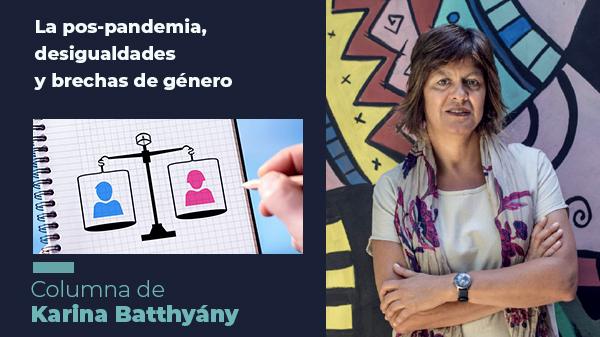
(Transcription of Karina Batthyány's Column)
(In InfoCLACSO – November 4, 2020)
Continuing the journey we've been undertaking – which, let's remember, is ultimately about establishing some key areas where CLACSO believes it's essential to organize regional spaces for reflection, exchange, and above all, building new consensus and new alternatives for our region, but also for the world, and considering this in terms of the global scenario that obviously transcends, although is very much marked by, the pandemic situation we are experiencing – I propose that we address what we previously described as inequalities specifically in the area of gender, and also consider this pandemic situation and, above all, the post-pandemic period as an opportunity to hopefully shorten, and why not eliminate, the gender gaps.
Let's briefly recall what we said a few weeks ago: this pandemic has undoubtedly found our region deeply marked by extreme and persistent inequalities. These inequalities make the entire population more vulnerable unless public policies are in place to counteract them. And one of the most persistent and profound inequalities is precisely that between men and women, which will be absolutely essential to address in order to provide an adequate response to this crisis. Because let's not forget that these inequalities between men and women clearly intersect with other inequalities that we have already discussed in these columns, such as those related to ethnicity, race, age, territory, and a long list of others that I won't go into now…
We know very well—and the current context has made it abundantly clear—the chain of inequalities that women face in the region. I won't repeat here the data we've already presented in other columns; let's just recall three. First: poverty, where for every 100 poor men in Latin America and the Caribbean, there are 132 women in that condition. Second: the labor market, where, as we've already mentioned, women suffer higher unemployment, larger wage gaps (i.e., a greater wage gap with men), and a higher percentage of women in informal jobs who lack any kind of social coverage or protection and who have also been among the hardest hit by this health crisis. This health crisis is once again showing us the consequences for everyone's lives, and especially for our shared lives, of the commodification of public resources and, in many cases, the primacy of private interests over the common good.
That is why we propose as an alternative the need to broaden the public agenda, the agenda of public and common issues, and to consider new forms of social organization where the gender dimension, and particularly within the gender dimension the issue of care, occupy a central role and become essential drivers of social life. We know, because we have already mentioned it, that this pandemic deepens the inequalities and gender gaps that exist in our region; that there is a profound devaluation and denial of the domestic and care work that is essentially performed by women, and that this devaluation and denial lies at the heart of gender inequalities in Latin America and the Caribbean. And although these inequalities became very visible in the context of the pandemic, we still fail to assign them the economic and social value they have for everyone's lives, ultimately, for social reproduction.
Therefore, we must consider that the time has come to start thinking about new forms of organization, where the social organization of care plays a central role. Why? Because if we want a society that prioritizes life, then care must be valued, just as the people who care for children, the elderly, and so on, on a daily basis must be valued.
Let us remember that valuing care also implies thinking about it in relational terms, in terms of the relationship that is established, of the recognition and respect towards the other, and of shifting once and for all the axis of that liberal individualism that has marked us so much in these years, and of that autonomy that is supposed to prevail in our daily relationships in order to place at the center of concerns and of the alternative construction, the interdependence, reciprocity and complementarity between everyone.
I believe that is the only truly comprehensive and effective response to the crisis of life reproduction we are facing. And that the solutions, as we have already stated in this forum, will come from universal institutions, public institutions, institutions that allow access for everyone. Ultimately, they will come from spaces of the common good, solidarity, and collective action, which are also so important for overcoming these gender gaps that affect the Latin American and Caribbean region.
-Are there starting to be stronger public policies being implemented that haven Did this scenario take into account the post-pandemic era?
The answer is no, generally speaking. Because if there's one thing this crisis has shown us, it's that in all the measures taken, at least initially in the various Latin American countries, the gender dimension was completely forgotten. Just think of two measures: "Stay home." What does that mean for many women? Stay home subjected to gender-based violence. Why? Because the abusers are in the homes. And it didn't occur to anyone that for the 30% of Latin American and Caribbean women who suffer gender-based violence, "Stay home" was a deadly paradox in many cases. Second measure: "Stay home and work remotely." It didn't occur to anyone that within the framework of "Stay home and work remotely," once again, as in pre-industrial societies, the coexistence of productive and reproductive work became an impossible trap for women. Working remotely while caring for others, doing schoolwork, managing household chores, all within the same 24 hours of the day. Initially, there were no measures in place to address this. Only recently has a response emerged, following demands from the Feminist Women's Movement.
So, in the context of the pandemic, this dimension was not taken into account. This is not to say that if we look at the last 20 years, from the beginning of the century until now in the region, there haven't been public policies to promote gender equality, implemented by different states and depending on the situation in each country. But in any case, those structural gender inequalities I mentioned at the beginning remain; they haven't been eliminated, and the pandemic only exacerbated them. And within the context of the pandemic, the policies that were proposed were completely gender-blind.
If you would like to receive more information about CLACSO's training programs:
[widget id=”custom_html-57″]
to our email lists.

