
“Poverty affects the Afro-descendant population differently.”
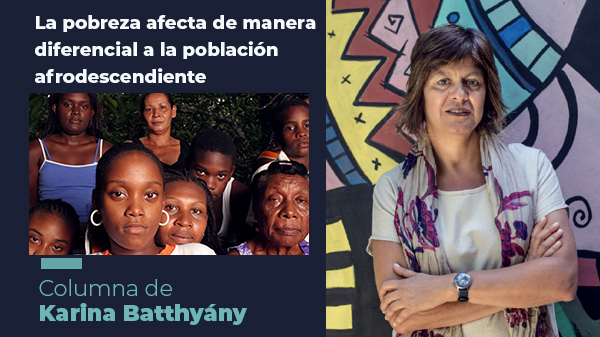
(Transcript of the Column by Karina Batthyány
in InfoCLACSO 16 September 2020)
We are addressing different dimensions of inequality, using the important multidimensional perspective to analyze social inequality, understanding how these dimensions of inequality intersect, intertwine, accumulate, reinforce, and interact. One dimension that is absolutely central, and to which I propose we dedicate today's session and next Wednesday's as well, is ethnic and racial inequalities. Today we will focus on racial inequalities and leave ethnic inequalities for next week.
We know that in Latin America and the Caribbean, approximately one in four people identifies as Afro-descendant, that is, 24 percent. To give you an idea, that's more than 133 million people in our region. This population is distributed quite unevenly among the different countries of Latin America and the Caribbean. Brazil and Venezuela are at the top of the list, together accounting for more than 90 percent of the region's Afro-descendant population. And there is a common factor, beyond the differences between countries: poverty affects this Afro-descendant population disproportionately. In fact, some reports from the World Bank and ECLAC (Economic Commission for Latin America and the Caribbean) refer to them as the largest excluded minority in the region. Just to give one example: in Brazil, one of the countries with the highest proportion of Afro-descendant population, an Afro-descendant person is twice as likely to be poor as a non-Afro-descendant person. But here in Uruguay, where we have a relatively low proportion of Afro-descendant population, a Black person is nevertheless three times more likely to be poor than a non-Black person. This is just one example of the inequalities that impact this population.
It's also worth mentioning that, as we've discussed in other columns, although some aspects of inequality decreased in Latin America until around 2015, especially when we look at the Gini coefficient, which is the measure we use, significant inequalities persist for the Afro-descendant population, even within these coefficients and the indicators that comprise them. We also know, to give another example related to the pandemic or the current health crisis, that this population faces distinct difficulties in accessing adequate housing. What do I mean by adequate housing? For instance, they live in more overcrowded conditions, which clearly hinders the implementation of some of the recommended measures in various countries. And, of course, Afro-descendants also make up the majority of the population living in poor neighborhoods or favelas.
But we also know that they have higher unemployment rates, and therefore less employment, and lower-quality employment with lower wages. Furthermore, they are working in the informal and service sectors, which have been the hardest hit by the pandemic. This is to say nothing of the educational inequalities, where at all levels we find that a lower percentage of the Afro-descendant population completes primary, secondary, and university education compared to the non-Afro population. All of this is related to the current situation with the coronavirus: there is a fairly recent report from the World Population Fund that specifically alerts us to the impact of the pandemic on the Afro-descendant population. And it mentions factors such as the housing inequality I mentioned earlier, which exposes this population to a greater likelihood of infection. It also mentions the issue of health, the greater inequality in access to healthcare and supplies, and also the problems in many countries with access to water and sanitation, which again are related to measures, for example, to prevent infections.
According to the Centers for Disease Control and Prevention in the United States, more than 75 percent of children who die from COVID-19 are from minority groups. And they're talking about Latino and Black children in the United States, what kind of health insurance they have, and a number of other things—clear examples of how inequalities operate systematically…
Absolutely. That's why the issue of health is central, as are the educational gaps I was mentioning. Because to maintain—as we analyzed in another column—continuity, educational engagement, internet access, and the necessary equipment are absolutely essential for distance learning, and this population has greater difficulties with this and also with accessing the food programs associated with schools. In other words, they have lost access to these food programs and, as we said, are in a situation of greater poverty. Furthermore, let's remember that many of the measures our governments have taken are primarily aimed at the formal sectors of the economy and therefore at workers in the formal sector. It is in the informal sector where there is a greater concentration of Afro-descendants in our countries, and they are excluded in most cases from the measures that have been taken. And another interesting fact, as we mentioned, is that the service sector—caregivers, healthcare workers, food delivery drivers, supermarket employees, etc.—is the sector most exposed to the risk of infection, and it's also where significant numbers of Afro-descendant workers are concentrated. Therefore, we felt it was important to bring up this dimension today in general to contribute to the analysis of social inequalities and their specific manifestations in relation to the pandemic.
Just one more thing to conclude: remember that CLACSO is also working in this direction, and despite the progress made, we still face many difficulties due to the lack of disaggregated statistics that would allow us to know the racial or ethnic origins of the population. And again, in the case of the current pandemic, this information simply doesn't exist. So, in many cases, we fear that the impacts are even greater than we are reporting, simply because we lack accurate information to document them. Therefore, I believe this is a central dimension, and as I said, at CLACSO we are addressing it through research and also through training, with one of our specializations.
If you would like to receive more information about CLACSO's training programs:
[widget id=”custom_html-57″]
to our email lists.

