
“The pandemic makes visible the unpaid domestic and care work within households”
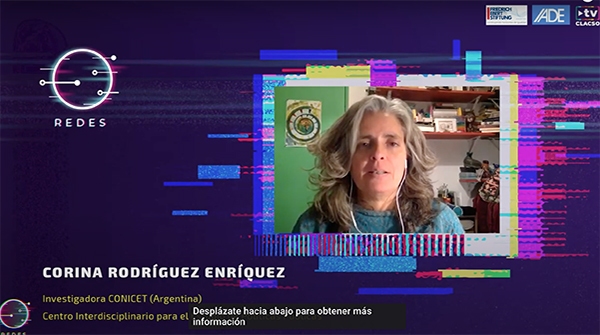
Corina Rodríguez Enríquez, an Argentine researcher from CONICET, Interdisciplinary Center for the Study of Public Policies, was interviewed by CLACSO TV after her participation in the second meeting of the Cycle of virtual conversations on Social Security and Pension System, organized by CLACSO, the Friedrich Ebert Foundation, IADE and the CLACSO Working Group on Social Security and Pension Systems.
Interviewed by Gustavo Lema
Corina Rodríguez Enríquez explained that, in her view, “the pandemic, first and foremost, clearly compounded a pre-existing reality, and that pre-existing reality in Argentina and Latin America was one of economic precarity, both in general terms for economies and in particular for individuals, and a reality of inequality. Latin America remains the most unequal region on the planet, and particularly in Argentina, inequality had begun to deepen again in recent years. So, the pandemic compounded this and produced two things: on the one hand, it made visible situations and mechanisms for reproducing these inequalities that we had already been pointing out, and in some cases, it exacerbated and deepened them. I think some of the things that the pandemic made visible—and that we in feminist economics, the field in which I work, have been pointing out for some time—have to do with two or three things. The first is the importance of care work. I think that has been forcefully exposed by the pandemic; in fact, the pandemic is a disease that requires care to be overcome. But the health measures taken To confront the pandemic in our countries with decades-old, deteriorating healthcare systems and deficient infrastructure, the main tool used by those countries that opted for rapid action has been social isolation. In Argentina's case, this meant mandatory social isolation, which entailed a return to the home. This return to the home was possible because the daily reproduction of life takes place within the home. In other words, it was assumed that those who would provide care in the absence of schools, care services, and institutions that normally provide care would be found within households. This effectively made visible the unpaid domestic and care work that is always performed within homes and serves as the ultimate guarantor of care. What time-use surveys in our countries clearly demonstrate is that this care work is distributed very unequally between men and women and between people from different socioeconomic strata. Generally speaking, women do more care work than men. "For men, that's absolutely true, but women in lower income brackets do far more unpaid care work than women in middle and high income brackets."
The panel for the second meeting of the series was completed by:
Pablo Yanes Rizo, Research Coordinator at the ECLAC subregional headquarters in Mexico.
Agustín Salvia, Social Debt Observatory of the Catholic University of Argentina – Co-coordinator of the CLACSO Working Group on Structural Heterogeneity and Social Inequality.
Laura Pautassi, CONICET Researcher – Faculty of Law, University of Buenos Aires. Director of the Interdisciplinary Group on Social Rights and Public Policies.
Itai Hagman, Argentine National Deputy and Director of the Observatory of Economics and Public Policies.
If you would like to receive more information about CLACSO's training programs:
[widget id=”custom_html-57″]
to our email lists.

