
“The pandemic has a silent and devastating impact on education”
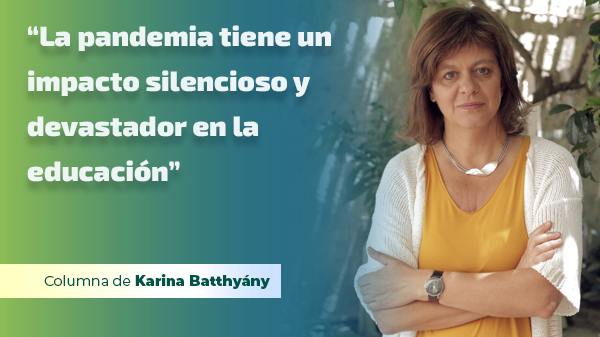
(Transcription of Karina Batthyány's Column)
(In InfoCLACSO – December 7, 2022)
Regarding the issue of inequality, there is a very valuable tool: ECLAC's annual publication on the Social Panorama of Latin America and the Caribbean, which released its 2022 edition a couple of weeks ago. Of course, it provides a detailed and thorough analysis of the various dimensions of inequality, but it always focuses on a particular aspect: in 2022, the theme is education.
I will summarize some of the main messages of that report:
-It begins by showing the prolonged social crisis that our Latin American region is facing and that is further aggravated by a context of uncertainty in the third year of the pandemic: it deepens social inequalities and has a silent and devastating impact -words of the report- on education.
-This edition of the Social Panorama of Latin America and the Caribbean takes as its central theme education and the place of education in the debate on policies for the recovery of our region.
-If we look back to 2015, a clear deterioration in well-being levels was already observed in the region; a deterioration also from 2014 onwards in what had been the reduction of the inequality gap and which from 20215 onwards stopped closing and began to amplify again.
Since 2015, progress in educational achievements has stagnated, and poverty has also risen slightly, but year after year this indicator continues to increase slightly. The COVID-19 pandemic generated the crisis we have discussed so much: a significant social crisis that continued throughout 2022 for the third consecutive year.
-We are all waiting for the end of the pandemic, but the region has not yet managed to move towards recovery after these social impacts and recover at least the level of 2019, that is, the level prior to the start of the pandemic.
Furthermore, let's consider the impact of the unstable geopolitical landscape, marked, for example, by the war in Ukraine, but also by these processes aimed at destabilizing the political systems of Latin American democracies. Then, let's add this impact to the global economic landscape, which is characterized by slow economic growth, sluggish job creation, especially of quality jobs, and inflationary pressures affecting the entire world, including the Latin American and Caribbean region. These factors have led to increases in food and energy prices, as well as significant declines in investment in the regional economy.
ECLAC shows us that after the 6.5 percent expansion of the regional gross domestic product in 2021, 2022 is estimated to close with economic growth of 3.2 percent (half that of the previous year). And a further halving is projected for 2023, meaning growth of just 1.5 percent for our region. If we add to this the high inflation, especially in the food component of household consumption baskets, we can clearly see the effect on individuals and households with lower incomes, known as the lowest income quintiles, which affect the most vulnerable sectors of the population in our region.
- In its report, ECLAC calls for the consolidation of inclusive social policies to protect and guarantee the well-being of the population and to allow the full exercise of their rights.
In particular, the report details, in a very interesting way, the increase in food and nutritional insecurity, using data from the FAO (Food and Agriculture Organization of the United Nations) to show the rise in food prices and how this implies an increase in poverty levels, but particularly in the situation of the population suffering from hunger. Since the last available data from 2021, it affects almost 57 million people in the region.
-Detailed poverty statistics are always included in social overview reports. I want to highlight one in particular: poverty among people under 18 in our region. The latest available data shows that 45.4 percent of people under 18 live in poverty. Furthermore, extreme poverty affects almost 19 percent of this group.
In this context, addressing the immediate needs of the population and strengthening human capacities in the medium term is more crucial than ever. This is where the educational dimension enters the analysis of this Social Panorama report. The impact of the pandemic on the education sector, which ECLAC calls a “silent crisis,” is also examined. This crisis stems from the prolonged interruption of in-person education in the region and the resulting learning losses, which were not part of the immediate response of our states and countries to the crisis. This situation only exacerbates pre-existing educational inequalities.
Our region is precisely one of those that interrupted in-person classes for longer periods starting in 2020 at the beginning of the pandemic. This meant the discontinuity of studies or remote access for some students, because not all were able to connect or continue their courses virtually. In other words, it has created gaps in skills development, the loss of learning opportunities, and the risk of increased school dropout rates. This situation has also contributed to weakening the protection of other essential rights within the educational structure, more specifically within the education system, such as protection from violence, access to food, and social interaction, among others.
This crisis, coupled with the critical deprivations faced by children and adolescents and the risks of increased food insecurity, jeopardizes the development and well-being of an entire generation of children and young people, and undoubtedly undermines development opportunities in the region. This impact refers to the consequences for the educational and professional trajectories of the generations affected by the prolonged closure of schools and educational centers, who are also affected by the economic effects of the pandemic, including decreased household income and social protection, and a decline in the socio-emotional well-being of individuals. All of this calls into question learning opportunities in the short and medium term. Without a doubt, this demands urgent action; that is, it is not a matter of beginning to consider what we can do, but rather taking action today in response to this "silent" crisis—as ECLAC calls it—which has revealed that the education systems of Latin America and the Caribbean were unprepared to face these changes, and this has only exacerbated the educational inequalities that existed before the pandemic.
Of course, the report also acknowledges some of the efforts made in the countries to try to provide some educational continuity from homes remotely, but with weaknesses and inequalities in infrastructure and equipment conditions, as well as in the skills of the teaching staff to transform teaching methods and maintain the educational link with the entire student population of the region.
Therefore, it is imperative that we commit to the recovery of these educational processes and also to the transformation of the education sector in line with the processes of change that we are observing in other dimensions in the social, labor and environmental spheres.
Greater investment in the education sector is needed, starting from early childhood. This silent crisis in education affects new generations and only exacerbates inequalities. If we don't prioritize finding alternative policy solutions to address this urgent need, we are headed down a path we already know will have devastating consequences for our region in the medium term.
Therefore, education is the central theme to which ECLAC dedicates its study in 2022. We must take the information provided there and also discuss some of the proposals specifically regarding educational policy. This is a topic on the work agenda in all Latin American countries and also on the CLACSO work agenda, because we are working within the framework of our Platform for Social Dialogue program, where education is precisely one of the key themes.
How many times since the pandemic have we heard political sectors say, "The return to normality"? First of all, how far we are from a normal situation, if we even have to use that word. And secondly, how far we are from more egalitarian societies, from the possibility of creating situations of greater access for a significant portion of society. What you describe regarding the landscape of inequality is brutal… Clearly, inequalities have deepened in all areas, and we are far from returning to that supposed normality before the pandemic…
The figures I've presented regarding poverty, hunger, and the low economic growth this year, as well as the projected growth for next year, should continue to alert us to the deepening inequalities in Latin America, the most unequal region on the planet. If this trend continues, it will only reinforce this unfortunate label we already bear. Therefore, it is urgent to develop alternative policies that place these concerns at the forefront and finally build welfare and social protection systems for everyone, especially for future generations—children and adolescents—whose educational development has been compromised by the effects of the pandemic.
If you would like to receive more information about CLACSO's training programs:
[widget id=”custom_html-57″]
to our email lists.

